
'With agents, artificial intelligence becomes workforce'
According to Asha Sharma, corporate vice president at Microsoft, both cloud and platforms with open source models are strategic for businesses

3' min read
3' min read
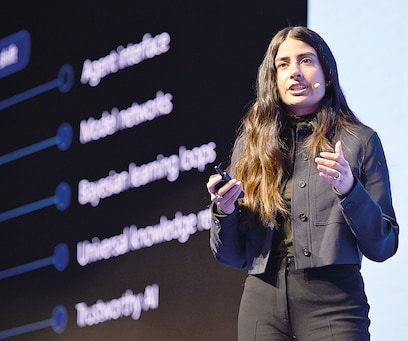
'Ai is reshaping the world', from climate forecasting to genetics to the preventive analysis of materials. But that's not all. Generative artificial intelligence is finding application inside the beating heart of companies, providing IT professionals and software developers with a wide range of tools to create customised solutions and agents that can address the specific needs of different industries. The picture was taken by Asha Sharma, Corporate Vice President and Head of Product Microsoft AI Platform, who spoke at the event organised by the American company in Milan to explore the state of the art of artificial intelligence. A speech, that of the young manager, served to reiterate how the further leap forward of this transformative technology lies in the hands of AI agents and their advanced ability to interact with people and other generative tools.
In three years, 304 billion generated
.The scenario into which his words fall is what IDC analysts describe, according to which global spending on Gen Ai will exceed USD 304 billion within the next three years, with a compound annual growth rate of 74 per cent. We are not talking about a futuristic promise, explained Sharma, but about something already real within many companies: Ai is redesigning operational architectures and the way processes are managed and rethought, enabling new business models and (above all) introducing a new form of collaboration between man and machine.
In the era of agent-based artificial intelligence, the question companies should therefore ask themselves is: what is the 'right' IT architecture to enable this technology? The answer, according to Microsoft, is essential: the one that manages the available computational resources with balance. And this architecture is helped by the cloud (Azure) and platforms such as Azure Ai Foundry, where a hundred million developers can find hundreds of open-source templates to easily and securely design Ai applications and agents.
A digital workforce
.'What is happening,' Sharma explains exclusively to Il Sole 24 Ore, 'is really interesting and I think we have not yet seen a limit to what artificial intelligence can do. Five years ago, we were moving mainly in the field of machine learning and predictive models, today we are entering a phase in which large language models will act autonomously, performing actions and contributing to the creation of content and projects'. The near future of Ai, in other words, will see us move from real-time interaction with chatbots to an approach where we can assign a task to a Copilot and let it work autonomously, and then check the result afterwards. A vision that opens the door to a new paradigm, in which agentic artificial intelligence becomes itself a (digital) workforce, fully integrated and complementary to the human one and capable of performing complex tasks to increase efficiency.
"The extraordinary thing about these tools," the Microsoft manager added, "is that they can operate above the infrastructure, in siloed environments where information is separate and does not communicate with each other, on structured and unstructured data. But not only that, agents can help us modernise code writing because anything deterministic can be handled with advanced reasoning models: we just need to provide them with the tools. And this is the beginning of the Ai cloud'.

