
“With Scythes of Love” at the Biennale: rediscovering our earthly roots
The choral work by the poet Giorgiomaria Cornelio opened the Public Programme at the Italia Pavilion

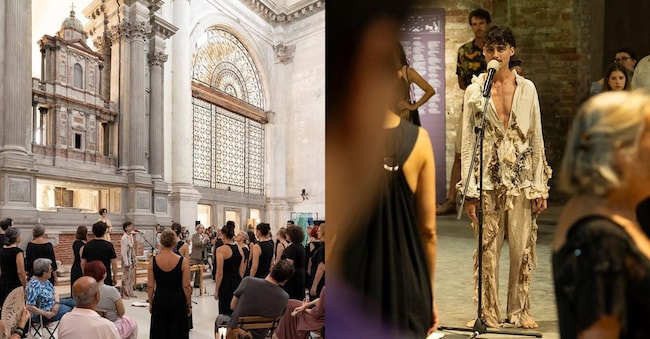
What can song still evoke when catastrophe has engulfed the language that dominates the present? This is the question at the heart of “Con falci d’amore (nenia per il nuovo millennio)”, presented as the opening event of the Public Programme at the Italia Pavilion of the Biennale, “Con te con tutto”, the project by Chiara Camoni curated by Cecilia Canziani. The work, commissioned by Lungomare (Angelika Burtscher and Daniele Lupo) and created by the poet Giorgiomaria Cornelio together with the musician Roberto Paci Dalò, was produced over a period of five months in collaboration with the Arcicoro Venezia, conducted by Elida Bellon, a Venetian choir of over thirty members that revives and reworks material drawn from traditions across the globe.
A multi-faceted approach
Cornelio’s work deliberately avoids the singular structure of the concert, the poetic performance and the sound installation, instead conceiving a multifaceted approach in which words and music cease to be autonomous and merge into a single perceptual environment. The work takes its cue from one of the great science-fiction allegories of the twentieth century, Martinson’s ‘Aniara’: in Cornelio’s poem, the comet-ship leaves a Earth now considered lost, carrying with it the golden disc of its songs. And the final transmission from Earth turns out to be the repository of a memory destined to outlive even our own species.
The metaphor that delves deep
Step by step, the poet wonders what kind of imagination remains possible when the future seems reduced to a mere management of the end. The answer comes in a dream: whilst asleep, Attalea (the protagonist of the cosmic poem) returns to Earth – that is, to the place which the narrative of the Anthropocene describes as irreparably compromised. It is a gesture that boldly overturns one of the main tropes of contemporary discourse: the obsession with the end of the world gives way to the possibility of lingering amidst the turmoil, at the very juncture where people still ‘warm themselves, wage war, eat and explain to us the most ancient words’. Cornelio’s writing proceeds through pervasive metaphors – the trite, the pestilential, the virulent, the battered – recognising in the wounded fabric of the present a form of belonging that remains available, and adding – compared to his usual work – a searing element of love: “With scythes of love / I have reaped myself / to be earthly / to the very core”. And the lament of the title thus becomes a practice of acclimatisation.
Dissolving the Individual
It was in this context that Paci Dalò’s composition – one of the most rigorous of his recent work – came to the fore. The score immediately established an acoustic geography in which instruments, soundscapes, live electronics and the voice redefined the perception of space, whilst the sound acted as an atmospheric backdrop. The work of the Arcicoro was also fundamental; thanks to them, the choral texture dissolved the centrality of the individual voice, transforming the text into a surface traversed by breaths and resonances. The result was a harmonic forest in dialogue with Camoni’s works; indeed, both seem to share the same slow, organic growth, in which every root retains the memory of its own evolution.
Earthlings through and through
In “Con falci d’amore”, Cornelio finally attempts to break free from a conceptual impasse in our collective imagination – namely, the forced choice between technological optimism and ecological apocalypse. It is no coincidence that the perspective evoked by the text is, as always, calmly contrary to this, as in his previous works, such as “La specie storta” (2023) or “L’ufficio delle tenebre” (2025), both published by Tlon. And it recalls what Matteo Meschiari defines as “Territà”, the indispensable reconstruction of a symbolic relationship with the Earth, capable of generating new cosmologies, but without straying into sentimentalism. The Earth, understood as a narrative condition to be continually shaped by thought, is the most compelling aspect of the project. In an age saturated with terminal narratives, *Con falci d’amore* restores tomorrow’s essential character – a pragmatic yet inevitable indecision that transcends the greenhouse effect of moral stereotypes accumulated over the last two centuries. The starship’s journey will continue without offering any landing places, yet keeping the mystery alive within the reader, who, precisely on the threshold of suspension, will rediscover “The world: this moment before pain. / For pain is not of the world / but ours”.

