
With my nose turned skywards, amongst the stars and myths
Giulio Guidorizzi takes us on a journey through the night sky, which the Mesopotamians first began to study and which the Greeks brought to life with heroes and gods

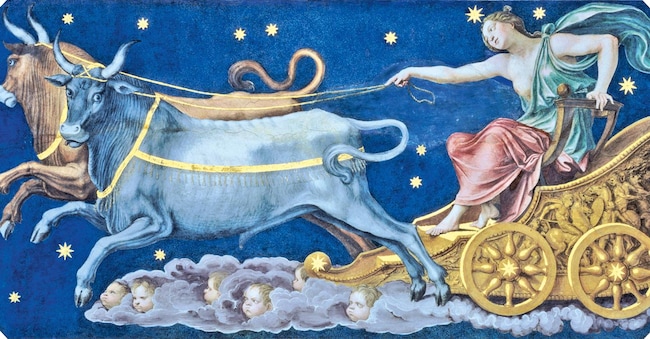
Heroes and gods race across the sky; fish and scorpions chase one another: this is the sky the Greeks saw, and which we too admire, as heirs to their celestial map. It is true that light pollution makes the spectacle of the night sky, with its veil of stars, a truly rare sight; yet when it is visible, the sense of wonder is primal. And it is no different from 2,500 years ago; this is why Giulio Guidorizzi’s book on The Myths of the Stars takes us back to an era that is distant, yet so close. So immensely our own. It was the Mesopotamians who first studied the night sky, then came the Greeks to bring some order to it and give the stars their names – which is truly a way of gauging the immeasurable – and Professor Guidorizzi admits to feeling a particular fascination for mythology, much like Aristotle: ‘The older I get, the more I fall in love with myths’ (fr. 668, Rose).
Northwards
Our sky is marked by mythology, and one need only look up to find gods, heroes and heroines. The Great Bear, for example, is made up of seven stars, more visible than ever, which the Greeks used as a compass pointing north: the Romans also called them ‘the seven oxen’, septem triones (from which our word ‘north’ derives). The Great Bear is up there, so high by the will of Zeus who, having defeated Cronus and seized power, chose to thank the guardians – two bears, in fact – who had protected him as a child.
There are many such stories, some dating back even before the Greeks, such as that of King Lycaon, who fathered fifty cruel and savage sons by various women, but also had a daughter who was different, Callisto, meaning ‘the most beautiful’, who joined the huntresses in Artemis’s retinue and was transformed into a bear when Artemis herself realised that Callisto was pregnant by Zeus, who had seduced her by ‘disguising himself’ as Artemis herself.
Romantic stars
Among the most ‘romantic’ constellations are the Pleiades, the seven sisters of the sky (one of whom is barely visible), described as follows by the Arab poet Ibn Hamdis (11th century): ‘Often at night I gaze at the stars, which look like / lit fuses or flashing spires. / I see the Pleiades rising, and they look like a string of seven / pearls from which you have made a necklace’.
Well before the 11th century, people were captivated by those seven sisters: in the Lascaux cave, in the Hall of the Bulls (around 17,000 years ago), the figure of a bison with its head raised can be seen, and above it are six dots arranged in a circle, which are interpreted precisely as stars, perhaps in connection with bison hunting. What is certain, however, is that the stars were indeed those engraved by an artist around 2000 BC on the Nebra Sky Disc, discovered whilst excavating a cavity in the Mittelberg mountain, near Nebra, in Germany.


