Interview

With ‘SchooLol’, laughter fills the classroom

“There isn’t enough laughter in our schools,” says Federico Taddia, who co-wrote the book with his brother Filippo
by Maria Piera Ceci

4' min read

Translated by AI
Versione italiana

4' min read

Translated by AI
Versione italiana

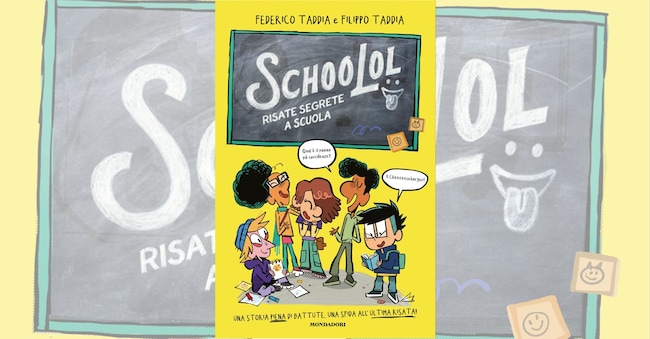
“There isn’t enough laughter in our schools,” wrote Gianni Rodari. “The notion that intellectual education must be a sombre affair is one of the hardest to combat.” Federico and Filippo Taddia’s latest book stems from this ever-relevant observation: “SchooLol – secret laughter at school”, published by Mondadori. A story halfway between Diary of a Wimpy Kid and a joke book, set in a secondary school where everything is designed to bore the pupils.

“Laughing together means understanding one another, seeing things the same way, speaking the same language, getting on the same wavelength, working as a team, building a connection, sharing an emotion, and processing information,” explains Federico Taddia, presenter on Radio 24 and television writer. “A laugh can carry far more authority than rigour for its own sake.”

Loading...

The password to enter the school in the book is Sb4d1gl1. A school where the headteachers who come and go are called Calapalpebre, Pisolini and Dormibene. A school so boring that Alexa pretends her phone has run out of battery just to avoid answering him. Is this what Italian schools are like? 

Fortunately, in the vast majority of cases, Italian schools are not like that. Mine is a hyperbole, a narrative exaggeration, but it serves as a reminder that the risk of boredom is always just around the corner, and that creating a fun, engaging and interactive atmosphere in the classroom can foster a positive bond between pupils and teachers. Italian schools aren’t boring, but there are teachers who sometimes take ‘non-boredom’ for granted, when in fact – as teachers know full well – it is something that has to be earned day by day.

In “SchooLol”, maths teacher Gaia Radice rebels against the school’s dull atmosphere and secretly organises a team-based joke and laughter contest, convinced that “happiness equals the sum of two smiles multiplied by the joy they radiate”. So is there a school that’s fighting back?

There are many schools in our country that are holding their own. These are the schools that refuse to accept bureaucracy, refuse to accept a lack of funds and dilapidated classrooms, refuse to accept stale teaching methods, refuse to accept shameful salaries, and refuse to accept those who view education solely in terms of marks, assessments and merit. The schools that are holding out are those where teachers study, experiment, develop their skills, put themselves on the line, sacrifice their energy and time, and see their pupils as people rather than just students. They rebel against the notion that ‘we can’t do any more than this’, proving instead that ‘we can do more than this’.

⁠In your imaginary Pier Piero Broccoli secondary school, sport is banned: everyone is stuck at their desks, the basketball hoop lined with thorny plants. And this at a stage of development when physical expression and understanding the body through sport and movement are so important. Is enough being done in schools in this regard?

Sport and physical activity are notably absent from our school system. Pupils spend too many hours sitting still, with very few hours of physical education, often taught by staff who are not properly trained. Similarly, there are far too few opportunities for outdoor activities: from hiking to sailing, our country is a natural gym from which schools could draw valuable resources.

⁠In your book, you also tackle important issues such as bullying through laughter. ‘If a joke hurts, it’s not a good joke,’ reads the Manifesto of the Laughter Resistance. Professor Radice explains it clearly: “If you make people laugh by hurting them, you’re not comedians, you’re mean.” At SchooLol, it’s not muscle that counts, but wit and quick thinking. Is bullying a problem to be tackled with every weapon at our disposal, including through reading?

The issue of bullying and cyberbullying must be tackled using every available tool, not least to provide a framework for understanding the phenomenon. And to give young people the means to become aware of it, recognise it and call it by its name. So as to offer possible ways out. And laughter, just as it can hurt, can also become a shield, a response, a lifeline. And that is what I have tried to bring to life within SchooLol.

⁠Another important issue is teamwork and group competition – concepts that are becoming increasingly important among young people, who tend to isolate themselves due to new technologies. How can we avoid demonising mobile phones (which are banned at school), whilst keeping young people grounded in the real world rather than just the virtual one?

Smartphones, social media, artificial intelligence: we are in the midst of a revolution and are acquiring the tools to find our way. As a communicator and educator, I see a great opportunity in this space: because true digital education can be achieved by also offering an education in the analogue world. It is not by banning mobile phones at school that you educate about digital technology, but by offering alternative activities, spaces, opportunities and moments to do other things. Young people are part of the virtual world and need a compass to guide them. But to be able to read that compass, they need real-world experiences. And that is the challenge of our time: making space for analogue experiences.

Your book is set in a secondary school. The final exams for the first stage of secondary education are taking place right now. What advice would you give to help make this exam as stress-free as possible?

My personal advice is to try and turn anxiety into a resource: it can serve as a gentle reminder of the areas where you feel least prepared, and so it shows you where to focus a little more attention. I’d also say to treat it as an adventure, an experience, a journey to be undertaken, where even the unexpected can still enrich and surprise you.

Scuola, tutti gli approfondimenti

La newsletter di Scuola+

Professionisti, dirigenti, docenti e non docenti, amministratori pubblici, operatori ma anche studenti e le loro famiglie possono informarsi attraverso Scuola+, la newsletter settimanale de Il Sole 24 Ore che mette al centro del sistema d'istruzione i suoi reali fruitori. La ricevi, ogni lunedì nel tuo inbox. Ecco come abbonarsi

Le guide e i data base

Come scegliere l’Università e i master? Ecco le guide a disposizione degli abbonati a Scuola+ o a 24+. Qui la guida all’università con le lauree del futuro e il database con tutti i corsi di laura

Lo speciale ITS

Il viaggio del Sole 24 Ore negli Its per scoprire come intrecciare al meglio la formazione con le opportunità di lavoro nei distretti produttivi delle eccellenze del made in Italy. Tutti i servizi

Copyright reserved ©
Loading...

Brand connect

Loading...

Newsletter Scuola+

La newsletter premium dedicata al mondo della scuola con approfondimenti normativi, analisi e guide operative

Abbonati