At the Lambrate Library

With Stefano Carrer a reflection on Japan's resilience

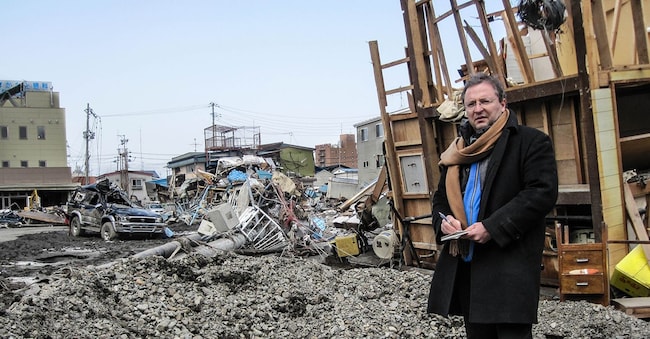
On show in Milan are the articles and photos of our colleague who died prematurely. Entitled 'From Hiroshima to Fukushima', the exhibition tells the story of how the Japanese country dealt with two nuclear catastrophes

by Riccardo Barlaam

Stefano Carrer col taccuino, 12 gennaio

3' min read

Translated by AI
Versione italiana

3' min read

Translated by AI
Versione italiana

There are colleagues who leave a mark. A small light. A trail to follow, an example of passion, intellectual honesty and professionalism for what they say is the most beautiful job in the world. Stefano Carrer was one of these, and he left too soon due to a tragic twist of fate.

A profound connoisseur of Japan and Asia, from the early 2000s he began commuting on Milan-Tokyo round-trip flights to report on the Land of the Rising Sun, then from 2007 as an Envoy and finally between 2013 and 2018 as a Correspondent for Sole 24 Ore.

Loading...

Until the top management of Il Sole, due to a series of economic turmoil following one of the darkest periods in its history, decided to close some correspondence offices, forced by accounts that were not going as they should. It was a parenthesis, but in that parenthesis Stefano was forced to return to the editorial office, leaving Tokyo. He continued from Milan to follow his issues with the same commitment. But he was no longer the same. He looked like a bird locked in a cage. Waiting to take flight again.

Con Stefano Carrer una riflessione sulla resilienza del Giappone

Photogallery6 foto

I remember a Saturday at work in the Sun, in early 2020. Stefano was on duty at the Foreign desk. I, who was then in New York as a Correspondent, had sent him a news article on the remarks of the American president - the same as now: he has not changed habits - who in the midst of the Covid-19 pandemic was inviting citizens to go to church for the Easter holidays and to drink disinfectants to avoid contagion. Stefano called me several times to fix the piece. I was struck by his professionalism behind the scenes, in the obscure and invaluable editorial work. He checked everything, even the commas. There are few colleagues left who still edit articles in this way. With an attention to detail, to the particular, to the seemingly small things. Attention to quality, which is what makes the difference. I was pleased to discover this. I wished him the best. Once the company crisis and Covid were over, Stefano would certainly start travelling again. He would return to Japan, who knows. Or maybe to China where, he confided in me, he would have liked to go.

Fate was cruel and a few months later an accident during a mountain hike, on 20 May 2020, still in the midst of the Covid emergency, snatched him from us.

Stefano as an Envoy and as a Correspondent was just as he had been that day with me, going through my article to the point of exhaustion. Shy, of few words, but capable of describing what was in front of him, precise and attentive, with a rare professional ethic. A writing style that, rereading it now, has the literary trait as well as the testimony of the thoroughbred reporter.

Silent Tragedy

Visualizza

He closely followed the triple tragedy of the Fukushima Daiichi power plant in March 2011, i.e. the earthquake, tsunami and nuclear emergency that devastated hundreds of kilometres of the Tohoku coastline bordering the Pacific, resulting in over 22,000 confirmed deaths. He was one of the first to leave. He visited the site of the nuclear disaster several times and risked himself by going there. He returned there every year until 2017 to document with his reports and photographs how the Japanese people recovered from that tragedy.

Stefano's sister, Giuliana Carrer, has collected in a 400-page self-published book all the reportages published in Sole 24 Ore to recount the Fukushima disaster. Many of those articles, together with her photographs, are currently animating a beautiful documentary exhibition at the Lambrate Library in Milan, open until 14 February, entitled 'From Hiroshima to Fukushima', a reflection on Japan's resilience. The exhibition was organised by his sister Giuliana, together with Susanna Marino, who teaches Japanese at Bicocca: Stefano had written a preface to a book by Professor Marino, published in 2020, which he did not have time to see printed.

Stefano's photojournalism covers a seven-year time span (from 2011 to 2017), and shows the destruction over a very long stretch of the Tohoku coastline, the first rescue operations for survivors, encounters with lone witnesses of courage, protests against atomic energy, and the inside of the nuclear power plant with the use of remote-controlled robots.

In 2023, the Japanese Consulate General in Milan awarded Stefano Carrer a Certificate of Merit in Memory. His work remains as a testimony.

CONFIDENTIAL REPRODUCTION

Copyright reserved ©
Loading...

Brand connect

Loading...

Newsletter

Notizie e approfondimenti sugli avvenimenti politici, economici e finanziari.

Iscriviti