Airlines

Wizz Air posts better-than-expected second-quarter results, but jet fuel costs weigh on the figures

The company recorded energy costs of 1.24 billion euros in the first half of the year. Its presence in Italia is growing with two new bases

3' min read

Translated by AI
Versione italiana

3' min read

Translated by AI
Versione italiana

Wizz Air is growing in terms of passenger numbers and capacity, but this strengthening of the business has not yet translated into a corresponding increase in profitability. In the quarter from July to September, turnover rose by 19.9 per cent to €2.29 billion. Operating profit rose by 8.8 per cent to €447.8 million, exceeding analysts’ expectations, whilst net profit reached €306.3 million, up 7.4 per cent year-on-year despite foreign exchange losses. Quarterly EBITDA rose by 13.8 per cent to 775 million, despite a 28.7 per cent increase in fuel costs. The company has not provided a full-year financial forecast due to uncertainties surrounding fuel prices.

The half-year results for the 2027 financial year, as at 30 September 2026, were stronger, with revenue of €3.8 billion, up 13.8 per cent compared with the same period last year. Despite this growth, however, net profit fell by 66.6 per cent, from €323.5 million to €108.1 million.

Loading...

Between April and September, Wizz Air carried 46.1 million passengers, 26.2 per cent more than the 36.5 million carried in the first half of 2026. Seat capacity increased by 26.1 per cent, whilst Available Seat Kilometres (ASK) rose by 17.1 per cent. The load factor remained broadly stable at 92.5 per cent, compared with 92.4 per cent in the previous year.

Despite the growth in revenue, operating profit fell by 39.8 per cent to €264.5 million, compared with €439.2 million in the first half of the previous year. EBITDA stood at €922.4 million, down 6 per cent, whilst the EBITDA margin fell from 29.4 per cent to 24.3 per cent.

The main cost driver is fuel. Fuel costs rose by 33.7 per cent, reaching 1.24 billion euros. The company is strengthening its hedging strategy. As at 6 November, 82 per cent of the projected fuel requirements for the second half of the 2027 financial year were hedged, with an average maximum price of $860 per tonne. For the 2028 financial year, hedging coverage stands at 41 per cent, with an average cap of $1,009.

It also improves operational efficiency. According to the company, cancellations have fallen compared with last year, despite a 23 per cent increase in the number of flights operated. Punctuality exceeded 70 per cent, helping to reduce costs associated with service disruptions and improve crew management.

The half-yearly figures were particularly affected by the weakness seen in the first quarter, which was driven by tensions in the Middle East. In the second quarter, which ended on 30 September, performance showed signs of improvement.

“Unit revenues improved over the summer, supported by solid load factors and resilient demand,” commented CEO József Váradi, emphasising that the company had maintained significant volume growth in a challenging operating environment.

The development strategy continues to focus on expanding the company’s presence in Europe, with particular emphasis on Central and Eastern Europe and markets offering growth prospects.

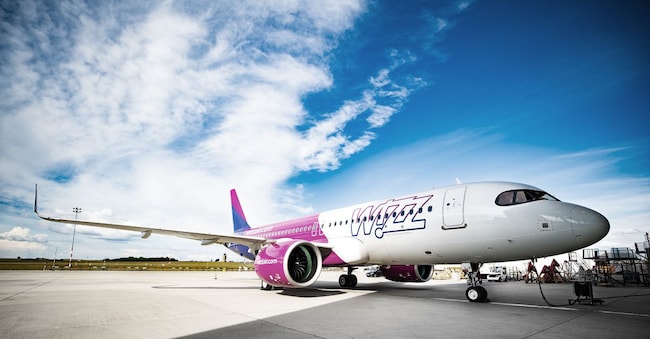
As at 30 September, the fleet comprised 276 aircraft, compared with 243 a year earlier. The business plan envisages further expansion: the fleet is expected to reach 300 aircraft in the 2029 financial year and 385 in the 2032 financial year, before stabilising at 383 in the 2033 financial year. The order pipeline comprises 235 Airbus A321neo and A321XLR aircraft.

Loading...

On the commercial front, Wizz Air has strengthened its presence in Italia, bringing the number of aircraft based in the country to 42, partly through the opening of two new bases. The airline has also announced new bases in Spain – in Valencia, Madrid and Santiago de Compostela – as well as in Pristina, Kosovo, and Brasov, Romania.

In Central and Eastern Europe, the airline maintains a leading position, with a 27.8 per cent share of seats on offer in the market at the end of September.

One of the main sources of uncertainty remains the availability of Pratt & Whitney GTF engines. As at 30 September, 22 aircraft were grounded for engine-related inspections, a figure which is, however, an improvement on the 35 aircraft grounded during the same period last year. Wizz Air plans to reduce the number of grounded aircraft to 15–20 by the end of the financial year and aims to bring this figure down to zero by the end of 2027.

Copyright reserved ©
Loading...

Brand connect

Loading...

Newsletter

Notizie e approfondimenti sugli avvenimenti politici, economici e finanziari.

Iscriviti