
Wood and cement alternatives to reduce ecological footprint
Research is also advancing on bacteria-based materials that absorb Co2 from the atmosphere
Key points
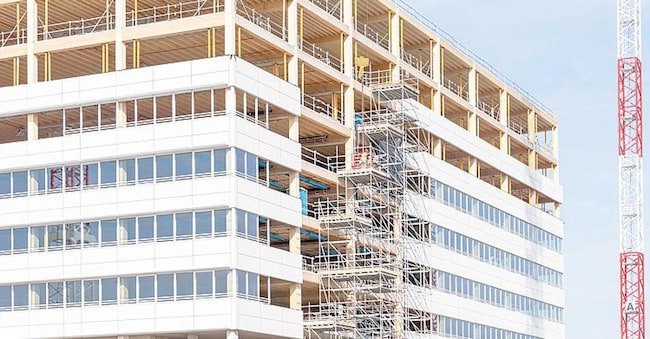
The built environment is a climate nightmare. Producing cement, steel and plastic - the materials we commonly use to build our infrastructure - emits large amounts of carbon dioxide. If cement were a state, it would be the world's fourth largest emitter of greenhouse gases after China, the United States and India. For this reason, reducing the carbon footprint of building materials is an essential climate protection effort. Of the solutions considered so far, the simplest and most effective is to replace concrete with wood. Buildings such as the Ascent Tower in Wisconsin, the Mjøstårnet in Norway or the HoHo Tower in Vienna have successfully demonstrated the potential of timber construction as an alternative to concrete and steel. Now also in Milan two buildings are being constructed with cross-laminated timber structural elements (Xlam) as part of the Mind project: a 13-storey tower, Zenith, and an 8-storey tower, Horizon.
In Stockholm a wooden quarter
.In Sweden, however, they are thinking bigger: in Sickla, a former industrial area south of the capital, Stockholm Wood City is being built, 'the world's largest solid wood district', according to developer Atrium Ljungberg's description. The settlement, which will include 2 thousand new homes, 7 thousand offices, schools, shops and restaurants all made of wood, on 250 thousand square metres, is unique in its size and the priority given to sustainable building principles. Wood in itself is a material that stores carbon rather than emitting it, as trees absorb CO2 as they grow, but even in site management it can reduce carbon emissions by up to 60% compared to traditional methods, because it is lighter and faster to work with than concrete, allowing extensive use of prefabricated construction. It is no coincidence that the project is ahead of schedule and will complete the school building by the end of this year, with the rest of the thirty buildings to be delivered between 2026 and 2027.
From BeNewtral a mineral binder alternative to cement
.Another front being worked on to reduce the carbon footprint of buildings is the search for alternative materials to cement that are just as effective. This is where an Italian start-up, BeNewtral, born from PoliHub, the Milan Polytechnic's accelerator, has entered the field. This summer it launched a mineral binder alternative to cement on the market. ReBind is a patented material created from the valorisation of non-hazardous industrial by-products, which are transformed into a high-performance binder for non-structural applications such as flooring, sub-bases and coatings. Ongoing tests show that ReBind provides high fire resistance, good thermal stability and durability comparable to or better than traditional cements, with a much more favourable environmental profile. The data, validated under the European Life programme, confirm a reduction of up to 90 per cent of CO₂ equivalent per tonne of product, a 98 per cent reduction in energy required in the production cycle, a 93 per cent reduction in water use and the total elimination of quarrying. The co-founders of BeNewtral, Nicolò Verardi and Riccardo Frezzato, describe their mission as follows: "We want to contribute to redefining the paradigms of construction, a sector that still has a heavy impact on the environment. We believe in a radically different model: regenerative, circular, low impact. An industry that not only reduces emissions, but is able to generate environmental, economic and social value'. In fact, ReBind's production process is organised in local, flexible and low-cost micro-plants, which allows for the creation of value on a territorial scale.
Co2-eating bacteria
.Research is also advancing on 'living' building materials that absorb carbon dioxide from the atmosphere. So far, researchers have put 'carbon-eating' bacteria in bricks, paints and even in a self-healing concrete, which captures carbon dioxide by turning it into minerals. Now, a team from the Swiss Federal Institute of Technology Zurich has created a living material that can be 3D printed in various forms. The material is a gel containing photosynthetic bacteria that trap carbon dioxide from the atmosphere, storing it in biomass, which thus hardens over time. "As a building material, it could help store carbon dioxide directly in the buildings of the future," says Mark Tibbitt, professor of macromolecular engineering. Tibbitt and colleagues 3D printed several structures that would allow cyanobacteria to survive and grow for over a year. The printed structures are initially soft, but as the bacteria grow and form carbonate minerals, they harden.
Elena Comelli

