
Wood remains the centrepiece across timber varieties, the supply chain and design
The natural material par excellence is back in the spotlight as an element capable of combining sustainability, innovation and artisanal quality

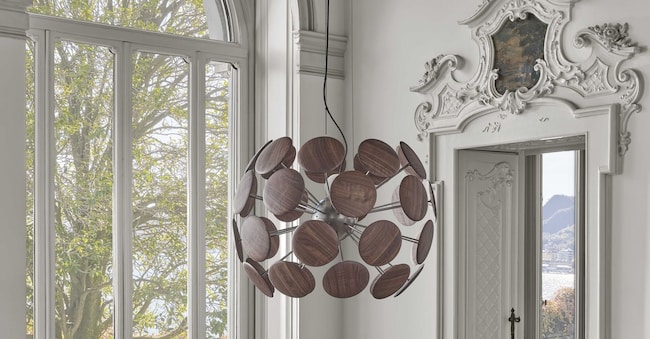
What role does wood play in interior design in the third millennium? As a testament to its inexhaustible creative power, it remains the most valuable ally and the primary material for furnishing and decorating the home: versatile, living, natural, recyclable and renewable. Wood also serves as an open bridge to woods and forests – living entities that are often (far too) distant from urban homes – and which this material has the power to evoke.
Simply saying ‘wood’, however, is no longer enough. All woods have a first name, a surname and an address of origin: an origin that is increasingly often certified; this revelation sheds light on their marvellous biodiversity and different characteristics, making explicit the – hopefully respectful – relationship we establish with the source.
The local area becomes a project
The initiative “Nodi. Culture, business and Trentino wood design” centres on this key role of wood in interior design, aiming to revitalise regional resources and supply chains through a partnership with the world of design. The initiative, launched in 2025 by the Autonomous Province of Trento and whose results were presented in Milan last April, brought together 15 artisan and industrial firms from Trentino and an equal number of designers of national and international renown, who together conceived and produced 15 pieces of furniture and home accessories for the home and hospitality sector, using local timber: not merely a design exercise, but genuine products to be launched on the market.
The event encouraged businesses and creative professionals to explore new avenues of innovation, whilst also rediscovering their traditional heritage; this was the case, for example, with Restel, a larch hall unit, combining storage and coat rack functions, designed by Monica Graffeo in collaboration with Falegnameria Bosetti and inspired by a rake: not merely a rural reference, but a tribute to the geometry of a tool used to create order and a welcoming space. Giulio Iacchetti, on the other hand, in collaboration with Fiemme Tremila, has designed Vertigo, a continuous parquet floor made of spruce planks – a wood for which the Val di Fiemme is renowned – which softens the angle between the floor and the wall thanks to a curved profile that ensures an uninterrupted transition from the horizontal to the vertical plane.
As part of the ‘Nodi’ project, designer Alex Terzariol, in collaboration with Maria Elisabetta Ripamonti, has developed the Kirizuna modular chair in Paulownia ‘super-wood’, the result of a patented industrial densification process developed by Xlam Dolomiti (Valsugana). Paulownia, the world’s fastest-growing tree, is capable of absorbing over 100 tonnes of CO₂ per hectare per year – up to ten times more than any other species. Densification increases the natural density from 250–300 kg/m³ to over 1,000 kg/m³, giving the material mechanical strength comparable to that of steel, a negative carbon footprint and fire resistance superior to that of common woods. The Kirizuna seat, which can be used to create large arrangements, is constructed from thin strips, curved to form the backrest and seat in a fluid, continuous line.
Brand connect


Newsletter RealEstate+
La newsletter premium dedicata al mondo del mercato immobiliare con inchieste esclusive, notizie, analisi ed approfondimenti
Abbonati