
Wood, the 'binary' effect - between freight, roundwood and energy costs - resets margins to zero
The perfect storm is hitting the industry: raw material costs are not coming down even though demand is weak

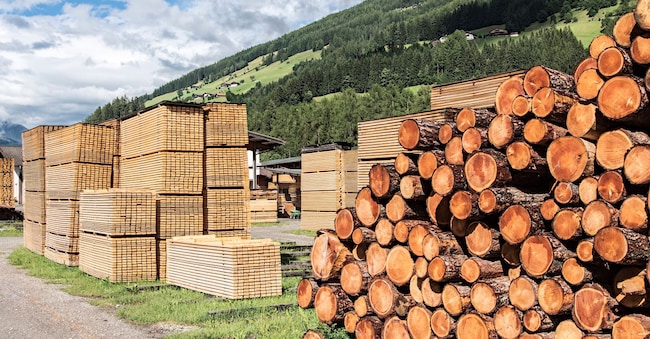
(Il Sole 24 Ore Radiocor) - International geopolitical tensions, fuelled by the war in the Middle East, are having a heavy impact on the timber market. The perfect storm is hitting the sector. The conflict in Iran has paralysed the Gulf routes: with freight rates up tenfold (from USD 500 to USD 4,000), exports to the Middle East are at a standstill, leaving Europe with an oversupply that, paradoxically, does not cool the price lists. It is the 'Divergent Binary Theory'*: in the face of weak demand, the cost of logs remains at an all-time high (up to 148 euros/cubic metre in the DACH area, i.e. Germany, Austria and Switzerland), squeezing sawmills' margins into a systemic loss. In Italia, as in Europe, the market for logs is saturated, but the severe limitations on cuts due to bark beetle damage and various storms (such as Vaia) are keeping log prices firmly at an all-time high, given the difficulty in finding available raw material. From this point of view, the case of the Magnifica Comunità di Fiemme is emblematic: for the first time post-Vaia and post bark beetle, it will have to purchase more than half of the raw material outside its forests. This is an epoch-making change that pushes the country towards a transformation model with high added value, while the large European sawmills, forced to 'too big to stop', are moving towards budgets in the red by millions of Euros.
The Italian sawmill revolution
The sawmill sector in Italia has been undergoing a profound transformation over the last 15 years, driven by a paradox between technological growth, generational change, flexibility and inefficient management of raw material by public authorities, according to an analysis by Conlegno. The industrial evolution, thanks to the combination of the abundance of timber (caused by Vaia and bark beetle) and the increase in prices of sawn timber, and the contribution of Industry 4.0, has led to a modernisation of Italian sawmills: they have increased their production capacity while maintaining their typical flexibility, managing to compete without the economies of scale of the central European giants. However, compared to European sawmills, Italian sawmills suffer from the blockage of the national forestry system, struggling to find logs despite the theoretical availability of material in the territory. Therefore, according to Conlegno, while Italian sawmills have made a quality leap by investing in technology and productivity, they remain 'hostage' to a forest bureaucracy that has enormous difficulties in managing the forest, forcing companies to search for raw material even at long distances.
The panel flare
It is no better on the processed products front. Soaring oil and gas prices have overwhelmed the panel industry. The increase in chemical components for glues (urea in the lead, burdened by Cbam regulations) and the energy costs of presses have generated price rises of between 5 and 10 per cent. In detail, OSB: +10% since the beginning of the year, driven by the restart of construction sites; Particleboard: increases of over 10% due to strategic production stoppages; Pine plywood: the most critical case. The combination of EU anti-dumping tariffs (5.4 per cent), the reopening of the US market, and the increase in freight rates from Brazil pushed up list prices over 10 per cent.
Pallets and wooden packaging between "anvil and hammer"
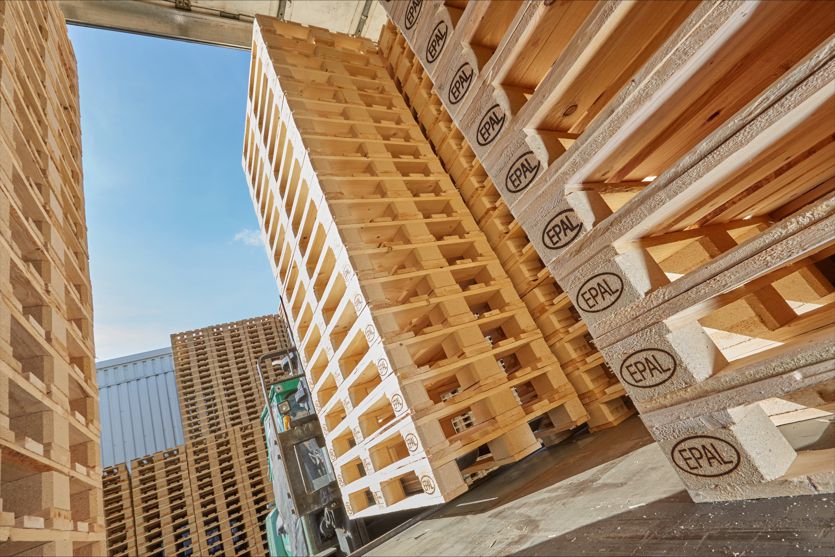
The picture reflects an extreme industrial dualism: on the one hand, the forced resilience of pallet and packaging prices in a stagnant market (including the construction market), which are struggling to pass on price increases to end customers despite pressure from sawmills, squeezed by prohibitive log costs and in the midst of collapsing profitability. On the other hand, the recent Cril Index (promoted by Filiera Legno) certifies an opposite trend: between the beginning of the year and the end of March 2026, semi-finished products for pallets recorded a sharp increase of 4.8%, confirming an upstream inflationary drive that has no outlet downstream. In this scenario, the continuation of this downstream value transfer situation will lead to serious problems for manufacturers of pallets and wood packaging, up to the realignment of index values between logs and sawn timber. This imbalance cannot last long without triggering drastic and inevitable upheavals in the entire supply chain.
*The Divergent Binary Theory


