
Labour, here's why demographic decline may lose up to 9 GDP points in the next 25 years
The deputy head of the Economy and Statistics Department of the Bank of Italy, Andrea Brandolini: 'Over the next twenty-five years, if employment rates, working hours and hourly productivity were to remain unchanged at current levels, the decline in the working-age population would imply a decrease in labour input and thus in GDP of 0.9 per cent per year'
3' min read
Key points
3' min read
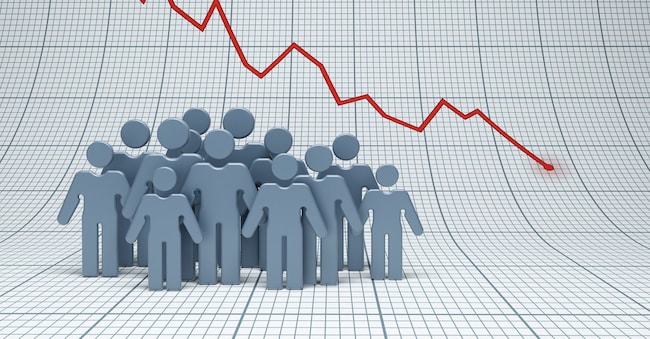
"Over the next twenty-five years, if employment rates, working hours, and hourly productivity were to remain unchanged at current levels, the decline in the working-age population would imply a decrease in labour input and thus in GDP of 0.9 per cent per year". This was stated in the report by the Deputy Head of the Economy and Statistics Department of the Bank of Italy, Andrea Brandolini, before the Parliamentary Commission of Inquiry into the economic and social effects of the demographic transition underway. 'The reduction in GDP per capita would be smaller, 0.6 per cent per year, due to the parallel decline in the overall population,' Brandolini added, however.
What will happen if labour participation rates continue to grow at the same rate as today
"Increasing participation rates can contribute substantially to increasing labour input, counteracting the effects of demographic decline. This has been the case from the early 2000s to the present; it can only continue to do so over the next twenty-five years if there are significant changes in labour supply and demand. If participation rates by gender and age group continue to grow at the same rate as in the last decade, all other things being equal, GDP would drop by almost 9 per cent between now and 2050, by 1.6 per cent in per capita terms'. These were the words of Andrea Brandolini, deputy head of the Economy and Statistics Department of the Bank of Italy, during the hearing convened by the Parliamentary Commission of Inquiry into the economic and social effects of the demographic transition underway.
There is plenty of room to act
.'There are wide margins,' reads the memorandum presented at the hearing, 'on which action can be taken. Despite progress over the last fifteen years, the Italian participation rate in 2024 was still the lowest in the EU: at 66.6 per cent, it was about 9 percentage points below the European average. The gap was particularly wide among women and younger people'.
Accelerating population ageing than expected
."Population ageing is a global process and faster than expected only ten years ago. It reflects both a significant improvement in the health of the population and a faster-than-expected decline in fertility in some economies of Asia, primarily China, and Latin America'. This is what Andrea Brandolini, deputy head of the Economy and Statistics Department of the Bank of Italy, said at a hearing before the Parliamentary Commission of Inquiry into the economic and social effects of the demographic transition underway. "In the median scenario of the latest United Nations demographic projections, the world population is expected to peak at just over 10 billion around the mid-1980s of this century, and then slowly decline. From that time forward, life expectancy at birth will exceed 80 years, and people aged 65 and over will outnumber those under 18'.
Pensions, further flexibility possible in contribution system
"In principle, the characteristics of the contribution-based system could allow, for those who are fully subject to the new rules, additional forms of flexibility on exit; forms of minimum guaranteed return could also be introduced so as to reduce the macroeconomic risks to which policyholders are exposed," Brandolini explained. 'If implemented without affecting the principle of actuarial fairness,' reads the memorandum filed with the Commission, 'these changes would not call into question the sustainability of the system; they would, however, increase expenditure in the short to medium term by absorbing resources that could otherwise be devoted to strengthening social protection against other risks equally worthy of protection'. The Institute's economist pointed out, in this regard, that 'among the main countries in the euro area, Italy is the one that today spends more on pensions (five points of GDP more than Germany, two more than Spain, one more than France). Conversely, for health and long-term care it allocates fewer resources than both Germany and France'.

