
Working with artificial intelligence: creative dream or endless internship?
The promise is that we will have more time, be more productive and ready to 'make a difference', but we may not be smart enough

3' min read
3' min read
There is no conference with AI in the title where, at some point, there isn't someone from a Big Tech who comes out extolling the time 'freed up' by AI from repetitive tasks. But are we really sure that it will be nice to take care of the creative and strategic aspects of our work and leave the boring part to AI?
In theory, certainly yes. In practice, it depends on expectations, what will be asked and how we will be asked. Put yourself in the shoes of the new creative people evolved by AI: more time to invent, study and design services, products and procedures means a different organisation of work. It is not just a question, which is not easy, of deciding how to redistribute tasks on the basis of the supposedly greater efficiency generated by generative artificial intelligence and AI agents.
Wanting to be consistent with the dictates of an AI First approach, which sees AI at the heart of the company's services, means engineering a creation process that sees humans and machines working in multidisciplinary teams, redesigning processes and divisions, in practice rethinking the last twenty years of business economics.
For those still at university, not much will change: it will still be a new world. For those who are already inside, however, it means changing the way they work. The most pessimistic imagine this 'paradigm shift' (the umpteenth, ed.) with a more or less extended phase of quality control, where the 'domain knowledge holders' - the professionals or senior managers - train the 'machine' to work for them and check for errors. To use a fashionable mantra in AI, we can call this phase Human in the loop: a human at the beginning and end of the process. He does the data input and checks at the end how the machine performs.
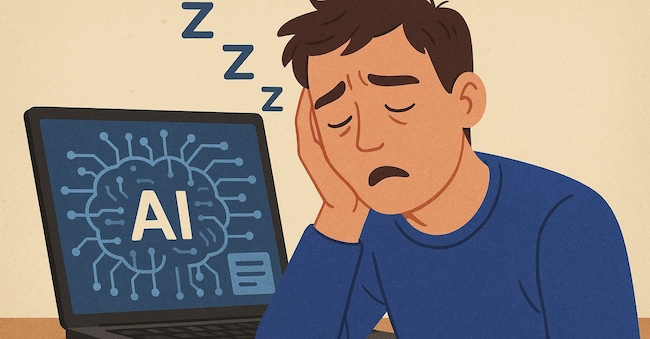
One manager defined this phase as follows: 'Once IT has worked out which agent to use, i.e. once the proof-of-concept phase is over, it will be like teaching the trade to a new generation of interns destined, at worst, to take your place, at best to make you their guardian'.


