The event in Milan

The World Manufacturing Forum calls for a change of direction in Brussels

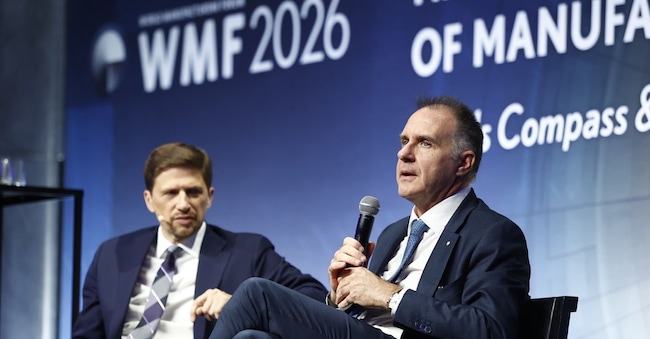
Orsini: ‘We are deindustrialising Europe.’ Witucki (Business Europe): ‘Now is the time to make our voices heard and apply pressure.’

6' min read

Translated by AI
Versione italiana

6' min read

Translated by AI
Versione italiana

An industrial plan that prioritises manufacturing, creates a single energy market and sets aside ideology in order to bolster Europe’s competitiveness. Confindustria President Emanuele Orsini reiterates the business community’s stance in the face of the current economic climate, calling on Brussels to take more decisive action. “On certain key issues, there can be no room for ideology,” he explains, “and politics must not be played out at the expense of businesses and citizens. In Europe and in Italia, the only thing we need is a long-term industrial plan. Today, partly due to decisions made in the past, we are deindustrialising Europe.”

Orsini is speaking in Milan, at Piazza Affari, on the first day of the World Manufacturing Forum, an international event now in its 14th edition and organised by the World Manufacturing Foundation, which is dedicated to the major transformations that are reshaping the future of manufacturing.

Loading...

“This is a crucial moment,” explained Maciej Witucki, President of Business Europe, “when we can make our voice heard and put pressure on the institutions to take action. We have a slightly better chance than in the past, given that our views are certainly taken more seriously today than they were before.”

Strengthening the single market, creating a single energy market, and simplification are the priorities identified, in a process which, according to Witucki, sees the various business associations across different countries united and in agreement on their objectives.

“We were pleased,” adds Orsini, “to see all the German associations unite in calling on Chancellor Merz not to cut the European budget, because if you want to boost competitiveness, you cannot take 400 billion euros out of the budget, as has been proposed.”

Future competitiveness is at the heart of the Forum, an event bringing together international experts in strategic policy, industry leaders, academic researchers and technological innovators to support the global manufacturing community in navigating emerging trends and technological opportunities.

The two-day event will feature 400 companies, 30 international speakers and 10 production sectors, with speakers from 21 countries taking part in the discussions.

The highlight of the first day was the presentation of the World Manufacturing Report 2026.

In a context where geopolitical tensions, climate change, demographic trends and the rapid spread of artificial intelligence are all intertwined, businesses can no longer rely on a single forecast of the future. They need tools to continuously monitor change and to decide where to take action first.

The Report proposes two of these. The Trend Compass maps the geopolitical, economic, social, technological, regulatory and environmental forces that are shaping supply chains and production systems. The Technology Radars assess five technology families (wearable devices and person-centred technologies; industrial data analytics; digital twins, augmented reality and industrial metaverses; agent-based and cognitive artificial intelligence; humanoid robotics) according to four dimensions: industrial readiness, strategic impact, current stage of adoption and expected timeframe for mass adoption.

Loading...

In terms of trends, the key point is that resilience, sustainability and a people-centred approach can no longer be treated merely as a response to crises or as discretionary objectives: they must become the underlying factors in every project involving networks, facilities and technologies, and must be taken into account before these are defined. In terms of resilience, the Report urges businesses to identify their critical dependencies even beyond the first tier of supply – where a significant proportion of disruptions originate – and to build flexibility into their facilities and products. In terms of sustainability, it identifies circular manufacturing and the sharing of interoperable data throughout the life cycle – starting with digital product passports – as the way to reduce the use of virgin resources. In terms of people, it highlights the skills shortage – identified by the World Economic Forum as the main obstacle to transformation in 52 of the 55 economies examined – and the need to maintain effective human oversight of automated systems.

An analysis of the radar charts reveals a common theme: technological maturity does not automatically translate into industrial adoption. The greatest obstacles increasingly lie at the interfaces between technology, data, organisation and people, and in the governance required to adopt innovations in a climate of trust. The path outlined is therefore a gradual one: scaling up technologies that already generate value, experimenting with and validating emerging technologies through pilot projects, and building the data, standards and skills that all of them require.

The report reveals that over 60 per cent of executives in the manufacturing sector plan to adopt artificial intelligence agents within two years, but fewer than 20 per cent have already done so. A word of caution comes from Gartner’s analysis, which estimates that over 40 per cent of agent-based projects are likely to be cancelled by the end of 2027 due to rising costs or low added value. As for humanoid robotics, the market has entered the first phase of commercialisation, with estimates ranging from 13,300 to 16,000 units in 2025, over 80 per cent of which will be in China; these will be deployed primarily in existing production environments rather than in new, fully automated facilities.

The Report concludes with ten recommendations for businesses and institutions. The first five concern the use of the Trend Compass: systematically monitoring the external environment, involving various stakeholders in interpreting trends, setting priorities in line with strategy, translating trends into initiatives with clearly defined objectives and resources, and periodically reviewing the Compass. The other five relate to the Technology Radar: continuously monitoring emerging technologies; classifying them according to their impact on value creation and readiness for adoption; validating them through trials and pilot projects; establishing cross-functional technology governance with clear responsibilities and human oversight; and updating the Radar regularly.

The voices of the protagonists

Diego Andreis, President of the World Manufacturing Foundation: “The World Manufacturing Forum is evolving towards an increasingly international model, bringing together countries with different industrial histories and development prospects. Against a backdrop of rapid technological transformation and great uncertainty, the challenge lies in distinguishing structural changes from the hype surrounding innovation, understanding their real implications and translating them into informed industrial decisions. The Forum offers precisely this compass: a space for global dialogue to shape the future of manufacturing and build new opportunities for cooperation.”

Attilio Fontana, President of the Lombardy Region: “Lombardy is Europe’s leading manufacturing region and intends to remain so by investing in innovation, skills and attractiveness. We want to turn artificial intelligence and emerging technologies into practical tools to support businesses, particularly SMEs. Through the Innovation and Development Zones, we are bringing together research, training, infrastructure and investment, capitalising on the regions’ areas of specialisation and making the Lombardy ecosystem increasingly open and competitive, capable of attracting capital and talent and guiding supply chains towards more robust, innovative and sustainable growth. We have warmly welcomed the Government’s recent willingness to extend the Special Economic Zone to the North as well. We look forward to getting this initiative up and running, which we are certain will enable Lombardy to move forward even faster.”

Giuseppe Pasini, President, Confindustria Lombardia: ‘Innovation, high levels of production diversification, a global outlook, the central role of local areas, and macro-regional collaboration: all these elements make Lombardy – which is currently hosting the World Manufacturing Forum as a key player – the ideal place to become the manufacturing hub of the future through its own development model. A model which, in order to tackle and overcome the challenges of the present and the future, requires a series of strategic contextual levers: an energy mix at sustainable costs, autonomy in the management of cohesion funds to enhance local areas and supply chains, access to critical raw materials, uniform rules compared with international competitors, AI and cutting-edge technologies. Confindustria Lombardia, with a sense of responsibility and duty, offers a vision of the future that places industry at the centre: ‘if we are to avoid the forced deindustrialisation of the European continent, there is no time to lose’.

Donatella Sciuto, Rector, Politecnico di Milano: “The World Manufacturing Forum represents an important opportunity for dialogue between businesses, universities and institutions on one of the key challenges for the future: steering the transformation of manufacturing through a period of great technological, industrial and social complexity. The future cannot be navigated by following a single course: it requires the ability to interpret different signals, combine expertise and forge alliances. It is with this in mind that the Politecnico di Milano intends to make its contribution: by integrating education, research and innovation, to transform technologies into industrial competitiveness, sustainable development and value for the country.”

Marco Taisch, Scientific Chairman, World Manufacturing Foundation: “The World Manufacturing Forum was established to produce scenario analyses that institutions and businesses can adopt immediately as part of their operational decision-making. The WMF Report 2026, published to coincide with the event, serves precisely this purpose: to provide a method that helps make sense of the uncertainty of the present. The findings we have presented convey this message to managers and policy-makers: technology, on its own, is not enough. The barriers to development lie in data management, organisational structures, a lack of up-to-date skills among workers, and governance frameworks. It is on these fronts that industrial policy — at European, national and regional levels — must focus its resources in the years to come. Industry and politics that are able to anticipate change will generate lasting growth. Year after year, the WMF is the forum where that capacity for anticipation is built. And it is an honour for Milan, I believe, to host this important event.’

Copyright reserved ©
Loading...

Brand connect

Loading...

Newsletter

Notizie e approfondimenti sugli avvenimenti politici, economici e finanziari.

Iscriviti