
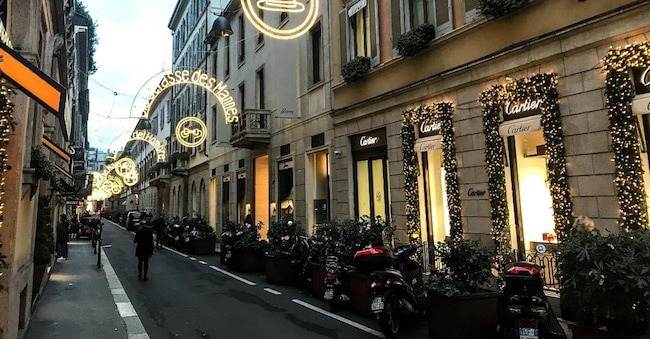
Rents, Montenapoleone in Milan the most expensive luxury street in the world
This is the first time a European city has made it to the top of the podium in the global ranking. New York, London and Hong Kong follow

3' min read
3' min read
She was always one step away from New York. Now it has succeeded. Via Montenapoleone, in Milan, becomes, for the first time, the most expensive luxury shopping street in the world, with high-end (so-called prime) rents of 20,000 euros per square metre per year, as emerges from the latest edition of the Report "Main Streets Across the World" by Cushman & Wakefield and now in its 34th edition. It is also the first time that a European city has made it to the top of the podium in the global ranking. The report monitors 138 urban retail locations around the world, predominantly in the luxury sector, based on the value of prime rents and the ranking is based on the most expensive location in each country.
Limited supply and stronger euro (than the dollar)
.Synonymous with fashion and luxury, Via Montenapoleone has steadily climbed the rankings in recent years, reaching second place for the first time in 2023. In the last 12 months, however, rents have risen by 11% (+30% in the last two years), reaching 20,000 euros per square metre per year, slightly higher than the 19,537 euros per square metre per year of Upper 5th Avenue in New York, which has been stable for two years.
In addition to continued strong demand from retailers in a context of limited supply, Via Montenapoleone also benefited from the appreciation of the euro against the US dollar.
New Bond Street in London reclaimed third place worldwide (EUR 17,210 sqm per year), overtaking Tsim Sha Tsui (EUR 15,697 sqm per year), Hong Kong's main shopping street. With an annual growth of 10%, the Avenue des Champs Élysées in Paris retained fifth place, although the Ginza district in Tokyo narrowed the gap with a 25% year-on-year increase. In the European ranking, which includes more than one street per country, Via Condotti and Piazza di Spagna in Rome took third and tenth place confirming the importance of Italy in the world of retail in Europe: three Italian streets were in the top 10 of the ranking.
The competitive tension between strong demand and scarce supply was reflected in year-on-year rent growth in 57% (79) of the 138 locations monitored. In particular, there was a global average rent growth of 4.4%. Overall, rental growth in the US was nearly 11 per cent - more than double the 5.2 per cent recorded last year - followed by Europe and Asia Pacific with 3.5 per cent and 3.1 per cent, respectively.
"Milan," said Thomas Casolo, Head of Italian Retail and Co-Head of Luxury at Cushman & Wakefield, "has certainly become a global brand, but let us not forget that Via Montenapoleone is a unicum and that in the same street there are a variety of rental values, depending on the commercial characteristics of the shop. The opening of new shops in the most desirable area of the quadrilateral, between Via Verri and Via Sant'Andrea, has certainly weighed on the current positioning, but also the size of the street: it is concentrated in a very small space, unlike other cities such as London, Paris and New York, and in the last year it has become the place to be for luxury brands'.
Brand connect


Newsletter RealEstate+
La newsletter premium dedicata al mondo del mercato immobiliare con inchieste esclusive, notizie, analisi ed approfondimenti
Abbonati