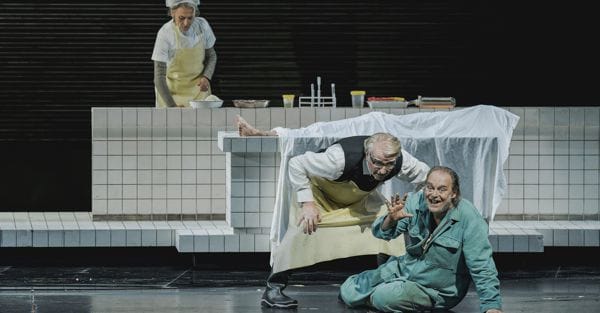
Wozzeck: a masterpiece of theatrical technique

Just three performances of *Wozzeck* in Florence. It happens: sometimes the most precious things can also be the preserve of a select few. Given the success of the *premiere* – with the Maggio theatre packed to the rafters, including many young people, who were enthusiastic and moved – perhaps a few more performances might have been envisaged. Still, it’s fine as it is: the strategy is not to pander to the public by lowering standards, but to refine the theatre, making it ever more attractive and international. Being there becomes a must. This is demanded and confirmed by Deborah Warner’s production of Alban Berg’s masterpiece, rightly brought over from London’s Covent Garden, where it had its debut three years ago. A masterpiece, because it is a lesson in theatrical technique, whilst staging a unique work in the history of opera, built solely on a succession of musical forms, each different and never repeated. The height of icy formalism envelops Büchner’s text, the most brutal of Expressionism.
L
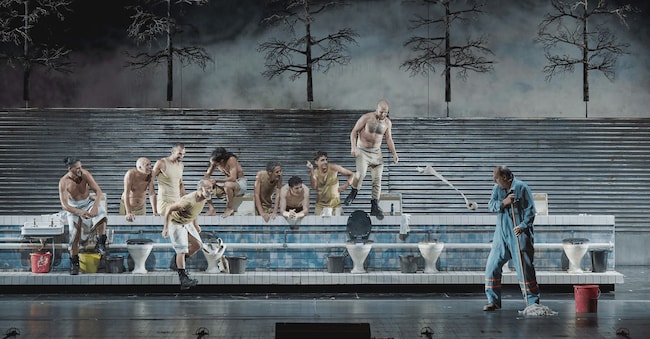
The English director has a keen ear; she is one of the few capable of visualising the structural framework of a score. Here, her work becomes a dual exercise: a virtuosic performance that mirrors Berg’s rigorous rhythm – cold, precise, essential. That is why it touches your heart. The stage is already set as you take your seat, and you hardly notice that there, right in front of you on stage, is a row of toilets – the lowest-grade public loos – where extras enter, urinate, and leave. Emaciated, filthy, so much like the decay that surrounds us and to which we’ve grown accustomed. Warner is right: the scene is a continuation of the poverty we stumble upon on our way to the theatre. Here, as in London, as everywhere. The play’s dramatic backbone is a small, white curtain, almost like a street-theatre sheet: it rises and falls at every stage of *Wozzeck*. Behind it, with the acrobatic virtuosity of the stage machinery (the technicians are brilliant, truly superb), the various settings are constructed: the countryside with seven dry, uprooted saplings; Marie’s room; the street; the tavern; the barracks.
Empty, full, empty: first, the cot of Wozzeck’s child, where you can see – just as if you were at the cinema – the hand of Marie, the mother, nervously tucking him in; in the scene at the tavern, the wretched patrons pour in in droves, like discarded scraps, and the pianist has to play that old, out-of-tune upright piano (exactly as Berg intended) whilst standing, the instrument missing its lid and swaying like a tramp, ungainly and unpleasant. Shortly afterwards, Wozzeck will kill Marie: seen in profile, he and she, and once again all around is the void of a slimy black glaze that advances – blood or water – her body lying in the foreground, after the knife blows to her stomach. The single blow to the neck is more brutal than expected; the stabs to the womb are even more savage. Adam Silverman’s lighting – which is fundamental – shifts from the objectivity of on-stage naturalism to the modern effect of dazzling the auditorium, with a golden glow bouncing off the curtain’s fabric and engulfing the audience. It goes without saying how crucial Hyemi Shin’s set design, Nicky Gillibrand’s costumes and Kim Brandstrup’s spot-on ‘common folk’ dances are.
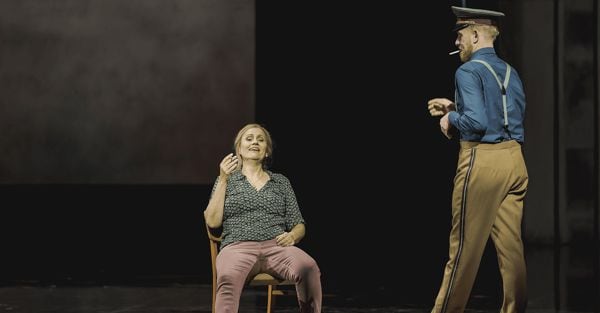
And the cast is perfect – because with such profound direction, every performer is exemplary – featuring Anja Kampe, brought over from London, who is now the new Waltraud Meier (unforgettable, in Paris with Barenboim and Chéreau, a thing of the past) and Helena Rasker in the small but crucial role of Margret. The male cast, too, features one outstanding performer after another: so vividly characterised: Wolfgang Koch’s abyss of despair, the perfect baritone for Wozzeck; Clive Bayley’s cynical Doctor; Wolfgang Ablinger-Sperrhacke’s coarse Hauptmann; and Ian Koziara’s elegant Drum Major. Thomas Guggeis conducts, and the Maggio Orchestra, Chorus and Children’s Choir respond flawlessly: the cohesion of the interpretation is the young maestro’s greatest strength. In time, the ‘piano’ and ‘pianissimo’ passages will also emerge, and above all the rhythmic character of the folk forms. And the nostalgia, just as in Mahler. But these are feelings that are learnt.