Scenarios

Xi Jinping launches the BRICS Open-Source AI Zone and strengthens cooperation as an alternative to the West

At the New Delhi summit, Xi proposed a technological and trade alliance for emerging economies, with the aim of creating an alternative to US hegemony and an integrated market within the Global South.

from our correspondent Marco Masciaga

Aggiungi Il Sole 24 Ore
ai preferiti su Google
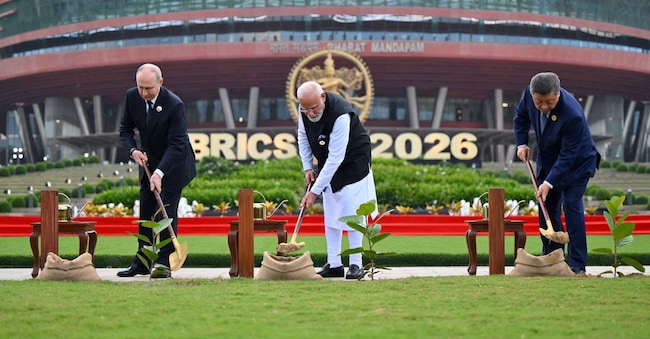
Il presidente russo Vladimir Putin, il primo ministro indiano Narendra Modi e il presidente cinese Xi Jinping partecipano a una cerimonia di piantumazione congiunta durante il vertice dei BRICS a Nuova Delhi, in India, il 12 settembre 2026. Ufficio stampa indiano/Foto fornita tramite REUTERS via REUTERS

3' min read

Translated by AI
Versione italiana

3' min read

Translated by AI
Versione italiana

NEW DELHI – The BRICS summit in New Delhi concluded on Sunday with Chinese President Xi Jinping of a series of initiatives to boost cooperation between emerging economies and reaffirm Beijing’s ambition to act as a spokesperson for the countries of the Global South, offering them an alternative to tariff barriers and US hegemony in the field of artificial intelligence.

Xi emphasised the need to step up cooperation, maintain the stability of industrial and supply chains, and develop an integrated market, stressing that the Greater BRICS (the organisation’s member countries and those that may join in the future) should set up innovation incubators, modernise traditional industries, develop emerging sectors and lay the foundations for the industries of the future.

Loading...

‘Greater BRICS’ is a term used by China to refer both to the ten members of BRICS – Brazil, Russia, India, China and South Africa, recently joined by Iran, the United Arab Emirates, Egypt, Ethiopia and Indonesia – and to around ten partner countries taking part in the summits. Among those present in New Delhi were Nigeria, Thailand, Saudi Arabia, Malaysia and Vietnam.

Beijing’s role in AI and trade

The Chinese President has announced that China will take a leading role in establishing a BRICS Open-Source AI Zone, with the aim of promoting cooperation in the field of artificial intelligence, large language models, training and an open AI ecosystem. The BRICS countries must ‘strengthen cooperation in the field of artificial intelligence, promote open source, openness, collaboration and sharing’, said Xi.

On Saturday, Xi had invited the BRICS countries to join a new organisation promoted by Beijing, which brings together nearly thirty states and is known as the World AI Cooperation Organisation. Xi also proposed a partnership between the BRICS Special Economic Zones and announced that China will host a forum next year – when it holds the organisation’s rotating presidency – to strengthen trade ties and investment.

Vertice Brics, foto di famiglia al vertice in India

Modi takes a hard line on rare earths

The solutions developed within the BRICS, said Indian Prime Minister Narendra Modi as he opened the proceedings on Sunday, should not be limited to the group’s members alone, but should be adaptable and accessible to the needs of the entire Global South. On a less conciliatory note, the Indian leader warned that the ‘exploitation of technology and critical minerals’ could hinder global development and shared prosperity. This was a reference to China’s ambitions in the AI sector and Beijing’s near-monopoly on rare earths.

Pandemics, climate-related disasters and supply chain disruptions have shown that, in today’s interconnected world, no crisis remains confined to a single region,” Modi added, announcing that the bloc had agreed to establish an integrated early-warning system for infectious diseases, aimed at strengthening preparedness and response capacity for future epidemics.

The conflict in the background

The New Delhi summit took place against a backdrop of severe geopolitical tensions, with fighting resuming in the Gulf and the Tehran-backed Houthis in Yemen having extended the conflict to Saudi Arabia. However, on Saturday the summit achieved a diplomatic breakthrough, succeeding in reaching consensus on a statement backed by countries on opposing sides, such asIran and the United Arab Emirates. The statement condemned unilateral acts of aggression, expressed deep concern at the recent escalation, and called on all parties to exercise the utmost restraint.

Separately, the Iranian president Masoud Pezeshkian met the Crown Prince of Abu Dhabi, Khaled bin Mohamed bin Zayed Al Nahyan, on the sidelines of the summit, in the highest-level dialogue between the two countries since the start of the conflict. The two leaders discussed de-escalation, regional stability and initiatives aimed at promoting peace and development.

Copyright reserved ©
Loading...

Brand connect

Loading...

Newsletter

Notizie e approfondimenti sugli avvenimenti politici, economici e finanziari.

Iscriviti