
Xiaomi prepares to enter the European market with its high-tech cars
At the international exhibition in Beijing, Xiaomi announced its arrival in Europe next year and at the same time the establishment of a new research and development centre for electric cars in Munich. Aggressive pricing, hyper-technological solutions, and a premium positioning characterise the Xiaomi offering

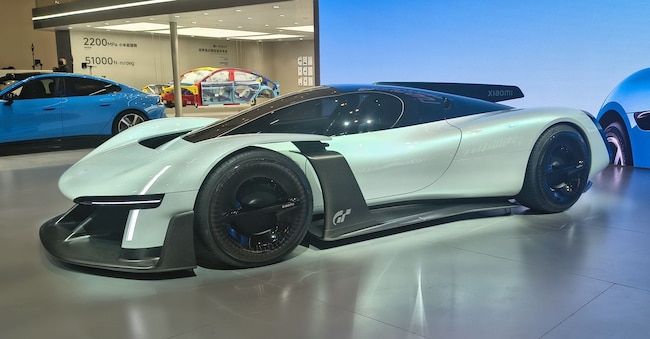
Auto China 2026 is the framework chosen by the Chinese manufacturer to announce its landing in Europe: immediately with a Munich-based research and development centre for electric cars, and next year with its own cars. It will consist of a team of engineers from European manufacturers led by Rudolf Dittrich, with 15 years' experience at BMW. At the Beijing International Motor Show, Xiaomi also unveiled the Vision GT concept, which European operators were able to admire a few months ago at the Mobile World Congress in Barcelona, and the GT version of its YU7 suv, while maintaining the utmost reserve on the timing of its release.
The value of the Xiaomi ecosystem
The idea of uniting devices for humans, the home and machines is what prompted the Chinese manufacturer to launch into the automotive market. One of the strong points of the Xiaomi proposal is in fact the integration with smart devices and smartphones: thanks to a single operating system (Hyper OS), the devices are designed to interact with each other. From your mobile phone, you can open doors, control parameters and set charging, while from the car, you can control your devices at home, even if only with your voice. For example, when you drive away, the car is able to turn off all the lights, appliances and close the curtains, as well as automatically activate the air conditioning when it notices that you are coming home.
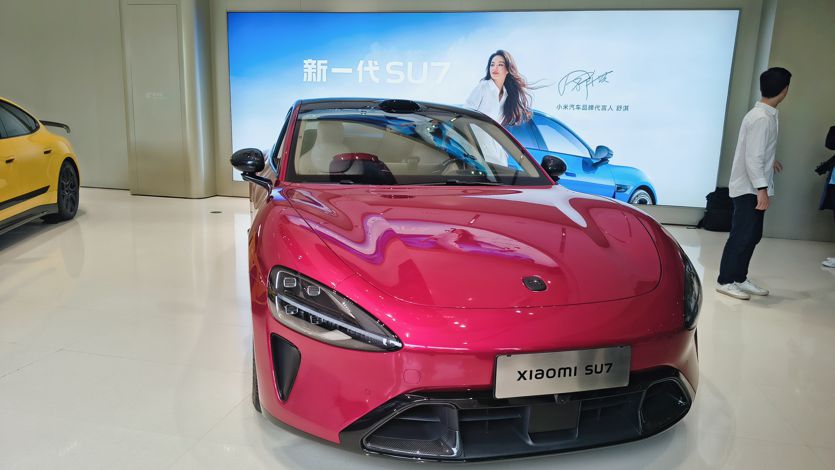
But hypertechnology is not the only added value of the Xiaomi cars: quality materials such as leather, carbon fibre and alcantara, fine finishes and a builder's dynamic with years of experience make the cars extremely interesting, especially considering the rather aggressive prices. In China, the SU7 costs between 27,000 and 38,000 euros, although it is far too early to project these figures onto possible European prices. The design, needless to say, is reminiscent of some Porsches, but the impression we got at Auto China 2026 was that the manufacturer was certainly not the only one to be 'freely inspired' by European production cars.
A young story
The Chinese manufacturer, which can boast the worldwide sale of more than one billion smartphones and smart home devices, announced in 2021 that it would enter the automotive market, and the first model, the SU7 sedan, hit the market in October 2024. Last year saw the unveiling of the YU7 electric SUV and most recently the SU7 Ultra hypercar. In less than two years and without any 'history' in this sector, Xiaomi has sold 650,000 cars in the certainly large but equally competitive Chinese market alone. The Xiaomi brand in China is particularly strong, thanks to an extremely passionate fan base, the enormous popularity of CEO and founder Lei Jun and, last but not least, the spread of all kinds of smart devices for the home.
Even from a 'mechanical' point of view, Xiaomi is surprising for the speed with which it seems to have brought itself up to par with brands with decades of history: the hypersport SU7 Ultra is a monster capable of developing, with its three electric motors, 1,550 horsepower and more than 1,750 Nm of torque, of reaching 100 km/h in less than two seconds and of reaching a top speed of 350 km/h, electronically limited.

