What’s new

Xpeng L03, the Chinese coupé SUV with ‘physical’ AI that takes on Tesla

Designed for the global market, the new model – which is available in fully electric and extended-range versions – embodies the brand’s most advanced proprietary technologies, notably an innovative driver-assistance system.

4' min read

Translated by AI
Versione italiana

4' min read

Translated by AI
Versione italiana

With the L03, Xpeng is setting its sights not only on premium European brands – as it has done so far with the P7+ – but also, much more decisively, on Tesla, thanks to the massive array of technologies designed and driven by physical AI. The L03 is not the typical Chinese SUV adapted for export, but a model designed for distribution across sixty-four markets, into which it enters with a host of innovations developed in-house by Xpeng to make it highly user-friendly.

Xpeng L03: powered by a lightning-fast processor and physical AI

Loading...

The new coupé SUV is the second model in China to form part of the Mona series – an acronym for ‘Made of New AI’, meaning created using new artificial intelligence. Therefore, first and foremost, we must describe what stands out in its software-defined architecture: namely, the AI Touring chip developed by Xpeng. In the case of the L03, depending on the version, the processor may feature one or three modules, each with 750 TOPS, for a total of 2,250 TOPS, capable of processing trillions of operations per second.

Xpeng L03, le foto del suv cinese software defined

Photogallery9 foto

This computing power drives the NGP (Navigation Guided Pilot – VLA 2.0) system, which is based on physical AI that processes far more data than its digital counterpart. The system does not rely on high-definition maps or LiDAR, but solely on cameras and ADAS to perform manoeuvres in real time without any intermediate ‘linguistic’ steps, enabling the SUV to follow pre-set routes autonomously. In fact, the system is capable of instantly translating what it sees into actions, based on a proactive rather than reactive approach – just as, after all, an intelligent driver should always do. Furthermore, the L03 marks the launch of version 6.0 of the cockpit’s software architecture, which, thanks to integrated AI, optimises human-machine interaction, particularly with the infotainment system. In this regard, Xpeng is taking advantage of the coupé SUV’s launch to announce its partnership with Google Maps Auto SDK, through which the brand will develop its own navigation system, thereby avoiding the need to download the Google Maps app or use smartphone mirroring. Naturally, it will be Google Maps’ mapping data that underpins the basic XPilot driver-assistance system and the more sophisticated NGP – VLA 2.0 system.

Xpeng L03: powertrains and other technologies

The L03 range includes fully electric and EREV (extended-range electric) versions based on a 400-volt architecture. The electric version is powered by a rear motor delivering 249 cavalli and 280 Nm of torque, which can be paired with 56 or 69 kWh Lfp batteries from Cabl, resulting in standard and long-range versions, promising ranges of up to 520 kilometres on the WLTP cycle. As for charging, Xpeng currently states only that a charge from 10 per cent to 80 per cent takes twenty minutes using direct current, without specifying the power output. A twin-motor version with all-wheel drive is derived from this model.

The L03 Erev combines the electric powertrain with a 1.5-litre petrol engine producing 95 cavalli to recharge the 37.2 kWh battery from Eve Energy, enabling it to travel 315 kilometres with zero emissions. By also utilising the 42 litres of petrol in the tank, this L03 is rated as having a total range of over 1,000 kilometres.

View our price list

To combine dynamism with comfort, Xpeng has developed the Anti-Motion Sickness 2.0, which prevents travel sickness by optimising the linearity of power delivery and braking; this system can deliver maximum efficiency when combined with the AI-controlled adaptive suspension. Furthermore, it has added stability control to its safety systems, operating at speeds of up to 180 all’ora in the event of a tyre blowout.

Xpeng L03: balanced and highly aerodynamic design

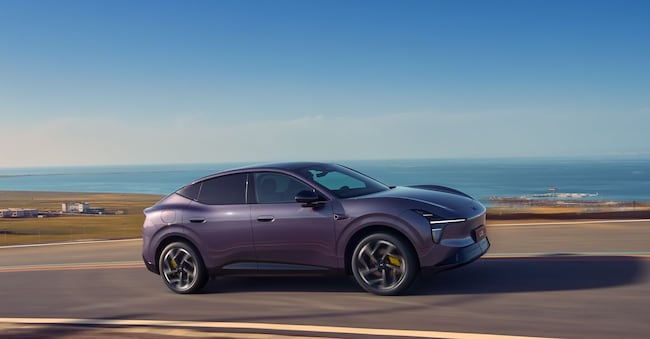
Whilst it is not a benchmark in terms of originality – given that, particularly from the side, the L03 bears a resemblance to certain Tesla models – the SUV has a pleasing and well-proportioned appearance, with the roofline sloping down towards the rear being the feature that most clearly sets it apart amongst those inspired by the world of coupés. It also fits into this category thanks to the clean lines of its surfaces and stylistic features that lend its appearance a certain muscularity. However, the design’s impact extends beyond mere aesthetics, as it is also the result of considerable attention to aerodynamics, culminating in over twenty solutions incorporated into the bodywork which have enabled a drag coefficient (Cx) of just 0.22 to be achieved; according to the manufacturer, has increased the range by 59 kilometres. This achievement can be attributed to the experience gained at Ferrari and Genesis by the brand’s head of design, JuanMa Lopez.

The Xpeng L03: spacious and minimalist to a fault on the inside

Xpeng’s latest model is a mid-size SUV, measuring 4.65 metres in length, 1.89 metres in width, 1.60 metres in height and with a wheelbase of 2.85 metres. This dimension is the main factor behind the generous interior space, which, incidentally, is not compromised in the rear by the sloping roofline. The well-designed interior follows a minimalist style, particularly with its clean-lined dashboard, which features a 15.6-inch touchscreen display in the centre for thealways-connected infotainment system, but which features no physical switches – much to the detriment of ergonomics – although some vehicle functions can be controlled via the AI-powered voice assistant. The interior features numerous storage compartments, some of which are very spacious, such as the one on the centre console between the seats, near the panel with two slots for charging smartphones. Finally, the L03’s cabin also features electrically adjustable, ventilated, heated front seats with a massage function, whilst the rear seats also feature electrically adjustable backrests.

The list price – excluding road tax and vehicle registration tax – for the Bev versions ranges from €35,000 for the standard range to €47,000 for the all-wheel-drive version; the REEV costs €38,000.

Copyright reserved ©
Loading...

Brand connect

Loading...

Newsletter

Notizie e approfondimenti sugli avvenimenti politici, economici e finanziari.

Iscriviti