
Xpeng launches robotaxi with the computing power of a supercomputer
Chinese brand from Guangzhou unveils a mass-produced machine capable of 3 million billion floating-point operations per second

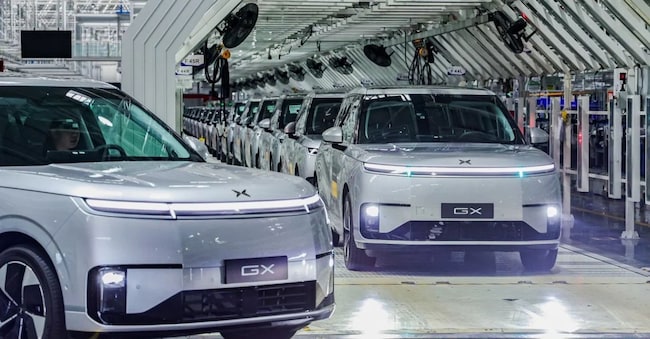
Xpeng has unveiled the first mass-produced Robotaxi in China developed in-house and based on an automotive platform built by the Chinese brand. Today's launch underlines the brand's commitment to the vertical integration of hardware, software, artificial intelligence models and vehicle engineering for autonomous driving, amid growing competition in China's autonomous mobility sector. Xpeng's Robotaxi division plans to start demonstration tests as early as the second half of this year, with the aim of accelerating the commercialisation of the new autonomous mobility service.
All the special features introduced by Xpeng on its first Robotaxi
The Robotaxi service, according to Xpeng, is designed to combine the comfort of a high-end cabin with advanced autonomous driving functions based on artificial intelligence. The Robotaxi features tinted windows, zero-gravity reclining seats and an automatically activated rear passenger entertainment display. Occupants can access travel information, stream entertainment content, adjust cabin settings and interact with the voice assistant Xiao P
The combined computing power of 3,000 TOPS is the highest today
Produced on Xpeng's GX platform, the Robotaxi is equipped with four internally developed Turing AI chips offering a combined computing power of 3,000 TOPS, or 3 million billion floating point operations per second. This represents the highest on-board computing capacity currently available in a production vehicle globally. The Robotaxi also integrates the second-generation AI VLA model that enables Level 4 autonomous driving functions under certain operating conditions. In January, Xpeng received approval to conduct road tests in Guangzhou with intelligent connected vehicles to start using Level 4.
Planned a business unit dedicated exclusively to Robotaxis
In March, the carmaker formally established a business unit dedicated to Robotaxis, responsible for overseeing the planning, development, testing and operational implementation of the product, ahead of its commercial launch. Compared to many other autonomous driving systems, Xpeng's Robotaxi platform does not rely on LiDAR sensors or high-definition mapping, but uses a different approach in addition to its second-generation VLA model to manage driving decisions in real time, so that system responses are guaranteed to be less than 80 milliseconds.
The brand opened its development kit
Xpeng believes that the simplified structure improves reaction speed, decision-making accuracy and adaptability to different driving scenarios, thus laying the foundation for future expansion also internationally. Last year, Xpeng stated, at an early stage, that it intended to open up its software development kit for Robotaxi to external partners as well, with the aim of securing a broader strategy in development programming

