Middle East

Supertanker ablaze in the Strait of Hormuz, fresh raid on Aramco sites

West Bank: Israeli settlers attack a convoy of European diplomats. The attack took place in the village of Taybeh during the olive harvest. Clashes have also been reported between some Israeli civilians and several Palestinians in the Beit Lid area, where one Israeli was injured.

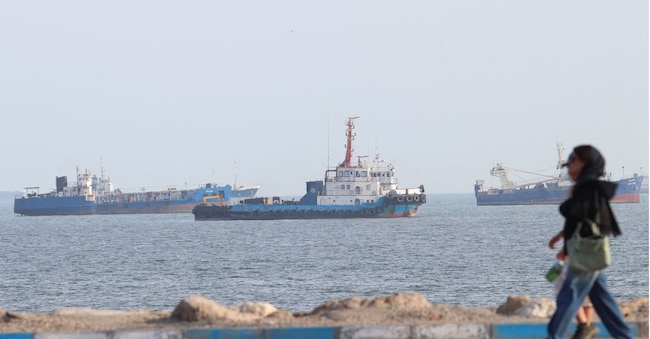
Navi nello Stretto di Ormuz, nei pressi della spiaggia di Bandar Abbas, in Iran, 13 ottobre 2026. Razieh Poudat/ISNA/via WANA (West Asia News Agency) via REUTERS via REUTERS

4' min read

Translated by AI
Versione italiana

4' min read

Translated by AI
Versione italiana

The Hormuz trap. Two supertankers carrying over two million barrels of oil caught fire after striking mines, whilst at the same time Houthi attacks, backed by Tehran, kept Saudi forces occupied in the Riyadh region and the eastern part of the kingdom, where Aramco’s oil facilities were once again “hit by a fire”. Against this explosive backdrop, the Yemeni rebels themselves have in turn denounced a massacre carried out by the Saudis in the Taiz area and in the province of Dhamar, with twelve victims, including three children.

It was the Pasdaran Navy which, in the early hours of the morning, announced that a “illegal oil tanker” carrying over 2 million barrels of crude oil, which was attempting to cross the Strait of Hormuz on an unauthorised route, had been involved in an incident following “an explosion”. Then, in the late afternoon, the Revolutionary Guards themselves reported that another oil tanker, also carrying over two million barrels of crude oil, had caught fire after striking mines, again in the Strait of Hormuz.

Loading...

The stretch of sea separating the Gulf monarchies from Iran, which claims control of this strategic waterway, through which a fifth of the world’s hydrocarbons used to pass before the war unleashed in late February by Israel and the US, has now become a deadly trap for vessels attempting to cross it. According to the Wall Street Journal, Tehran is continuing to support the Houthis in launching increasingly powerful and sophisticated attacks against Saudi Arabia and its Yemeni allies – such as last week’s attack in Riyadh, which left 13 people dead – thereby tightening the pincer grip on the Wahhabi Kingdom.

West Bank: Israeli settlers attack convoy of European diplomats

According to the Times of Israel, citing Army Radio, vehicles carrying diplomats from France, Belgium and Poland were attacked by Israeli settlers in the village of Taybeh whilst they were harvesting olives.

The Israeli army has stated that it condemns the “serious” attack carried out today by settlers against European diplomats in the West Bank, whilst pointing out, however, that the visit had not been coordinated with the armed forces. “The IDF strongly condemns the serious act of violence that took place in the Taybeh area, during which diplomatic representatives were attacked by Israeli troublemakers,” the army said.

The armed forces have reported that police officers are entering the area, escorted by the IDF, to gather evidence and witness statements for the purposes of the investigation. “The consulate’s visit had not been co-ordinated with the IDF,” the army said, adding that “such co-ordination is important to prevent incidents of this kind”.

IDF sends troops to Beit Lid following an attack by settlers on Palestinians

The IDF reports that it has deployed forces near the Palestinian village of Beit Lid, in the north of the West Bank, “following reports of clashes between a number of Israeli civilians and several Palestinians in the area, during which an Israeli was injured”. According to Ynet, a group of settlers arrived in the area to prevent the olive harvest, attacking Palestinians and the activists accompanying them. There are also suspicions that the settlers stole a vehicle which was subsequently involved in an accident that left at least one person injured. The IDF states that further details will follow.

Houthis: “Saudi attacks have claimed 12 lives, including 3 children”

Saudi air strikes that began overnight have killed at least 12 people in Yemen, including three children, according to the Houthis. The news agency of the Iran-backed group reported that today Saudi warplanes struck “civilian homes” in the governorate of Taiz, killing nine people and injuring 16; the agency also added that there are still people trapped under the rubble. Earlier, the same source had reported night-time attacks in Dhamar province, which killed three children and injured a further 17 people. The raids were reportedly carried out “using cluster bombs, weapons banned under international law”.

Iran steps up support for the Houthis

Iran has stepped up its military support for the Houthi rebels in Yemen, helping to make attacks against Saudi Arabia and its Yemeni allies more sophisticated. This is according to the Wall Street Journal, which cites sources close to Saudi and Yemeni intelligence, who claim that Tehran has provided intelligence, training, tactical advice and assistance in identifying targets for missile and drone operations.

Increased Iranian support is believed to have facilitated the rapid territorial advances of the Tehran-backed militias, which now control the Yemeni coastline along the Bab el-Mandeb Strait. This is a strategic chokepoint for international maritime traffic and for the energy routes linking the Red Sea to the Gulf of Aden.

Loading...

Trump: Israel has helped Saudi Arabia

On the diplomatic front, US President Donald Trump has stated that Israel has provided assistance to Saudi Arabia in its military offensive against the Houthis. Responding on 16 October to a question from the press about whether Riyadh would accept Israeli support, Trump replied: ‘Yes, certainly’, adding that he believed the Saudis would accept such assistance.

As the Times of Israel reports, last Tuesday Israeli Prime Minister Benjamin Netanyahu was asked whether Saudi Arabia had requested assistance from Israel. “There is hardly a single state in the Middle East that does not ask us for help,” Netanyahu replied. Trump’s comments also touched on the prospect of normalising relations between Israel and Saudi Arabia, a diplomatic objective pursued by Washington. When asked whether the issue was back on the table, the US President replied in the affirmative: “Yes, I think so. Perhaps more than ever.”

Copyright reserved ©
Loading...

Brand connect

Loading...

Newsletter

Notizie e approfondimenti sugli avvenimenti politici, economici e finanziari.

Iscriviti