Film Festival

"Yes, exactly": Robert De Niro's lecture in Cannes

In a packed hall, the 'Taxy Driver' actor was interviewed by JR with whom he is making an intimate film

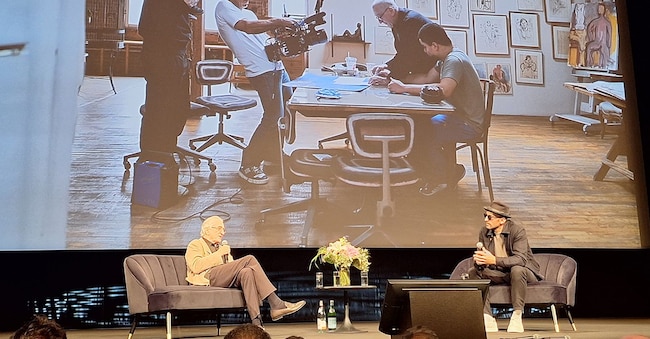
Robert De Niro durante la lectio Magistralis al festival del cinema di Cannes

5' min read

Key points

  • The standing ovation
  • The project with artist JR
  • The obsession to conserve
  • The film seen together with the audience

5' min read

Leonardo DiCaprio, in presenting the Palme d'Or for Lifetime Achievement to Robert De Niro last night, warned the audience: 'Giving Bob more than one Yes, exactly is tough'. We all realised this today, in the anxious audience who queued up for an hour to get there in time to take their seats for the lectio magistralis of 'Bob'. Not only journalists or film critics, but also actresses and actors waiting for his word, fans and enthusiasts who managed to secure a ticket.

The standing ovation

.

A cheerful crowd that gave a standing ovation perhaps even longer than last night's at the opening ceremony. De Niro exhibits that crooked smile we all know from Taxi Driver to Once Upon a Time in America to Raging Bull to Killers of the Flowers Moon. And we get a little excited that he's showing it off just for us in his beige jacket, polo shirt and brown trousers, as if he's in his living room at home.

Loading...

The project with artist JR

.

This is indeed the atmosphere, as visual artist JR, who has been making a visual narrative about De Niro's family for years (in 2017 we had seen him with Agnés Varda in Visages Villages), climbs up on mirrors to give the audience the juicy morsel they expect from his idol.

Yap, yap mostly Bob replies, laughing under his moustache, to JR's complex questions. And we, at the end of the day, are with Bob, even as we grieve for JR.

Let's take a step back: JR had met De Niro through Jane Rosenthal, De Niro's partner at the TriBeCa Festival, when he moved to NY at the age of 27. They became friends and Bob took him around with him. Until, three years ago, he takes him to the studio of his father, who was a painter.

 JR projects a large image onto a screen: there is JR with his son straddling his shoulders and Robert De Niro with his son Elliot, the latter drawing on the work table in De Niro's father's studio. In the middle is the cameraman of this film in fieri, Roberto De Angelis. Bob shows him his father's paintings and explains that the studio is untouched since his death decades earlier. Cigarettes, brushes, everything is still in place as he left it.

"I wanted to keep everything intact for my children," De Niro, who has seven children from four different relationships, explains with effort. 'Obviously my older children knew their grandfather, but my younger children did not. So I preserved the practice, I kept it intact like that. It was important to me and to them. I also took pictures of the studio, but I also wanted the children to experience the space'.

La lectio magistralis di Robert De Niro

Photogallery4 foto

The obsession to conserve

.

De Niro also keeps objects from the films in which he acts.

"I realised that people sometimes took objects away on set, as if they were souvenirs, and, instead, I wanted to keep them for myself because they were part of the film. Over the years I accumulated so many papers and things that I had to hire an assistant".

The project between JR and De Niro came about a bit by chance. With the occasion of a small exhibition in Ny in honour of his father, JR had the idea of filming De Niro in his father's studio. No more than 20 minutes, a kind of social media spot, for the younger generation so that they would be more aware of an artist called Robert De Niro Sr., of Irish and Italian descent, also called Roberto De Niro. When Roberto De Angelis (on camera) and JR entered the studio, Bob also handed JR his father's diaries, which Bob had never read. So after reading Robert Senior's diaries JR returned to the studio with De Angelis and instead of 20 minutes, the shoot lasted five hours.

Thus was born this project that does not yet have a precise duration and direction.

"We don't have to worry about having a deadline," De Niro says slyly, and the audience, won over, laughs. "I did another documentary about my father, but it was for HBO. I had a deadline and did it myself, but this time I felt it had to be something more. Because it's not a painting where you have to buy brushes and canvases, but it's a much more expensive medium and we need a lot of money we don't have to worry about when it will end.

Bob's mocking smile towards Jr, general laughter from the audience.

The film seen together with the audience

At one point JR announces that we are going to see a part of the film and De Niro is also going to watch it with us for the first time. So JR comes down the stairs dragging Bob and brings him into the audience to watch the film.

It is indeed a charming clip in which De Niro is seen conversing with a giant picture of his father and one of him as a child, while Martin Scorsese admires them from a scaffold. And then De Niro symbolically dragging his father's gigantograph up the mountain among the sheep, or sleeping on it. Then we realise that in turn the blow-up is lying on a meadow, that he is lying on a barge sailing on the sea, as we later realise from the final shot of a drone filming everything from above.

The audience is bewitched: it is like entering De Niro's life and wounds, a kind of therapy suggests a spectator from the audience. Not only the father, but also the mother. An unconscious and unknown process that one does not know where it leads.

Both agree that the further one goes, the more painful it is. And in addition to the diaries, Bob also kept hours and hours of recordings: images of when he was young, of his mother (who painted) appear. De Niro only handed over the reels six months ago. 'I had them and they were there. I knew I had them,' De Niro shrugs.

And here begins the real ping pong of the absurd with very long questions and answers that are as short as they can be. We get to the subject of death. "Are you scared?" asks JR. 'I don't have a choice,' De Niro is amused to answer, but then returns to his father: 'I should have spent more time with him, but maybe part of me didn't want to. Children want to go out and live their own lives, experience things for themselves and they don't want to remember negative things. He was very dear, he genuinely adored me and so I adore my children. I wish I had spent more time with my children when I was young. I wish I spent more time with them now.

Then there is almost nothing left and questions from the audience begin. Some people talk about themselves and he comments: 'OK'. Some ask him questions about the danger our democracies are in, since the day before he had spoken of autarchies and fascism.

"People have to fight for their rights. People know what the right thing to do is. Those who have power and do not do it, know that they do not do the right thing and do not want to do it'.

Then a budding actor asks him for advice on how to approach his part: 'Joe Pesci says:

"When in doubt, have no doubt. If the director tells you where to go, follow him. But the most important thing is that you feel good, you have to be smart enough to follow your instincts".

We are at the end, no amarcords or anecdotes. And on the future of cinema. "I don't know where cinema is going. I just know that seeing the cinema in a hall or alone is a very different experience. Nothing is like the hall, the hall is special'.

Copyright reserved ©
Loading...

Brand connect

Loading...

Newsletter

Notizie e approfondimenti sugli avvenimenti politici, economici e finanziari.

Iscriviti