
You learn about history by setting out on a journey
The Liberation Route Italia project, supported by the regions of Tuscany and Emilia-Romagna: a route from Sant’Anna di Stazzema to Marzabotto, so that we never forget what Nazi-Fascism was like

It was the most dramatic, bloodiest and, at the same time, the turning point for Italia under the Nazi-Fascist dictatorship, with the liberation of Rome, Florence and – moving northwards – the most ravaged areas of the North. In the summer of ’44, those fighting for the democracy that was to arrive within a few months paid a very high price. Not only partisans and soldiers from the Allied forces, but also defenceless civilians, women and children were brutally murdered. These massacres, which we commemorate every year on anniversaries when the pain of such savagery is renewed, are a wound destined never to heal.
To keep the memory alive, but above all to gain a deep understanding of what that turning point in our history entailed, Liberation Route Italia has launched the initiative Cammino 44: a commendable, informative and exemplary project in the etymological sense of the word. An example for our region to follow.It is a route which, as its name suggests, takes us back to that crucial year, organised by the association along the Tuscan-Emilian Apennines in collaboration with the Regions of Tuscany and Emilia-Romagna (a commendable achievement in itself: it is not always possible to carry out joint projects). The route stretches for 188 kilometres: it begins at a symbolic site such as Sant’Anna di Stazzema (Lucca) and ends in an equally significant area, the Monte Sole Park (Marzabotto, in the province of Bologna). Along the way, the route passes through fourteen municipalities, each deeply marked by history.
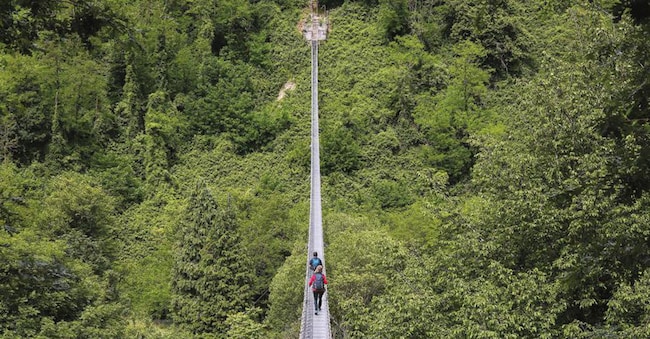
At last, as you walk through the woods and across bridges, crossing rivers, arriving in small villages and pausing amidst nature, you come to understand what the Gothic Line was – the German defensive barrier that is not simply a ‘line’: it extends some thirty kilometres deep and makes use of the surrounding mountains and watercourses. Hidden within the folds of this landscape are bunkers, dugouts and trenches; minefields are laid out and fortifications are built: the Germans spared no effort in the spring of ’44, and stepped up their efforts in the months that followed, when the 16th SS Division began a veritable manhunt. This division alone was responsible for some fifty attacks and 1,500 deaths.The contrast between the tranquillity and beauty of these places along the route and what took place here 80 years ago is disarming. The greenery, the high sky and the silence clash with the image of the terror experienced by families and the ruthlessness of the massacres. The shelters with their kilometre-long tunnels, the embrasures from which rifles were fired, the barbed wire and the anti-tank walls bear the scars of war: observing them means experiencing, with intensity and immediacy, the senseless everyday reality of the conflict. It also means being inspired to find out more, and to feel gratitude towards those who fought alongside the partisans: soldiers of many nationalities (alongside the Americans and the British) whom we often overlook in our accounts. The Brazilians who liberated Camaiore, the African Americans in action at Bagni di Lucca, the Canadians who would advance, in December, to Forlì and Ravenna. Along with them, all the others.
The emotion one feels standing before the little church of Sant’Anna di Stazzema, in an almost unreal tranquillity, is indescribable. This feeling is heightened later by the account of a survivor, Adele Pardini: she was eight years old and lost her mother and her sisters, including Anna, who was just forty days old. She is moved as she recalls the massacre, even though it is yet another (painful) testimony. Every year we commemorate that 12 August 1944. But being there is different. It is already different just getting there, imagining the treacherous and terrible landing of the enemy who had but one objective. And feeling horrified at the thought of that little square, in front of the façade of the sacred place, the repeated executions, then the raids on the houses, the people hunted down with no chance of escape. Standing there, in silence, is perhaps even more meaningful than visiting the nearby historical museum of the Resistance (which is, in any case, useful for recalling the events of the summer of ’44). There, the belongings of those who were exterminated, displayed in a glass case, remind us of lives cut short for no reason: an alarm clock frozen at 6.50 am (the time of the attack), a doll, a wallet, a hat.
Similar feelings are evoked at Monte Sole Park. At the visitor centre, a large map helps visitors understand what happened in the hamlets of the municipalities of Grizzana Morandi, Marzabotto and Monzuno. Between 29 September and 5 October, the Nazis slaughtered hundreds of inhabitants, destroying homes, burning barns and stables, and wiping out the lives of those who tilled the fields and reared livestock. They annihilated entire communities and generations. Such was the brutality that it prevented any revival: in the post-war period, life never flourished again in Monte Sole. The villages were never rebuilt, and the trauma was never overcome. All that remains are a few ruins, footpaths and woods. As evening falls, no lights can be seen. An absence, etched into the landscape, which, eighty years on, is no less striking than the great memorial at Marzabotto, with its long lists of the victims’ first and surnames.


