
You sound like ChatGpt. So artificial intelligence makes us kinder but more distrustful
It has not even been three years since ChatGPT debuted that artificial intelligence is changing not only how we work and how we study but also how we talk.

4' min read
4' min read
Less than three years have passed since the debut of ChatGPT, and artificial intelligence has already begun to change not only the way we work and study, but also the way we speak. In the linguistic sense of the term. So says a study by the Max Planck Institute for Human Development, which analysed almost 280,000 videos posted on YouTube by academic channels. Result? Since the OpenAI chatbot entered our lives, the way we speak has also been 'modelled'. What does that mean? There are words that we start using without realising it. They slowly enter our lexicon, creep into everyday speech, peep into videos, posts, podcasts. But what if those words come from an artificial intelligence? Some words - such as 'thorough', 'meticulous', 'realm' and 'expert' - have become much more frequent. Up to 51% more than three years ago. But this is no coincidence: according to an earlier study by Stanford University, these are exactly ChatGPT's favourite expressions. And now they seem to be ours too. Hiromu Yakura, first author of the study, puts it this way: 'We are internalising a virtual vocabulary,' he explains. In other words: we are starting to speak like the AI that talks to us every day. Translated: it is not just us teaching machines to speak like humans. The reverse movement has begun. The language of AI 'shapes' us, and not only in the written text. Orality - especially the more reasoned kind, as in educational and academic videos - is absorbing, word by word, the lexicon of large AIs. The change is measurable, not only in quantity but also in quality. Indeed, the analysis compared the trend of words typical of the GPT language with similar terms but less associated with artificial intelligence, noting that only the former have increased markedly since the launch of ChatGPT on 30 November 2022. Not only that: in more than half of the cases, GPT-like words were not read from a script, but pronounced spontaneously. One word, above all, emerges as the linguistic watermark of the new generative vocabulary: 'deepen'. Levin Brinkmann, co-author of the study, calls it an invisible marker, a kind of semantic watermark. If you hear it popping up in a conversation, you may not think about it, but perhaps the long shadow of ChatGPT is behind it. The consequences?
Ai is also changing the way we think
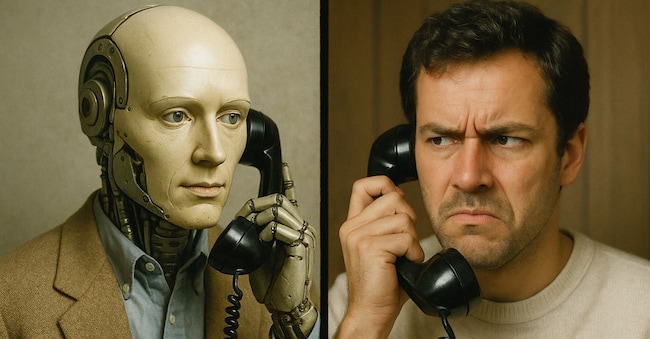
.A research from Cornell University analysed our use of intelligent responses in chats. Basically, they conducted two controlled experiments on about 1,000 participants, using automatic suggestions of short textual responses generated by an artificial intelligence during a chat, email or messaging conversation. They found that the use of Ai makes chats faster, more emotionally positive, and those who use it are judged to be more collaborative. However, if people believe their partner is using AI in the interaction, they rate him/her as less collaborative and more demanding. Basically, it was not the actual use of artificial intelligence that discouraged them, but the suspicion that they were using it. We can call this the paradox of augmented communication. Basically, the more perfect the message, the more suspicious it seems to us. And it doesn't matter whether our interlocutor actually used an Ai or not. The suspicion is enough to alter our perception of him: we judge him to be less authentic, less involved, more 'mechanical'. It is not the actual use of artificial intelligence that chills relationships - it is language itself that, when it seems artificial, alienates us. This is well explained by Malte Jung, associate professor at Cornell and co-author of the study, who tells The Verge: 'We form our impressions based on linguistic signals. And when those signals seem artificial, something in the relationship breaks down'. Basically, it is as if our brain triggers an alarm: 'This sentence is not yours, it is not true'. The thought goes to Blade Runner and systems to detect replicants. According to the researchers, signals can already be detected to understand whether there is a human or a machine on the other side. The dirtier, clumsier and more ironic the communication, the more human it is. Let's take two sentences: 'I'm sorry you're upset' and 'Sorry, I got upset at dinner, I probably shouldn't have skipped therapy this week'. The first is functional and cold. The other is imperfect but alive. The consequence is that of a deeper change. For Naaman, the real risk is not the use of Ai per se, but the loss of our ability to think in our own words. 'Instead of articulating what we think, we simply articulate what the chatbot suggests. And so we become more persuaded, more passive'. And if this pattern spreads, suspicion grows. We only trust face-to-face communication. No longer chats, not even video calls. Because it is only in the body, in the tone, in the spontaneity that one recognises a human being. The rest - even if more efficient - begins to seem too polished, too perfect. Too much like a machine.


