
Young artists in the field for peace
The 'Desires for Peace' exhibition, a small review promoted by the Genti Arrubia association, can be visited in Quartu Sant'Elena until 13 May
by Stefano Biolchini
 Aggiungi Il Sole 24 Ore
ai preferiti su Google

There are small exhibitions that are able to surprise the visitor far beyond the fascination of the most emblazoned exhibitions, all the more so if they are kept in real treasure chests complete with hidden wunderkammer. I was by chance, at the invitation of a friend, to visit 'Desideri di Pace', a small exhibition promoted by the Genti Arrubia association with the support of the Fondazione di Sardegna as part of the Mediterranean Literature Festival. Well, in that ancient Capuchin convent, it was a crescendo of unexpected emotions. Having forgotten the stereotypes and the most frustrated clichés of ready-to-wear goodism, the children of classes 2ªC and 3ªA of the Istituto Comprensivo n. 4 di Quartu Sant'Elena ventured into a veritable excursus on the evils, wounds and lacerations that war entails. Their small installations, collected in tall dark wooden showcases, appeared to me from the outset to be the most authentic representation of what Nelson Mandela used to say: 'Peace is a dream that can become reality... but to build it, one must be able to dream'. Well then, the cardboard boxes, inhabited by figurines and toy soldiers standing out among plywood and paper tanks, have the ability to describe minutely how the most harrowing and acute reality can be alleviated, and perhaps cured, only by the dreamlike desire of those who, with a growing soul and naturally projected into the future, have the natural ability to believe and be able to hope for a better future, where 'flowers sprout from the gun barrels'.
Utopias
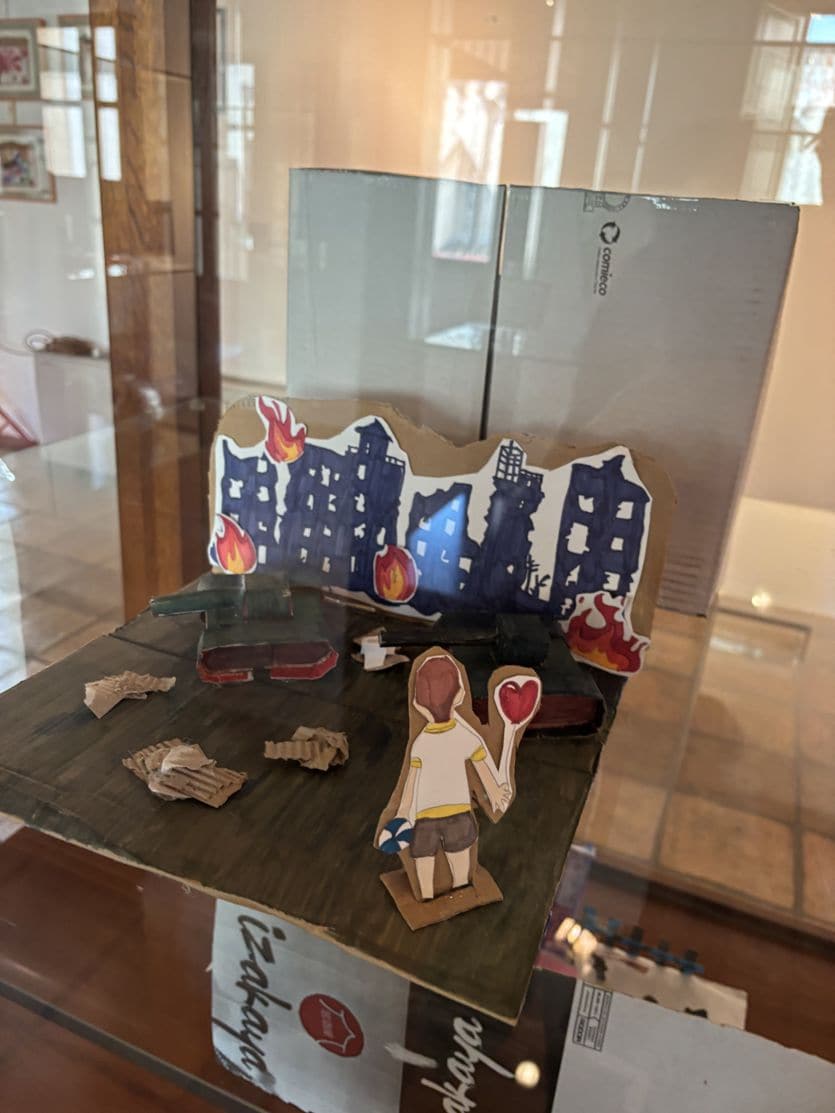
Utopias, but without utopia, the world can only inevitably be worse, as is well attested by a contemporaneity that believes in the strength and domination of the strongest and that inevitably tramples, with its prevailing imperialism, on the last and the weak. So the figurines of these young people, one in particular with a child looking at the burning buildings with a heart-shaped balloon in his hands, like a sign to shout loudly/silently his stop to the destruction of my, and our, future, becomes an emblem, perhaps naive, but so dense with meaning, of a world that, as lacerated as today's, cannot but rely on our young people, who more and more often, even at the head of clumsy 'Flotillas' or only equipped with a pen and tam tam via social networks, prove that they know how to assert their no to wars, genocides or attempts at anti-democratic abuse.
Emilio Lussu
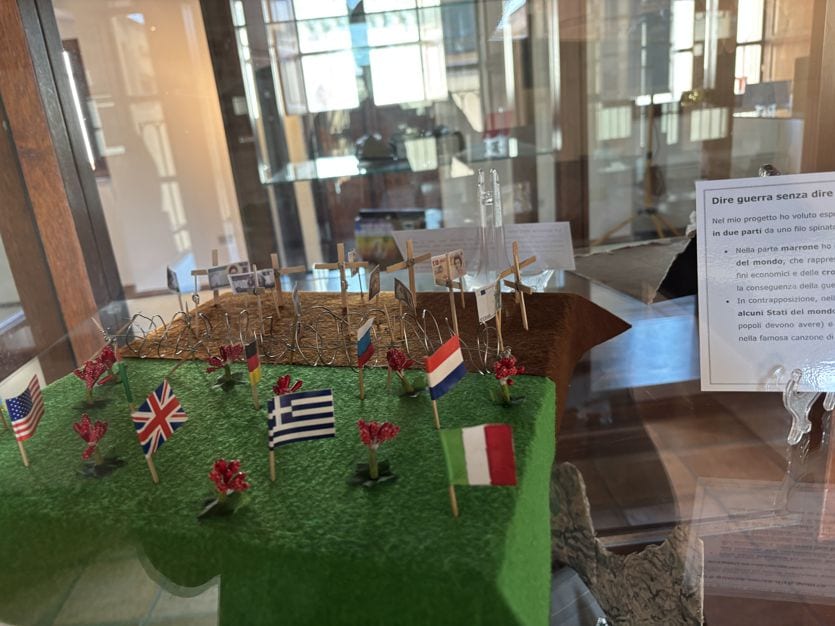
And what can we say about the young author's installation that divided and marked the field between the green of festive flags amidst flowers and the gloom of crosses and banknotes, symbols of a war economy that suffocates and destroys everything, and of a predatory finance for which people are nothing but nothing? With the disarming simplicity of the very young, he has summed up the absurdity of the world without discount, and perhaps it is no coincidence that such mature reflections were born among the fellow countrymen of that Emilio Lussu who so well described the atrocities of the past, where the young Sardinians, brave for a tradition that has always made a virtue out of necessity, were the most atrocious example of how the last of the Italians were sacrificed to the front lines, because for centuries condemned to never having a voice.
Istic summaries
Simply iconic in its political synthesis is the young man who portrayed the UN Glass Palace in flames: his crude political synthesis leaves one stunned by the maturity of his political analysis. No less representative is the small world of the author who, using plasticine, has summed up the pain and anxieties of a mother fleeing the bombardments with her child in her hand, looking back at the world she is leaving behind, just to remind us that the drama of those who are refugees is no less than that of those who live in hardship around the battlefields, and that the terrible time of "courageous mothers and their children" never ends! In the haste of an unplanned visit, I did not jot down the names of these and many other budding artists. Now this writing is just a small remedy and above all an invitation to visit the exhibition. To the young people who have so plastically shown the horrors of war, it only remains for me to express my applause and, above all, an invitation to continue on this path of testimony: this is how conscious citizens are formed who will soon be the masters of the world. This is a good start, and recent events in the Venetian chronicle show very well that we need free citizens and free artists more than ever: is this perhaps the winning combination for a peaceful future?
"Desires for Peace", Quartu Sant'Elena, former Capuchin Convent, until 13 May

