
Young Confindustria: no use floating, we need a vision. EU reacts, it's time for enough
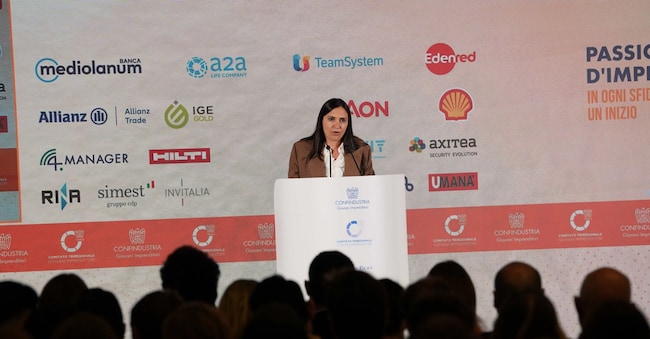
President, Maria Anghileri, from the Rapallo conference of industrialists under 40: 'If the American dream seems blurred today, now is the time to build our great Italian dream'
3' min read
Key points
3' min read
From the Young Entrepreneurs of Confindustria a 'message to Italian politics and institutions: we need a long vision of development. The fundamentals are stable, now let's go further. The moment is now'. The president, Maria Anghileri, from the Rapallo conference of industrialists under 40, warns: 'Italy, Europe's second-largest manufacturer and one of the world's largest exporters, is the country of industry, if in such a country the goal is to float for another 20 years our answer is: no, thank you'. And he says: 'We ask the government to set a new fundamental commitment: the doubling, within the next 10 years, of public investment in the 'Future Chain', which is made up of birth rates, education, innovation, and young companies'. He concludes: 'If the American dream appears blurry to us today, now is the time to build our great Italian dream'.
"EU reacts, it's time for enough"
."We think the time has come for 'enough'. No more fear. No more humiliation. No more complaining. We must react,' warns Anghileri. 'We want new, unprecedented solutions. It is no longer time for endless mediations and exhausting postponements, no longer time for suffocating rules, no longer time for ordinary maintenance. Today it is up to us, the Young Entrepreneurs, to shake up our Europe. And we are not backing down. The 'message to the European institutions' is 'enable us to stay and innovate. Both as citizens and as companies. We do not accept that it is easier and cheaper to do business in the United States. We want to stay here. But to do that we need to change the rules of how the European Union works. We need to make it, at last, pro-business. We urgently need to do industry in Europe, for Europe'. In a broader analysis, the leader of the under-40 industrialists emphasises: 'We ask the Commission to speed up the pace of implementation of the Draghi and Letta reports. In words, the Compass for Competitiveness acknowledges them. In deeds, still not. The reason is clear: 27 countries cannot agree. So we want to say firmly that the pace cannot be dictated by reluctant countries, otherwise we are finished'. And he warns: 'If the time is not ripe to move as one - and unfortunately it is not - let us move in groups that truly share both ends and means, and let us move forward'.
"Italy breaks pact between generations"
.From the Young Entrepreneurs of Confindustria also 'a message, addressed to the whole country: Italy is breaking the pact between generations and the responsibility is collective'. President Anghileri observes: 'If we look at the annual expenditure of public administrations, we can see that the resources earmarked for expenditure "for the future" are few compared to those dedicated to maintaining the status quo, hence "to the present". Out of more than 1.1 trillion spent by 2023, only 9 per cent is dedicated to education, research and development. This is too little'. And he warns: 'We must bet on tomorrow and on our extraordinary talents. We must abandon this Italian 'presentism' not with words, but with concrete choices. We would like the message to get through very clearly that Italy needs its young people more than they need her,' says the president of the Young Entrepreneurs: 'Until now it has been easy to ignore them because they are few. But there is no more short-sighted strategy in the world: those who only focus on the over-60s gain votes but lose the future'.
Meloni: 'Government in the field to defend companies from ecological transition rigidity'
"The government has chosen to be at your side and to commit itself to putting each of you in the conditions to work to the best of your ability". This is what Prime Minister Giorgia Meloni said in a video sent to the Rapallo conference of industrialists under 40. "We have demonstrated this," the Prime Minister emphasised, "by providing incentives to companies that hire and invest, by creating an environment that encourages Italian and foreign investment, by intervening with the resources available to deal with the high cost of energy, and by laying the foundations for a new energy policy that can structurally resolve the problem in order to promote the competitiveness of the Italian system on international markets. But also and above all by defending our companies from that excessively rigid and ideological declination of ecological transition, which has proved dramatic for European competitiveness and unsustainable from a social and employment point of view,' he concludes.

