
Young people and tomorrow: 60% fear a job they don't like
Emerging from the Next Gen Power research, promoted by the Hub of Knowledge, with the support of Cassa Padana BCC. Uncertainty the key word

Key points
He invites the director Fabio Tamburini to dare, addressing a generation that must overcome its fears. And the answer, precisely in that direction, is in the numbers. "Research makes it clear: we are not the apathetic generation that some often describe. We want to work, build a life, be ready for change. Economic, social and geopolitical insecurity is no longer temporary: it is the context in which we grow up every day. And school, all too often, does not help us deal with it: we ask for guidance, concrete skills, effective tools'. Carlo Alberto Chiavegato, a student at Liceo Aselli in Cremona is 18 years old and already has clear ideas, just like Paramjit Kaur, same age, a student at IIS V. Capirola di Leno, in the province of Brescia: 'We live every day with technology, artificial intelligence and a continuous flow of information, but often without the tools to really interpret what is happening. The research shows a generation that is curious, aware and attentive to major global changes, but struggles to feel involved in decision-making processes'.
Young people see today's frailties sharply
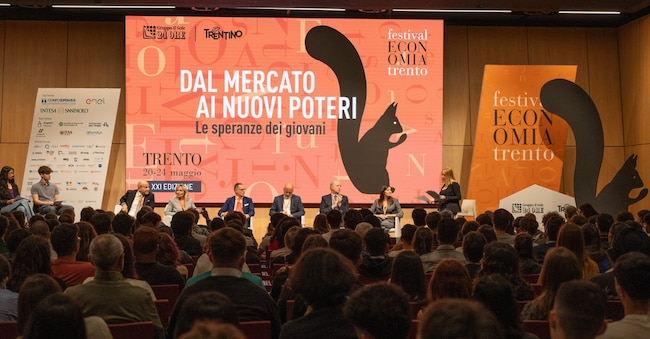
Alberto and Paramjit presented before 230 attentive peers, at the Itas Forum in Trento, the Next Gen Power research, promoted by the Hub della Conoscenza and led by the pro-rector of the Politecnico di Milano Giuliano Noci, with the support of Cassa Padana BCC, Anci Lombardia, the Informagiovani network of Anci Lombardia and the Politecnico di Milano. Far from apathetic, 14-19 year olds see the economic, social and geopolitical fragilities of the present, in many cases more clearly than adults. "A desire for coordination and tools to deal with the speed of the dynamics of change are the requests that seem most urgent to me, and I would add a meritocracy that is true not just in words," says Pro-rector Noci.
The word that emerges is insecurity
Of the work of the Hub della Conoscenza and Cassa Padana Bcc, the numbers are first and foremost striking: more than 6 thousand secondary school students from the lower Brescia, Cremona and Mantua areas were interviewed about the future, work, technology and geopolitics. The word that runs transversally through the entire research is insecurity. Not individual or identity-based insecurity, but systemic: economic, labour, social, geopolitical. Young people show a strong desire to build a stable future, but at the same time perceive the global context as fragile and often out of control. The dominant feeling is that of having to face the future without adequate tools and without truly credible points of reference.
The fear of doing a job you don't like
One of the most relevant data from the survey concerns the relationship with work. The public narrative that young people have little motivation is completely disproved. Fifty-four per cent of the respondents indicate the achievement of economic independence as their main goal in life. Two out of three young people, however, fear being forced into a job they do not like. Sons of a generation of adults who, at their age, when asked: what job do you want to do when you grow up? indicated fanciful jobs, today's young people answer with concreteness: I want to do a job that I like, that will be linked to my studies, that will also allow me to leave myself room to live. "The research offers many interesting insights," the opinion of Corrado Passera, entrepreneur, banker and former minister, who suggests "to this generation inundated with information to read newspapers, both Italian and foreign, of different orientations before forming their own ideas".
School is a critical junction
The school emerges as one of the most critical junctions of the entire research. Students continue to recognise its fundamental role, but at the same time denounce its profound limits. Limits and seems that also concern artificial intelligence with 62% of the students fearing the loss of human creativity and 47% the loss of jobs. Reassuring in this sense is Inps president Gabriele Fava, author of a true Copernican revolution of the institute, which manages a very wide range of protections that go beyond pension treatment alone. "The research delivers a very clear message. Young people are not asking for welfare. This is why Inps is investing in a new idea of public proximity Talking to young people means entering their languages, their spaces and their expectations. We have launched a new App and the Youth Portal, the first digital space in Italia that integrates over 50 dedicated services. It is a paradigm shift'.

