
Young people, more and more alone and less and less: over 2 million 25-34 year olds lost in 20 years
Institutions and the Third Sector join forces to combat isolation and educational poverty. On the occasion of the round table 'With young people, against violence. Preventing distress and defending relationships for a Zero NEET Lombardy", the Asilo Mariuccia Foundation turned the spotlight on a generation in distress
There is a generation in danger of becoming the most fragile and numerically smallest in recent Italian history. A silent army of young people struggling to enter the world of work, to train and to build stable relationships. Their presence in society is thinning and with it the life force of an ageing country. According to the most recent ISTAT data, in the last twenty years the 25-34 age group has lost more than 2.3 million individuals: there were more than 8.6 million in 2004 and today there are about 6.3 million, or 10.6% of the Italian population. The Cnel Report 'Demography and the Labour Force' also points out that those employed in this bracket have fallen from over 6 million to around 4.2 million, reducing their weight among workers from 27.1% to 17.8%.
Generational imbalance
A decline that reflects a broader generational imbalance: in Italy, the under-15s are now less than half of the over-65s, and soon they will be less than one in three. This demographic fragility is compounded by an equally significant social fragility: according to Eurostat, Italy has one of the highest incidences of NEETs (young people who do not study, do not work) in Europe, second only to Romania (19.4%), with 15.2% of young people between the ages of 15 and 29 out of education or work, compared to an EU average of 11%. "The condition of NEETs represents one of the most worrying signs in our society. Its incidence measures the waste of human capital of the new generations. Italy, unfortunately, remains among the European countries with the highest levels: a paradox, considering that we are also among those with the fewest young people and with a more pronounced process of 'degrowth'. Strengthening training and the link between school and work is the decisive investment to ensure economic vitality, innovation and social sustainability,' says Alessandro Rosina, sociologist and lecturer at the Università Cattolica del Sacro Cuore.
Emergency scenario
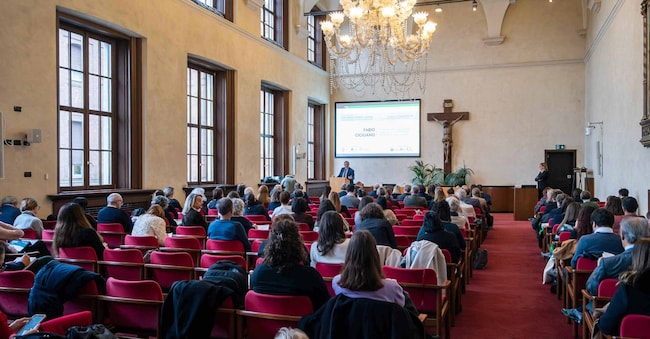
It is precisely in the face of this generational emergency scenario that the Asilo Mariuccia Foundation, which for over a century has been a point of reference for the reception and training of young people in vulnerable situations, is relaunching its commitment. It does so by promoting, in collaboration with the Università Cattolica del Sacro Cuore and ALTIS Graduate School of Sustainable Management, the round table "With young people, against violence. Preventing discomfort and defending relationships for a Zero NEET Lombardy'. The latter was sponsored by the Lombardy Region, the Municipality of Milan and UNEBA Lombardy. "The data on NEETs in Italy are alarming and cannot leave us indifferent. The Università Cattolica is therefore in the front line to take its share of responsibility and ensure that the situation improves. The heart of our educational mission is expressed in education power. The numbers I have mentioned will not improve if we do not start from education through targeted and synergetic projects. This is why the Athenaeum of Italian Catholics is committed, first and foremost, to partnerships such as this one with the Asilo Mariuccia Foundation, so that common action strategies can be outlined. I believe this is the real mission of a university, like ours, that wants to be in society and at the service of society,' adds Elena Beccalli, Rector of the Università Cattolica del Sacro Cuore.
Reflection on a fragile picture
An opportunity to turn the spotlight on a picture of fragility that is not only measured in numbers, but also in the perception of well-being. Those with a low educational qualification tend to feel worse off, a sign of how education remains a decisive factor in emancipation. According to Fondazione Cariplo's Inequalities Report 2025, in fact, among people with lower levels of education the feeling of progress, especially economic progress, is much less widespread than the average. The relational dimension is also affected: only 57% of the population declares itself satisfied with its social life, in terms of relationships, friendships and integration in its community, a figure that falls further among those with less integration or educational opportunities. "One does not become NEET overnight. This is well told by the young people we met. At first something gets jammed, then that crack doesn't get repaired, it seems to stay there defenceless and instead it is generating a chasm, which then drags you down: failures, social isolation, lack of self-esteem and what seemed like a hill becomes a mountain to be overcome without any equipment among other things. Those who are close to young people must be able to pick up on the signals that arrive; that is why we say that the blossoming of a young person is a collective process. What gives us confidence are the stories of those young people who overcame difficulties, who did not drop out of school even when they were about to do so, or if they did, they had someone who helped them get back on the path,' says Giovanni Azzone, president of Fondazione Cariplo.
Fragility and Exclusion
Where fragility risks translating into exclusion, the Asilo Mariuccia Foundation intervenes with a daily commitment to help young people regain confidence, skills and autonomy. Among the most significant projects are Coltivare Inclusione, dedicated to floriculture for Italian and foreign youngsters in the area with scholastic or social difficulties, and IntegrAzione, boat carpentry workshops on Lake Maggiore where 30 unaccompanied foreign minors learned technical and relational skills.
Brand connect


Newsletter Scuola+
La newsletter premium dedicata al mondo della scuola con approfondimenti normativi, analisi e guide operative
Abbonati