
Zaia shakes up the League with his manifesto: liberal right that thinks of young people
The Lega Nord exponent in Il Foglio: 'Autonomy, foreign policy, security, young people, freedom on ethical issues and integration are the "pivotal points" on which the centre-right must demonstrate that it is a governing force capable of reading the present in order to shape the future'
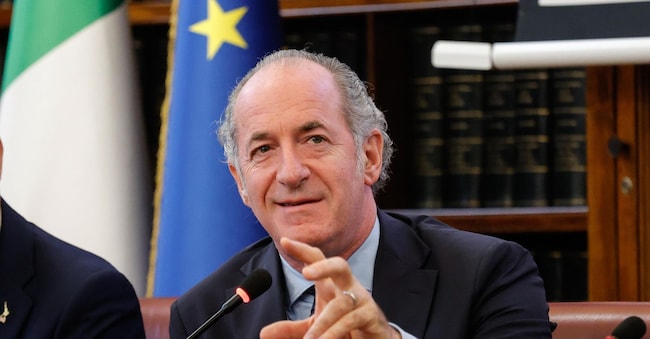
Autonomy, foreign policy, security, young people, freedom on ethical issues, and integration: these are the 'pivotal points' on which the centre-right must 'demonstrate that it is a governing force capable of reading the present in order to shape the future' according to Luca Zaia, a Lega exponent, former governor of Veneto, and now president of the Veneto regional council.
The Sheet article
In an article in the Foglio, defined by the newspaper as 'Zaia's political manifesto', the leftist dedicates a chapter to 'right and freedom': 'The winning right,' he writes, 'is the liberal one. The liberal one loses. I say it clearly: ethical, civil, end-of-life, civil unions issues cannot be ideological taboos. The right, the centre-right, of today is not that of fifty years ago, and it will not be that of tomorrow. The issues of civil rights and the end of life cannot be dismissed with a prejudicial yes or no. They question the individual conscience even before political affiliation. A mature right does not impose visions, but constructs clear, respectful rules, capable of holding together personal freedom, collective responsibility and the role of the state. Without renouncing its own identity, without retreating before its own ideas'.
Loading...
Integration as complexity-aware governance
'You only have to enter a kindergarten or primary school classroom today,' Zaia emphasises, 'to realise that Italian children are growing up alongside children from other cultures, histories and backgrounds. We can pretend not to see this, or we can govern this phenomenon intelligently. Identity is not an automatic reflex: it is taught, transmitted, constructed. And it is also strengthened by respecting the identity of others, of those families that our country hosts and that are now part of it. Our history proves this: Venice dialogued with Byzantium in a continuous, open, sometimes competitive confrontation, taking the best from that encounter and thus strengthening its own civilisation. This is the lesson we must apply today: integration not as renunciation, but as conscious governance of complexity. Citizens are looking favourably on the liberal choices of this government. The future will see us engaged in choices that are not easy, but we must always be clear that the people expect courage, as has been the case so far'.
The autonomy
Another key point in Zaia's manifesto concerns autonomy: 'I cannot fail to emphasise that there is a southern question that is morally unacceptable and intolerable. But there is also a northern issue that can no longer be hushed up or, worse still, dismissed as the secession of the rich, an act of selfishness. We must also address it without any guilt complex in the interests of the country: a few regions, mostly in the north, produce the tax residue that keeps essential services going throughout Italy. Solidarity and subsidiarity are not in question, they are complementary. North and South are not adversaries, they are parts of the same national destiny, they are Siamese twins. The death or life of one is the death or life of the other. I say this without hypocrisy: if the North demands more efficiency, less bureaucracy, better conditions to produce, it does so in the interest of Italy as a whole. The centre-right must have the courage to say this: either we do autonomy by choice, or we will have to do it by necessity. Together we also have the task of guarding against a serious risk: neo-centralism'.
Foreign Policy
The second point emphasised by Zaia is 'foreign policy': 'I am convinced that today Italy can play an international role well above its demographic weight. We are not a military power, but we can be a superpower of diplomacy and balance, thanks also to the excellent international relations work of President Meloni, who has not been seen for many years and has restored the country's position and standing. Political stability restores credibility. In a context in which Europe, as it is, does not yet have the geopolitical standing it deserves, the European centre-right must question itself on this limitation: there is no strong Europe without strong, responsible, authoritative states. Italy can be a bridge between Europe and the United States, and consequently barycentric in Mediterranean diplomacy. A credible interlocutor, a factor for stability. I believe that this is one of the highest tasks of our foreign policy: not to take sides by reflex, but to mediate with identity'.


Brand connect
Loading...
