
Zandomeneghi's Italian Way to Impressionism
The exhibition at Palazzo Roverella in Rovigo exalts the artist who united the modernity of Degas with the chromaticism of Renoir, creating an original figure
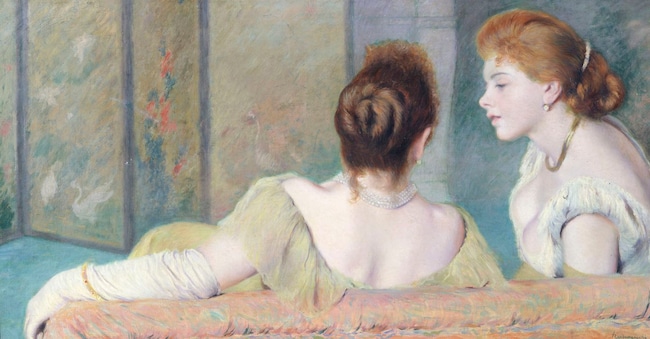
For once, the title of the exhibition "Zandomeneghi and Degas. Impressionism between Florence and Paris' is not, as it might seem, a somewhat pandering expedient to attract the attention of the general public, but the most legitimate formula to define the identity of the Venetian Zandomeneghi compared to that of the other two famous Italians in Paris, De Nittis and Boldini. In fact, he was the only one to share the struggles of the Impressionists, with whom his compatriots had a conflictual relationship, exhibiting at almost all of their collective exhibitions and weaving with them, in particular with Degas, Pissaro, Sisley and Renoir, fruitful relationships not only professionally but also personally. Like the Impressionists, he was a protagonist of the 'painting of modern life', establishing himself as an interpreter of the female figure depicted in the context of everyday existence, in its rituals punctuated by precise rules, such as the toilette, the walk to the Bois, reading, conversation. He was able to render a whole range of atmospheres and feelings, fixing with an attentive gaze the physiognomies, gestures and glances that, although identifiable with those of the Parisian woman of those years, have become, thanks to the seduction of his unmistakable style, the symbol of an ideal, universal femininity that is still very relevant today. Although he tackles the same themes, his painting is very different from the aggressive and talented Boldini, while he seems rather to combine the modernity of Degas' compositional cuts with Renoir's chromatic splendour, to arrive at an absolutely new and original figure.
The exhibition in Rovigo aimed to reconstruct the long and compelling career of a character who was always determined and consistent, capable of making courageous life and artistic choices, such as that of first of all leaving his city of origin, Venice, renouncing the advantages that would have accrued to him from the power and fame of his family, made up of famous sculptors. So he moved first to Milan, finishing his studies at the Brera Academy, and then to Florence where he arrived in 1862, after participating in one of Garibaldi's expeditions. His beginnings thus took place within the 'revolution' of the Macchiaioli of whom he shared the struggles and aesthetic and political ideals. His long and affectionate friendship with Diego Martelli, the supporter of the Macchiaioli movement, was fundamental, as was his frequentation of the lively meetings at the Caffè Michelangelo in Florence and Martelli's villa in Castiglioncello, the two places depicted in the 'macchia'.
His participation in the Third War of Independence and the annexation of Veneto to Italia led to his return to Venice, without interrupting his relations with the Tuscan milieu and, in particular, with Telemaco Signorini, whose interest in painting with a social background he shared, as demonstrated by the large painting, conserved at the Pinacoteca di Brera, depicting the Poveri sui gradini del convento di Aracoeli presented in Milan in 1872 and then at the Universal Exhibition in Vienna in 1873 together with Signorini's Alzaia. This important work aroused Manet's admiration.
His plan to move to Paris matured in the last Italian months he spent, before this decisive turning point in 1876, in Castiglioncello, once again a guest of Martelli. After his arrival in the French capital, he wrote to Signorini that he admired the then famous protagonists of Naturalism, such as Jules Breton, Jules Bastien-Lepage, Carolus-Duran; but then his sensibility led him towards less conventional forms of painting, approaching the Impressionists, in particular Pissarro, Monet, Renoir and Sisley, who could be seen at the movement's first group exhibitions in 1876 and 1877. Martelli's presence in Paris between 1878 and 1879 was decisive in encouraging him in his aesthetic choices and in freeing him from the cultural isolation brought about by his difficult character and lack of inclination towards worldliness. Thanks to the support of the great critic, an advocate of the Impressionists that he would also make known in Italia, Zandomeneghi managed to enter and be appreciated in Parisian artistic circles, becoming a great friend and interlocutor with Degas.
His conversion to avant-garde painting is represented by important and beautiful works such as Le Moulin de la Galette of 1878 or the paintings exhibited in the rooms of the Avenue de l'Opéra that welcomed the fourth exhibition of the Impressionists in 1879. In the 1880s, Zandomeneghi's production is characterised by splendid paintings in which he confirms his very personal adherence to Impressionism, as shown by works such as Mère et fille, Place d'Anvers, The Doctor, The Mothers, At the Café de la Nouvelle Athènes, The Roussotte, Visit to the Dressing Room, pervaded by a keen spirit of observation of Parisian society of those years.

