
The 2026 Nobel Prize in Chemistry has been awarded to Henri Kagan and Kenso Soai for their work on homochirality
Award presented to a French and a Japanese scholar for their discovery of non-linear effects and autocatalysis in asymmetric organic synthesis

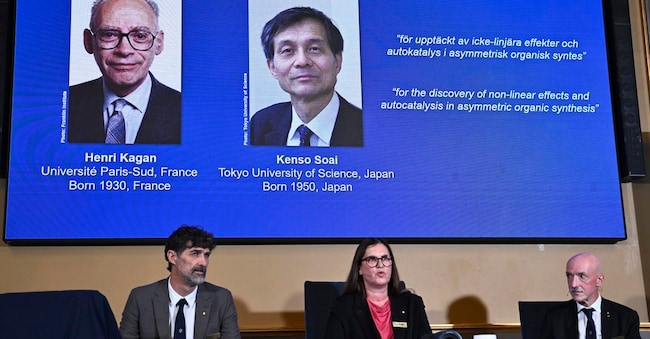
The 2026 Nobel Prize in Chemistry has been awarded to the French scientist Henri Kagan of the University of Paris-Sud in Orsay and the Japanese scientist Kenso Soai of the University of Science, Tokyo ‘for the discovery of non-linear effects and autocatalysis in asymmetric organic synthesis’. The announcement was made in Stockholm by the Royal Swedish Academy of Sciences.
This year’s Nobel Prize ‘therefore concerns fundamental chemistry. Many molecules exist in two different forms. Like my hands. They are mirror images of one another; they resemble each other, but they are not identical. I cannot place one hand on top of the other. Such molecules are called chiral, from the Greek word meaning ‘hand’,” said Heiner Linke, chair of the Nobel Committee for Chemistry.
An explanation of homochirality
‘For a long time, the origin of this chemical asymmetry remained a mystery to chemists’ until the two researchers awarded the 2026 Nobel Prize in Chemistry found an explanation. Kagan, aged 96, was born in Boulogne-Billancourt and was professor emeritus at the Université Paris-Sud. Kenso Soai, aged 76, was born in Hiroshima and is professor emeritus at the Tokyo University of Science. ‘Henri Kagan and Kenso Soai have provided the solution to a chemical mystery dating back over a century: how homochirality can arise spontaneously. The chemical reactions they have developed are extraordinary,’ says Linke of the Swedish Academy’s committee.
The reasons for the award
Kagan took the first decisive step in 1986, discovering a new method for manipulating chemical reactions. This enabled him to achieve a greater excess of one of the two enantiomers than had previously been thought possible. Soai, explains the Swedish Academy, ‘took the next step. In 1995, a seminal paper described how he had devised the first ever chemical reaction with the potential to generate homochirality. In 2003, he finally succeeded in this endeavour: he presented a reaction in which only one of the two possible enantiomers was formed. Apart from life itself, no one had ever achieved such a result before.’ Thanks to Henri Kagan and Kenso Soai, ‘we now know how homochirality can arise. Their discoveries have been crucial for chemists designing reactions for the production of medicines’, concludes the Nobel Committee’s citation.
One million prize split in half
This year’s prize fund totals 12 million Swedish kronor (approximately 1.06 million euros), regardless of whether the prize is awarded to a single individual, a small group of winners or an organisation. Kagan and Soai will therefore share the 2026 Nobel Prize in Chemistry equally, 50 per cent each. The award follows that of the Medicine and that of physics.

