

A drug originally developed for sleep disorders re-emerges as a candidate against multiple sclerosis
An international network led by San Raffaele identifies a drug for sleep disorders as a therapeutic candidate to protect neurons and promote remyelination
Key points
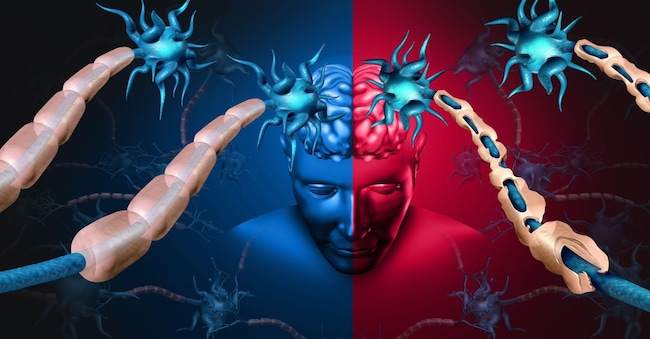
A drug originally designed for sleep and wakefulness disorders could open up a new avenue against progressive multiple sclerosis. It is called bavisant and is the molecule at the centre of an international study coordinated by the University Vita-Salute San Raffaele and Irccs Ospedale San Raffaele in Milan, published in Science Translational Medicine. In preclinical models the molecule has been shown to protect neurons and stimulate repair of the myelin sheath, two processes that are not achievable today with available drugs.
The research project
The discovery is the result of the BraveinMS project, a network launched in 2017 thanks to the support of the International Progressive MS Alliance and composed of leading research centres, including the Paris Brain Institute, the University of California San Francisco and the University of Münster. The programme tested the hypothesis of 'repurposing', i.e. the reuse of drugs already approved for other therapeutic indications, with the aim of accelerating the arrival of new clinical options. The clinical need is high. Progressive multiple sclerosis is the most severe form of the disease: it affects more than one million people worldwide and about 15-20 thousand in Italy and involves an irreversible degeneration of nerve fibres and a progressive loss of myelin. Unlike the relapsing forms, current treatments are unable to halt neurodegeneration or promote remyelination.
A filtered pharmaceutical pipeline with advanced models
The consortium developed an unprecedented screening platform, integrating computational analysis, human stem cell cultures, brain tissue and animal models. From an initial repository of around 1,500 drugs, in silico screening narrowed the field down to 273 molecules, followed by toxicity and efficacy testing on cells and experimental models. The process produced six final candidates, of which bavisant was the most promising. In experimental models, the molecule activated myelin-producing cells by promoting nerve fibre repair, reduced the expression of genes associated with inflammation, and showed neuroprotective properties. Its nature as a histamine H3 receptor antagonist and its known safety profile make it a ready candidate for the next clinical phase. 'For the first time,' the authors explain, 'it has been possible to identify a molecule with dual regenerative and neuroprotective actions using a systematic platform based on in vitro and in vivo human models. According to the researchers, this approach marks the entry of a new paradigm for pharmacological research in progressive forms of the disease.
Potentially faster clinical times and looking to the future
Bavisant is not an experimental molecule developed from scratch, but a drug with a previous regulatory history. This element could reduce the time and cost of the clinical pathway compared to a new chemical compound. The consortium is now investigating the mechanisms of action and optimising the formulation to evaluate the initiation of phase 2 studies in humans. The researchers point out that the project has produced not only a clinical candidate, but also an exportable platform for future therapeutic research. In addition to bavisant, around thirty further candidates with potential regenerative activity have been identified that could be investigated in later phases. The International Progressive MS Alliance, which brings together patient associations, academic centres, industry and funders, describes the result as an example of a 'patient-oriented' strategy, capable of accelerating trials in a clinical area that has so far lacked solutions. If human studies confirm the preclinical evidence, bavisant could represent the first drug capable of acting simultaneously on two fronts considered critical in the progression of multiple sclerosis: neurodegeneration and remyelination failure. A prospect that opens up a possible new season for regenerative therapies of the nervous system.


