What’s new under Al Shaara

‘A turning point in Syria. Efforts are under way to return expropriated property to Jewish owners’

Interview with Henry Hamra (candidate in Domasco for the People’s Assembly): ‘All the property belonging to Syrian Jews has been seized and administered by the Assad regime through the High Commission for the Property of Absent Jews. The Jewish Heritage in Syria Foundation (JHS) is working to return these private and communal properties to their rightful owners’. Numerous homes were handed over by the previous regime to Palestinians

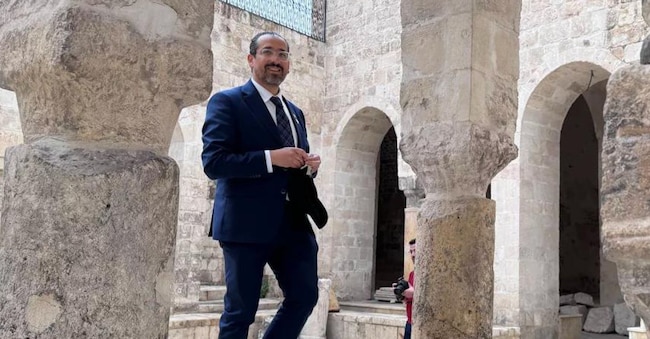
Henry Hamra, candidato a Domasco per l’Assemblea del Popolo

5' min read

Translated by AI
Versione italiana

5' min read

Translated by AI
Versione italiana

‘All the property belonging to Syrian Jews has been seized and administered by the Assad regime through the High Commission for the Property of Absent Jews. The Jewish Heritage in Syria Foundation (JHS) is working to return this private and communal property to its rightful owners.’

Speaking is Henry Hamra, a Syrian-American Jewish cantor. Born and brought up in Damascus, he left the country as a teenager. In October 2025, he became the first Syrian Jew to stand for election to Parliament, in the Damascus constituency, during the People’s Assembly elections. He was not elected, but his candidacy carried great historical significance: the last Jewish MP in Syria had been elected in 1947. In December 2025, together with other members of the Jewish diaspora, he co-founded the Jewish Heritage in Syria Foundation, with the aim of preserving Syrian Jewish heritage and recovering synagogues, documents and private property confiscated by previous governments.

Loading...

What is the role and mission of the Jewish Heritage in Syria Foundation (JHS), of which you are the president and co-founder, and what achievements have you made so far?

‘I am a Syrian-American Jew. I left the country when I was 15, together with my father, Rabbi Yusuf Hamra, who served and taught in Syria for thirty years and was the last rabbi to hold office there. (His uncle, Rabbi Avraham Hamra, was the last Chief Rabbi of Syria and subsequently settled in Israel, ed.). In 1992, when President Hafez al-Assad lifted the restrictions preventing Syrian Jews from travelling abroad, around 4,800 members of the community – the last remaining in the country – left Syria. The community’s assets and private properties were taken over by the regime. Today, our organisation is seeking to recover the keys to all community properties belonging to the Syrian Jewish community and to return the properties to their rightful owners. This is an ongoing process with the current government, which has not yet been completed. We are the main point of contact in this area and we work through the Syrian Ministry of Social Affairs, which has recognised the foundation’s role: to return the assets to their rightful Jewish owners. The restitution of properties belonging to the community as a whole is, however, more complex. We remain confident, however, that we are on the right track.”

What is the High Commission for the Property of Absent Jews, and how did this system work?

‘It was a government body previously linked to the Palestinian security branch in Syria, known as Fara’a Filastin. In Arabic, it was called Idarat mumtalakat al-yahud al-gha’ibin, meaning the administration of the assets of absent Jews. Following the fall of Bashar al-Assad, this system came under the control of the Syrian Ministry of the Interior. During the regime, the body administered the property of Syrian Jews who had left the country through Khoder Kabariti. Working alongside him was Albert Qamho, another key figure chosen by the regime. Kabariti did not hold the religious title of rabbi, which is sometimes erroneously attributed to him. These individuals not only held the keys to synagogues and private homes, but also managed a network of contacts, procedures and authorisations relating to bank accounts, which remained operational until the end of the regime. Although he was Jewish, Qamho did not reside in Syria and had been appointed to that role by the regime; he was not chosen by the Jewish community. The Committee administered the properties without involving the actual owners, whilst the rent collected flowed into the coffers of the Syrian state. In essence, the body – which still exists today – acted as an intermediary between the state, the rightful owners (who formally retained title to the properties without receiving any rent), and the tenants. Even today, for example, if you wish to visit a synagogue, you must contact the Palestinian branch of the internal security services and request permission to enter. The properties remain under government control. Our foundation is working to ensure that everything is returned to the Jewish community, entrusting the keys to trusted individuals.’

How many Jewish-owned properties in Syria are considered ‘abandoned’?

‘The keys to all properties, both communal and private, are held by the Syrian government. At present, it is only possible to estimate the total number of properties. It is, however, important to distinguish between the different historical phases of Jewish emigration from Syria. The first major wave occurred after 1948, following the establishment of the State of Israel, when many Jews left the country. At that time, around 30,000 Jews lived in Syria, concentrated mainly in Damascus, Aleppo and Qamishli. It is important to emphasise that, during that period, their homes were confiscated and used to house Palestinian families in the Yarmouk camp, including people expelled from Israel. It was then that the body known as Idarat mumtalakat al-yahud al-gha’ibin was established. We estimate that it currently administers between 300 and 400 Jewish homes. The current situation, however, is different. On paper, these are Jewish properties, but we do not yet know the total number of properties belonging to the Syrian Jewish community across the country. Part of the complexity stems from the fact that some Jews still hold title deeds, whilst others left Syria in a manner deemed ‘illegal’ and no longer possess documents proving their rights. One of the foundation’s challenges is to trace families who, from a documentary point of view, appear to have disappeared. Reconstructing and retrieving all this information is an essential part of our work, but also one of the most difficult.”

What happened to your house in Damascus after you left?

‘When I returned to Damascus, I visited my old home. I’d lived there until I was 15 and wanted to see it again after 33 years. It was a large house, with many rooms, in the city’s Jewish quarter. Today, several Palestinian families live there, each in a different room. I am trying to reclaim it, but the process is a long one. The house belonged to my grandfather and it will take time to establish our family lineage through the bureaucracy and the necessary documentation.”

Loading...

Do you believe there is currently the political will to return the property to the Jewish community?

‘Some steps have been taken in this direction. For example, the meeting I had in 2025, on behalf of the Jewish Heritage Foundation, with the Syrian Minister for Social Affairs was a positive sign. The process, however, is not yet complete. We are seeking to play a direct role in managing this transition, but it is a complex and multifaceted task. Prompt government intervention would be necessary to facilitate the transition and speed up the process, given that most homes are in a state of disrepair and we cannot wait much longer for reconstruction work to begin.”

Copyright reserved ©
Loading...

Brand connect

Loading...

Newsletter

Notizie e approfondimenti sugli avvenimenti politici, economici e finanziari.

Iscriviti