
Approximately 200,000 irregular workers are employed in the agricultural sector, 12,000 in Calabria alone
The phenomenon is widespread throughout Italia, many migrants driven by the need to earn money, in the absence of alternatives accept a daily wage of around 20 euro to work 12 to 14 hours in the fields without any form of protection

Key points
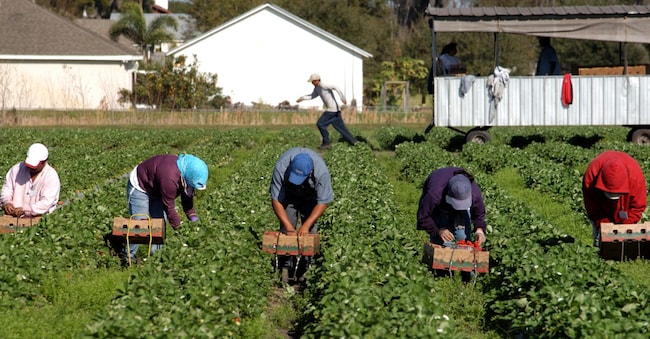
There are about 200 thousand irregular workers employed in the agricultural sector - among them 55 thousand women -, with an increasing irregularity rate that has reached 30% of the total. The latest ISTAT estimate dates back to 2023, the phenomenon is widespread throughout Italy (from Piedmont to Trentino, from Calabria to Basilicata), among them many are migrants driven by the need to earn money, who in the absence of alternatives accept a daily wage of around 20 euro to work 12 to 14 hours in the fields without any form of protection.
National Labour Inspectorate: 227 victims of child labour in 2025
According to Flai-Cgil's Placido Rizzotto observatory, the 'precarious socio-economic insertion of migrant workers in the context of arrival' fuels 'caporalato', and in this framework 'environmental crime that heavily impacts on the supply chain'. The phenomenon of 'caporalato' is widespread, yet in the latest report of the National Labour Inspectorate of 2025 the figure for victims of 'caporalato' under Article 603-bis of the Criminal Code records 895 workers, of which 227 in agriculture, down from the 1,226 total cases in 2024 (519 in agriculture) and the 3,208 cases in the 2023 report (of which 2,123 in agriculture alone), although these numbers can be considered 'provisional due to the different timeframes required by investigations and related criminal proceedings'.
Calabria: 69.5% of inspected companies were found to be irregular
So far the national picture. But let us come more specifically to Calabria, the territory where the massacre of the four labourers took place. In 2025, the Territorial Inspectorate of Cosenza carried out 282 inspections in agriculture, 69.5 per cent of the companies were found to be irregular, in the provisional data for the first four months of 2026, more than 61 per cent of the companies inspected were found to be irregular. There were 155 workers inspected, of whom 43 were totally 'illegal'. There were 91 cases of illegal outsourcing of labour, 2 cases of forced labour and 176 violations of prevention. In total, penalties of over 357 million were contested.
Illegals in the Calabrian countryside come from India, Morocco and Mali
In the Calabrian agricultural sector, the presence of about 12,000 workers employed in irregular conditions, mainly from India, Morocco and Mali, is estimated in the latest Agromafie e Caporalato Report, edited by Giovanni Ferrares and Donato Di Sanzo, of the Institute of Mediterranean Studies of the National Research Council. This phenomenon is very relevant during seasonal harvesting periods, with a wide range of cases: from only formally regular forms of employment, 'grey work', with the presence of a contract, to completely informal working conditions. Even apparently regular relationships can conceal exploitative conditions, with working hours that are longer than required by law and fewer declared working days than those performed. What fuels undeclared work is the precariousness of living conditions, the absence of a regular residence permit and the lack of real employment alternatives.
The two CNR-Ismed researchers investigate the phenomenon of 'caporalato' - a term of military origin that recalls a hierarchical model based on obedience and discipline -, characterised in recent years by a growing operational integration between foreign corporals and Italian intermediaries who adopt recruitment methods that are difficult to identify. In the networks of caporalato, reference figures from different foreign communities interact with economic interests and local structures, intertwining in Calabria with the traditional interest of crime in the agricultural sector. In this system, the use of violence is not an episodic element.


