Enquiry

Corporalism at the US Consulate in Milan, prison sentence requested for Ulas Demir

Investigation unveils exploitation of Indian workers in 200 million maxi-contract, with starvation wages and threats

by Rome Editorial Staff

aggiornato ore 15:40

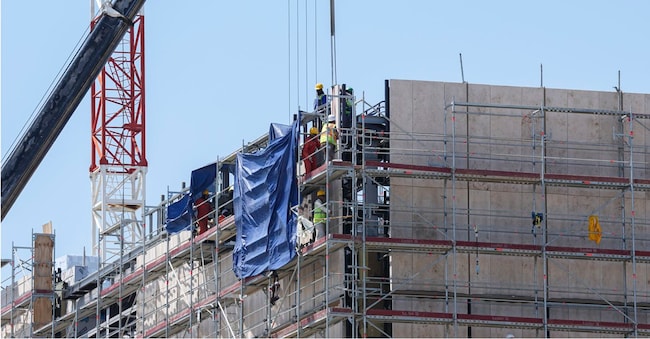
Cantiere del nuovo consolato degli Stati Uniti  in Piazzale Accursio, Milano (Italy) May 29, 2026 (Photo Claudio Furlan/LaPresse) LAPRESSE

3' min read

Translated by AI
Versione italiana

3' min read

Translated by AI
Versione italiana

Milan prosecutors Paolo Storari and Mauro Clerici have ordered the arrest on suspicion of flight risk of Ulas Demir, who is under investigation in the investigation into forced labour for the renovation and construction of the newUS Consulate in Milan together with the American company Caddell Construction Co.

Demir, one of the managers of Caddell's Italian branch, was stopped at Orio al Serio airport.

Loading...

After the judicial inspection on 29 May in which 'numerous violations' were found at the construction site, Demir, who had been intercepted, had a telephone call with an unknown caller, in which - according to the prosecutors - the Turkish manager's 'desire to flee' was 'clear'. The next day, i.e. yesterday, he bought a plane ticket to return to Istanbul. Demir was stopped today at Bergamo airport, from where he was leaving with his family for Istanbul, and was taken to prison.

On 1 June 22026, the Bergamo Public Prosecutor's Office asked to validate the arrest and apply the precautionary measure in prison against Ulas Demir. Presenting the request to the gip was the public prosecutor Raffaella Latorraca.The hearing is scheduled for Wednesday. The hearing is scheduled for Wednesday

The charges

On 26 May last, the Milan Public Prosecutor's Office, headed by Marcello Viola, ordered an emergency judicial inspection for forced labour for the American giant Caddell Construction - with a second office opened in the Lombard capital - because it is alleged to have exploited the work of hundreds of Indian workers employed in recent years in the construction of the new headquarters of the U.S. Consulate in Piazzale Accursio, which should be completed in 2028, for a contract worth '200 million dollars'.

The workers, the prosecutors reconstructed, were hired by the company with headquarters in Alabama through a 'recruitment' by the 'Dynamic House' of New Delhi, a company to which they had to give about 500,000 rupees, or 5,000 eur, in order to be able to arrive at the building site of the new Stars and Stripes Consulate by means of a work 'secondment' formula.

There, prosecutors Paolo Storari and Mauro Clerici write, 'they were exploited' with wages 'clearly not in line with collective bargaining and significantly below the poverty line'.

The sectors under the lens

This is yet another investigation into this phenomenon, with a 'criminal, dramatic and degrading' picture, carried out by the Public Prosecutor's Office, which has already targeted the logistics, fashion, private security and delivery food sectors.

As reconstructed in this new investigation by the Carabinieri of the Labour Inspectorate Unit, the workers, who in this case were found thousands of kilometres away and replaced with others within a few months, were told that they would be fired or 'sent back to India' if they did not accept those conditions. They were paid on average, taking into account various deductions, EUR 2 per hour.

The labourers' declarations

"Yes, lunch was provided by the company,' said one of the many labourers interviewed, 'but I had to pay EUR 6.50 a day. At the end of the month about 300-350 euro in cash to an Indian employee of Caddell's human resources department (...) I was forced to give that money because he threatened me all the time'. Another recounted: 'I had to sign other papers whose contents I did not understand, but I was forced to sign them'.

Caddell was investigated for the administrative liability of the entities and a company manager for forced labour, the Turkish Ulas Demir. During 'the peak of the work about 450-500 workers were used', shuttling between two residences in the Milan area, where they lived, and the construction site.

When investigators arrived to take statements from those who were at work again (a phase that will continue in the coming days), there was tension with those responsible. Now a judicial administrator will have to monitor compliance with the working conditions, regularise relations and prevent exploitation from continuing. And it will be up to a gip to validate the measure.

Copyright reserved ©
Loading...

Brand connect

Loading...

Newsletter

Notizie e approfondimenti sugli avvenimenti politici, economici e finanziari.

Iscriviti