Air traffic

EES, the police: ‘The system only handles 30–50 per cent of the traffic’

Paoloni, SAP: ‘The suspension has already been implemented at critical times.’ The airports facing difficulties: Fiumicino, Malpensa, Pisa and Verona

3' min read

Translated by AI
Versione italiana

3' min read

Translated by AI
Versione italiana

“The system can handle at most between 30 per cent and 50 per cent of passenger flows during border control procedures. Under current conditions, it is not possible to cope with the required workloads.” This is the assessment of Stefano Paoloni, general secretary of SAP, the Independent Police Union, whilst officers are busy managing the new European Entry/Exit System (EES).

The system, which was phased in from 12 October 2025 across the 29 participating countries and became fully operational on 10 April 2026, has replaced the traditional passport stamp with a digital record which, for citizens from non-Schengen countries, also includes the collection of biometric data. This procedure, according to operators, is slowing down checks at Europe’s main points of entry and could put further pressure on airports during the summer travel peak.

Loading...

The European Commission continues to maintain that the reorganisation of checks will, once the settling-in phase is complete, significantly reduce the time taken for the entire entry process. Once fully operational, Brussels estimates that the automated procedure will take between 10 and 15 minutes on average.

This assessment has failed to convince the aviation sector, which has been calling on the Commission for weeks to temporarily suspend digital biometric checks. However, the technical meeting held in Brussels in recent days between the European Commission and aviation representatives did not yield any concessions. The Commission points to the system’s initial results, which it claims have already enabled the detection of over 45,000 attempts to enter the EU in breach of the rules and around 1,100 potential security threats.

It did, however, confirm the possibility – provided for under European legislation – of temporarily suspending the collection of biometric data during the summer of 2026 should this prove necessary to ensure the smooth flow of passengers, whilst leaving the operational management of any critical issues to individual Member States.

In Italy, responsibility for border controls lies with the State Police. “It is already the case that the collection of biometric data is temporarily suspended when the flow of people becomes excessive, particularly in the early hours of the morning, which is the most critical time,” notes Paoloni, speaking to *Il Sole 24 Ore*.

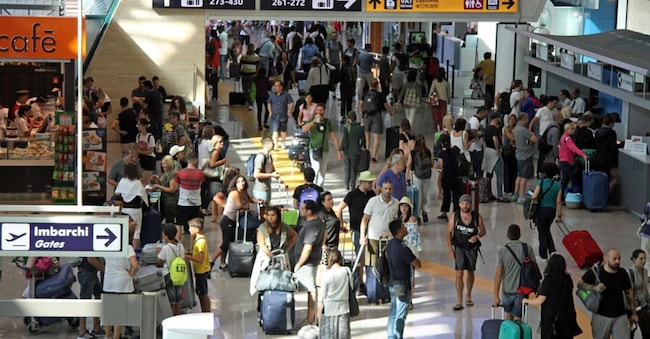
The greatest difficulties are being experienced at Fiumicino, Malpensa, Verona and Pisa airports, where long queues are putting pressure on airport infrastructure. “The risk lies not only in the prolonged waiting times for travellers, but also in moments of high tension affecting police personnel on duty at land, sea and airport border crossings,” adds the SAP secretary.

The increase in staffing levels over recent months has only partially alleviated the problems. The system’s operation requires constant monitoring of the self-service kiosks used by passengers for pre-check-in, which are not always fully operational. According to the procedures, one staff member is required for every three kiosks when electronic checks are combined with traditional document verification, and one staff member for every six kiosks when the entire biometric procedure is automated.

“Police presence has been stepped up, but this is often not enough. The real problem lies in the insufficient number of ticket kiosks available and the limited space for handling arriving passengers,” Paoloni points out.

The SAP secretary also criticises the limited involvement of the police in the design of the new system. “We were only consulted during the phase of organising the local offices, whilst we were not involved in defining the technical and organisational aspects,” he says.

As for the effectiveness of the EES in combating irregular entries, Paoloni prefers not to make a definitive judgement: “We do not yet have official figures, but the information we are aware of seems broadly in line with that recorded during last year’s trial phase.”

Copyright reserved ©
Loading...

Brand connect

Loading...

Newsletter

Notizie e approfondimenti sugli avvenimenti politici, economici e finanziari.

Iscriviti