
18 billion bill for sixth-generation fighter, no M5s and Avs: 'Chambers are not ATMs'
Defence Decree: compared to the estimated costs in 2021, the commitment needed by Italy to develop the air combat system has increased from EUR 6 billion to EUR 18.6 billion

Key points
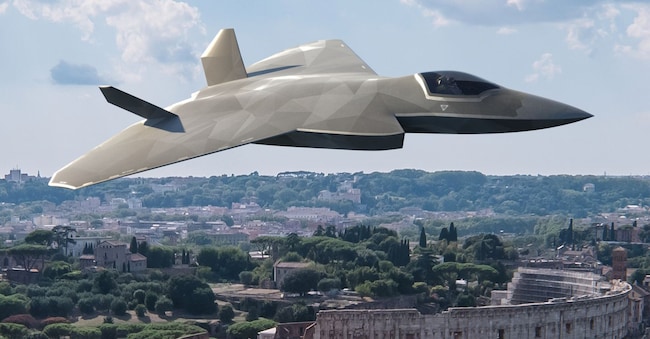
Defence raises the costs for sixth-generation fighter jets and the opposition, in particular the Five Star and Avs, attacks, denouncing 'incalculable expenses'. Raising the controversy is the figure that emerges from the decree of the Ministry of Defence, under examination by the Chamber's Defence Committee, which concerns the multi-year modernisation and renewal programme for 'the development of a complex and interoperable architecture based on a sixth-generation Air Combat System2', which includes the Gcap project (in which, in addition to Italy, the United Kingdom and Japan are participating) and advanced drones, 'intended for the prospective renewal of the Air Force's F2000 Eurofighter aircraft'. Meanwhile, the industrial groups involved, first and foremost Leonardo for Italy, are expecting the signing of the first international contract, which will be in the order of a few billion euros, shortly.
Sixth-generation fighters, defence programme rises to 18 billion
Compared to the costs estimated in 2021, the commitment necessary for Italy to develop the sixth-generation fighter aircraft system has increased from EUR 6 billion to EUR 18.6 billion. The programme, started in 2021, has an assumed horizon until 2050, divided into four phases. The six billion billed for the first two phases are therefore increased to 18.6 - as stated in the measure - 'taking into account the increased costs of technological maturation, experimentation, development and design'. The impact, sources close to the dossier report, is part of a context of profound transformation, marked in particular by the rapid evolution of Artificial Intelligence and the rising costs of critical minerals. 'The economic and industrial repercussions,' explains the explanatory sheet accompanying the decree, 'will be particularly significant, with expected benefits for the entire national defence ecosystem.
M5s and Avs brake
Asking for clarification are the M5s parliamentarians from the Defence commissions of the House and Senate. "While Meloni visiting Tokyo does industrial-military diplomacy, in the Commission," the Five Star MPs point out, "we receive a request from Crosetto to authorise another EUR 18.7 billion of expenditure for this programme, since the costs have tripled compared to the forecast that was approved by Parliament only four years ago. An expenditure that, as the Milex observatory points out, covering only the research, design and development phase of the aircraft, not the cost of purchasing future aircraft, which is incalculable to date, makes this programmethe most expensive in Italian military history, outclassing even the F-35 with its 18 billion for 90 planes" "We do not doubt the value of this programme," they conclude, "but it is not acceptable that our Commissions should be used as an ATM that dispenses billions like peanuts, without even providing a thorough and detailed explanation of this enormous increase in planned expenditure". And the group leader of the Alliance of Greens and Left Peppe De Cristofaro, president of the Mixed group in Palazzo Madama, adds: "These are funds from half a budget law that takes place without a public debate in the closed session of the parliamentary commissions, without any passage through the chamber". Avs calls for 'a stop to these programmes approved in the dark of the committees and which, due to their economic impact, are destined to burden several generations. Among other things, they will not even be able to be financed through the European funds of the Safe, being a non-European programme, and the costs will generate new public debt burdening the ordinary state budget'.
From Fremm to drones and submarines, 5.5 billion purchases to be voted on by the Commission
Meanwhile, a package of 14 Defence Ministerial Decrees for military means and programmes totalling EUR 5.5 billion will arrive next week for a vote in the competent Commissions of the House and Senate: from the modernisation of the Fremm frigates, to the continuation of the U212NFS submarine programme, to the upgrade of drones, Grifo air defence systems, and self-propelled howitzers. The logistical support and technological modernisation of the 10 Fremm frigates represents the largest burden on which the opinion is sought, with a total estimated cost of 2.44 billion between 2025 and 2039 (1.8 billion for MIMIT). An estimated 658 million over 15 years is earmarked to equip the four new U212FS submarines, which are currently under construction, with lithium batteries, to update logistical support and to upgrade infrastructure such as docks and piers. Nearly 600 million is earmarked for upgrading the Air Force's MQ-9A remotely piloted aircraft; a financial commitment of 435 million is for the purchase of self-propelled howitzers for the Army; and over 360 million for work on two U212A submarines.

