Design

Farewell to Olivier Mourgue, the designer of the armchairs in “2001: A Space Odyssey”

He designed the iconic red Djiin chairs featured in the film “2001: A Space Odyssey”

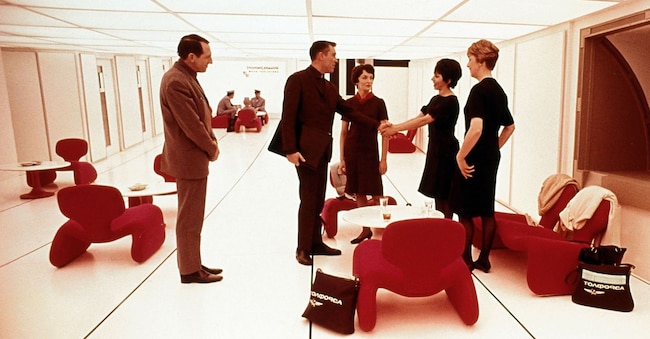
Da una scena del film “2001: Odissea nello spazio” di Stanley Kubrick, dove la stazione spaziale è arredata con sedie di design a firma Olivier Mourgue (ZUMApress.com/LaPresse)

5' min read

Translated by AI
Versione italiana

5' min read

Translated by AI
Versione italiana

Its red armchairs seemed to have come from a future yet to be imagined. Undulating, enveloping, hovering somewhere between sculpture and furniture, they went down in cinema history when the director Stanley Kubrick chose them for the interiors of the space station in the film ‘2001: A Space Odyssey’. With the death of Olivier Mourgue, who passed away on Monday 5 October at the age of 87 at his home in Keralio, Plouguiel, Brittany, as reported by the Parisian daily “Le Monde”, an important chapter in 20th-century French design has come to a close.

A design icon of the 1960s: pop yet versatile

A visionary designer, an interpreter of the Pop spirit of the 1960s and an advocate of an aesthetic at the service of everyday life, Mourgue has left a mark that extends far beyond the famous Djinn chairs: from furniture to experimental installations, from interiors to the automotive industry, his work has helped to redefine the relationship between form, colour and function.

Loading...

He had achieved international fame with Kubrick’s film, released in 1968, but his professional career had begun a few years earlier, amidst the wave of renewal that swept through European design in the post-war period. Mourgue belonged to a generation of designers who sought to move beyond the conventions of traditional furniture design, making objects more accessible, versatile and in tune with the changes taking place in society.

Alongside figures such as Pierre Guariche and Pierre Paulin, he had helped to bring a new design language into people’s homes, characterised by soft lines, vibrant colours and materials suited to industrial production. Born in Paris in 1939, he had shown a marked inclination for drawing and design from a young age.

He trained at the École Boulle, where he studied interior design, and subsequently at the École nationale supérieure des arts décoratifs in Paris, specialising in furniture design. After completing his studies, he gained his first professional experience in Northern Europe, working in Finland and Sweden and spending time at Nordiska Kompaniet in Stockholm under the guidance of Maurice Holland.

His engagement with the Scandinavian tradition – which emphasises simplicity of form, the quality of materials and the functionality of objects – helped to consolidate his design approach. In 1963, he began working with Airborne International, a French company specialising in furniture, a collaboration that was to become one of the defining moments of his career. Two years later, he designed the Djinn series, the project that would cement his reputation.

The Djiin armchairs

The name evoked the jinn of Arab tradition, a fantastical creature capable of taking on different forms. This reference was consistent with the identity of these chairs, which seemed to transform before one’s eyes, moving away from the rigid geometries of conventional furniture to take on an almost anthropomorphic character.

The armchairs, characterised by lightweight frames, enveloping padding and colourful upholstery, embodied a design philosophy in which the object was no longer merely a functional element, but became the focal point of the space. Their sinuous shape and the vivid red of the versions that entered the cinematic imagination contrasted with the white, sterile environments of 2001: A Space Odyssey. Kubrick incorporated them into the interiors of the space station, transforming them into an essential detail of the film’s aesthetic.

The American director’s choice marked his international recognition. In a work that envisioned the future through rigorous architecture, sophisticated technologies and ethereal settings, Mourgue’s creations introduced a touch of colour and softness, demonstrating how design could make a decisive contribution to the construction of a narrative universe. The Djinn chairs thus became one of the film’s most recognisable images and a symbol of the confidence with which 1960s culture viewed the possibilities of modernity.

Aesthetic experimentation and an eye for the everyday

But to reduce Mourgue to the armchairs made famous by Kubrick would be to overlook the diversity of a body of work that spanned almost every field of design. Alongside his collaboration with Airborne, the designer had worked for the Agence d’Architecture Intérieure Gautier-Delaye and, in 1966, had opened his own studio. From there, he developed projects for companies such as Disderot, Prisunic and Renault, as well as creating furniture for the Mobilier national, the French institution dedicated to the production and conservation of furniture for the public heritage.

Loading...

In the 1960s, his work stood out for its ability to combine aesthetic experimentation with a focus on everyday use. Among his best-known creations are the Whist chair and its footrest, designed in 1964, the Montreal series from 1967 and the Cubique chair from 1968, which won an AID International Design Award. These are joined by the Joker armchair, the Bouloum chair, created for Airborne in 1969, and the Flower lamp, designed for Disderot in 1970.

A key feature of his method was the emphasis on versatility. Mourgue developed coloured, easily replaceable covers, so that the appearance of the furniture could be altered without having to replace the entire piece. This choice met a practical need, but also reflected a freer approach to interior design: the pieces could adapt to their surroundings, the tastes and needs of those using them, taking on a new personality each time.

Mourgue’s research was not, however, confined to the scale of individual pieces of furniture. His interest in materials and in the relationship between architecture and the environment found one of its most significant expressions in Visiona 3 , the project realised in 1971 for the German multinational Bayer, as part of the Cologne Furniture Fair. The initiative involved a designer transforming an exhibition space on board a boat into an environment capable of anticipating the forms of future living. Following previous projects entrusted to designers such as Verner Panton and Joe Colombo, Bayer had chosen Mourgue to envision a world in which interiors were no longer organised according to the traditional separation of rooms and functions. The designer had created an artificial landscape inspired by nature, using carpets and fabrics to evoke meadows, rivers and the earth’s surface. The space thus became a continuous environment, in which industrial materials and natural references were integrated into an overall vision of living. Visiona 3 remains one of the most representative examples of design culture from the 1960s and 1970s, when design sought not only to improve existing objects but also to radically rethink the spaces of everyday life.

In Mourgue’s design, the vision of the future did not equate to a cold, technology-dominated environment: on the contrary, innovation went hand in hand with organic forms, colours and references to the natural landscape.

Copyright reserved ©
Loading...

Brand connect

Loading...

Newsletter RealEstate+

La newsletter premium dedicata al mondo del mercato immobiliare con inchieste esclusive, notizie, analisi ed approfondimenti

Abbonati