
Aerospace, Tajani: ‘New private mission for an Italian astronaut. The sector generates over 21 billion in turnover’
The third edition of the Space Economy Forum takes place at the Farnesina. Urso, Minister for Enterprise and Made in Italy: “We must prevent space from becoming a lawless no-man’s-land.” All the sector’s figures

Key points
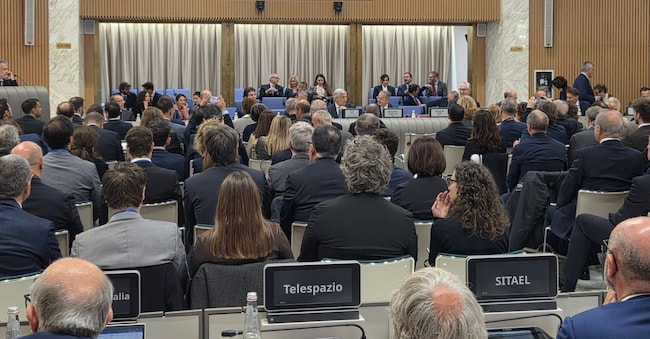
Italia remains at the forefront of the aerospace sector. In fact, a new mission is being prepared for one of our astronauts, most likely Walter Villadei in collaboration with Axiom Space. This was announced by the Deputy Prime Minister and Minister for Foreign Affairs, Antonio Tajani, who opened the third edition of the States General of the Space Economy at the Farnesina. The mission, known as Axiom 5, will be discussed at the next meeting of the Interministerial Committee for Space and Aerospace Research Policies (Comint). Axiom 5 is the fifth private space mission to the International Space Station, awarded by NASA to Axiom Space and scheduled to begin in January 2027. A colonel in the Italian Air Force, born in 1974, Villadei is one of the leading figures of the new generation of Italian astronauts, specialising in aerospace engineering and space activities.
“We must play a leading role in Axiom’s fifth space mission,” explained Tajani. “We will propose an Italian command and involve our entire scientific community and all our regions. ‘This is a strategic opportunity for the sector and for our industry,’ Tajani continued, also noting that the United States is our key partner. ‘Italia,’ he added, ‘is a key partner in the major Artemis project, which will take humans back to the Moon. Luca Parmitano is one of the key figures on the upcoming mission. We also want to develop new ideas for scientific and industrial collaboration, new solutions and new concrete projects with Canada, France, Germany, Argentina, China, Japan, India, the United Arab Emirates and Kenya,’ he explained, emphasising that “we are taking our vision around the world in all contexts, including at the United Nations, through Italy’s chairmanship of the United Nations Committee on the Peaceful Uses of Outer Space for the two-year period 2026–2027”. “Space and the defence of national security is an issue on which we simply must play a leading role,” emphasised the Foreign Ministry official, adding that on 15 December, Italia will host the European Space Agency’s mid-term ministerial conference.
Tajani: aerospace is the flagship of Italian industry
“Last May,” Tajani went on to recall, “we also adopted a fully-fledged national space strategy. We now have all the tools needed to support this sector. The aerospace sector is a flagship of our industry. It generates more than 21 billion in turnover. Over 80 per cent of this industrial base consists of small and medium-sized enterprises, which we intend to support by every means possible. All our regions make a crucial contribution to this excellence; we have 15 clusters covering the whole of the country. In Lazio, for example, the sector comprises 360 companies, 23,500 employees and a turnover of 5 billion euros. The clusters also play an essential role in linking large industrial groups, small and medium-sized enterprises, start-ups, universities and research centres, enabling our businesses to integrate into global value chains.” Tajani then highlighted the importance of exports in this sector too, where ‘in Italia they account for almost 40 per cent of GDP and we are the world’s fourth-largest trading power. Exports are booming and continue to grow: we reached a record of 643 billion last year and this year we have grown by 5.8 per cent in non-European markets. In particular, exports in the space sector have reached around 8 billion.”
Industry figures
As regards aerospace, Italia has a well-established industrial and scientific sector, with expertise in the construction of satellites and launch vehicles, telecommunications and Earth observation. The sector comprises large groups, small and medium-sized enterprises (SMEs), start-ups, universities and research centres. According to a survey by the National Aerospace Technology Cluster (CTNA) and Confindustria, the Italian space sector’s turnover reached €3.1 billion in 2024, up 63 per cent on 2021. The number of people employed rose from around 5,900 to 8,900, an increase of 51 per cent. The survey covers 38 large enterprises, 220 SMEs, 18 start-ups, 38 research organisations and 24 universities, spread across 15 industrial districts. Around 80 per cent of the industrial base consists of SMEs, whilst research and development accounts for 5 per cent of turnover. A separate survey by Istat and the Italian Space Agency (ASI), covering a broader scope of the space economy, estimates production at around 8 billion euros, added value of 2 billion and over 23,000 employees.
Marsiaj: mission to the US in December
The space industry views diplomacy as a practical tool for winning new market shares. Space diplomacy is one of the pillars of growth diplomacy: it fosters dialogue with partner countries, identifies commercial opportunities and connects Italian businesses with potential customers, investors and industrial partners. Speaking at the General Assembly at the Farnesina , Giorgio Marsiaj , Vice-President of Confindustria for Aerospace, emphasised that space diplomacy is also industrial diplomacy and is measured by the ability of Italian companies to forge international alliances and gain access to major global value chains. “Italia has a competitive supply chain,” he said, “ between 2021 and 2024, the turnover of the space companies surveyed grew from 1.9 to 3.1 billion euros and the number of employees rose from around 5,900 to nearly 9,000. We must transform this asset into new opportunities: from 6 to 15 December, we will be in the United States with ICE Agency, in coordination with the Italian Embassy in Washington, visiting four industrial ecosystems – Washington and Maryland, Arizona, Indiana and North Carolina – to facilitate the entry of Italian companies into American supply chains. But,’ he added, ‘we also need stable coordination between institutions and industry, security of supply, and clear and consistent national and European regulations that do not hinder cooperation and competitiveness.’


