The election in Germany

The AfD has made a landslide gain in Saxony-Anhalt and is a whisker away from forming the state government. The CDU has been dealt a blow

Alternative for Germany doubles its vote share but falls short of an absolute majority. The SPD and the Greens clear the electoral threshold, along with Die Linke. Sahra Wagenknecht’s Alliance, which only just made it over the line, is open to collaborating with the far right. Record turnout: 78 per cent of voters cast their ballots.

from our correspondent Gianluca Di Donfrancesco

Aggiornato il 7 settembre 2026, ore 9:58

Aggiungi Il Sole 24 Ore
ai preferiti su Google
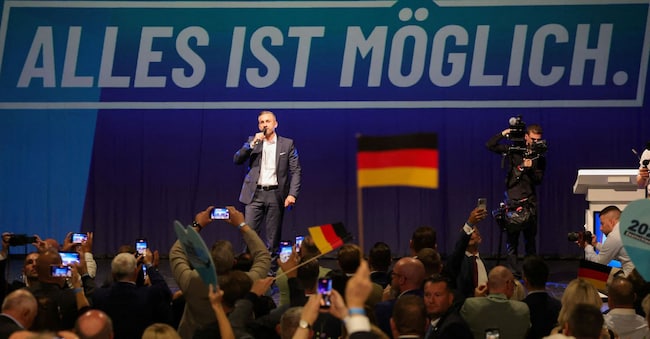
Il candidato di Afd), Ulrich Siegmund, alla festa del partito dopo la chiusura dei seggi (REUTERS) REUTERS

7' min read

Translated by AI
Versione italiana

7' min read

Translated by AI
Versione italiana

MAGDEBURG – Alternative für Deutschland has triumphed in Saxony-Anhalt, but does not have the absolute majority in the regional parliament required to install its candidate, Ulrich Siegmund, as head of the state government on its own.

The far right has secured 43.8 per cent of the vote, exceeding pre-election forecasts. It has won 39 seats, falling short of the 42 needed to secure a majority. The CDU has fallen below 17.2 per cent. Die Linke slips to 8.5 per cent, overtaken by an unexpected resurgence from the SPD (9.3 per cent) and the Greens (8.9 per cent), who would therefore enter the Landtag after having long been in the balance.

Loading...

The Sahra Wagenknecht Alliance, which had indicated a willingness to cooperate with the AfD, has cleared the 5 per cent electoral threshold (securing no fewer than five seats). It reiterates that it is ready to help. The party’s lead candidate, Claudia Wittig, maintains that the party ‘will make decisions based on policy’, in order to implement positive projects for the state ‘even with the AfD’. However, she proposes a ‘non-partisan’ governor, and for now, the day’s winner is holding back: ‘BSW is not a reliable partner,’ replies Siegmund.

Afd a valanga in Sassonia

Photogallery24 foto

The red-brown party, which emerged from a split within Die Linke, could enable Siegmund’s appointment even without voting in his favour. If two rounds of voting are held in the Landtag and no candidate secures an absolute majority, a simple majority is sufficient in the third round. If the BSW abstains, and the AfD has more seats than the CDU (assuming it votes as a bloc), the SPD, the Greens and Die Linke combined, the matter is practically settled.

Siegmund has also stated, for the time being, that he does not wish to lead a minority government and has even gone so far as to suggest a return to the polls should he fail to form a government. “If necessary, there would be new elections, and we would then secure 50 or 55 per cent.” However, he will also have to heed the guidance of the federal leadership: one of the two co-leaders, Tino Chrupalla, is pushing in the opposite direction to that of the Spitzenkandidat: “We will send proposals for talks to all the parties,” he says.

The AfD fell just a few seats short of an absolute majority in this state in the former East Germany, where the Office for the Protection of the Constitution declared a ‘confirmed case of right-wing extremism’ in 2023. Never since the fall of Nazism has a far-right party taken control of the government in any of Germany’s 16 federal states.

“We’ve already made history,” commented Siegmund in the heat of the moment, as he reaches out for potential partners to form a government and tries to poach a few defectors from the CDU. He makes it clear, however, that there will be no compromise on certain issues, particularly “immigration and security”. Alice Weidel, the other federal co-leader, claims a clear mandate for the AfD in the state.

Chancellor Friedrich Merz and the outgoing state premier, Sven Schulze, have promised to remain faithful to the ‘Brandmauer’ (firewall) policy, under which the Christian Democrats have imposed a ban on cooperating with the far right. “We do not collaborate with extremists and, above all, not with those on the far right,” reiterates General Secretary Franziska Hoppermann. The leadership will have to prove that it has the party under control. “The ‘Brandmauer’ has been definitively rejected by the voters,” proclaims Chrupalla, meanwhile.

Following such an intense election campaign and so much mobilisation on both sides, turnout was extremely high. By 4 pm, it had already reached 65 per cent and had surpassed the final turnout figure for the 2021 elections, which ended with a turnout of 60.3 per cent, including postal votes. In the end, 78 per cent of the 1.7 million eligible voters cast their ballots on Sunday. A record for Saxony-Anhalt.

The AfD benefited from this more than any other party. According to the polling organisation Infratest Dimap, 170,000 ‘new’ voters cast their ballots for the party – almost double the number for all the other parties combined.

Loading...

The shockwave reaches Berlin

In Saxony-Anhalt, 41 seats were allocated directly in single-member constituencies. According to the provisional results, the CDU did not win a single one. No fewer than 38 went to the AfD. Only Die Linke broke the spell, winning three seats in Magdeburg and Halle. In 2021, the CDU had won 40 of the 41 direct seats and the AfD just one.

The results are extremely bitter for Merz. Support for the Chancellor stands at around 15 per cent in the polls. And many within the party are criticising him. Nationally, the CDU stands at 20 per cent in the polls, a long way behind the AfD, which is approaching 30 per cent. The leader of the CDU-CSU parliamentary group, Thorsten Frei, is keen to emphasise that ‘the Bundestag is elected for a four-year term, as is the Chancellor’.

For the Deputy Chancellor and SPD leader, Lars Klingbeil, however, the developments in Saxony-Anhalt send an important signal: the federal government’s policies will need to be reviewed.

Weidel was on the attack, as always: “Merz can no longer govern; he will have to step down.”

The Linke issue

In Saxony-Anhalt, the CDU, SPD and the Greens will not, in any case, have the numbers to form a government: together they hold 31 seats. The support of Die Linke (8 seats) will also be needed for a minority government. And even then, they would only reach 39 seats – the same number as the AfD. This would result in a deadlock, and the BSW’s elected representatives would hold the balance of power. Furthermore, amongst the Christian Democrats – here as elsewhere – there is greater reluctance towards the Left than towards the AfD.

Die Linke says it is open to the idea, but is calling for a change of course. The party’s leading candidate, Eva von Angern, holds the Christian Democrats partly responsible for the AfD’s success: if the CDU ‘takes up the far-right’s agenda, then people will vote for the original’.

The Liberals of the FDP, allies of the CDU and the SPD in the outgoing government, remain outside the assembly.

In the 2021 regional elections, the AfD won less than 21 per cent of the vote, finishing behind the CDU, which secured 37 per cent. Die Linke stood at 11 per cent, the SPD at 8.4 per cent, the FDP at 6.4 per cent and the Greens at 6 per cent.

In the 2025 Bundestag elections, the AfD secured 37 per cent of the vote.

In two weeks’ time, on 20 September, elections will be held in Mecklenburg-Western Pomerania and in the city-state of Berlin.

In Mecklenburg, the AfD is in the lead with around 35 per cent, with the SPD trailing by just a few percentage points. In Berlin, the race is still wide open, with the CDU in first place on 20 per cent, just ahead of Die Linke and the AfD.

Upcoming events

Until a new governor is elected, the Schulze government will remain in office on an interim basis. The new Landtag must convene no later than the 30th day following the elections, on 6 October 2026. The first session is chaired by the longest-serving Member of the Landtag, and a new President of the Landtag is elected.

In Saxony-Anhalt, there is no statutory deadline by which the new Landtag must elect a new Minister-President. Once negotiations to form any kind of coalition or partnership between several parties have been concluded, the election is placed on the agenda.

The election of the governor is by secret ballot. More than one candidate may stand for election. A maximum of three rounds of voting are permitted. In the first round, an absolute majority (42 votes) is required. If this is not achieved, a second ballot must be held within the following seven days, and an absolute majority is again required. If this fails, an interim phase begins: the Landtag must vote within 14 days to decide whether to dissolve itself. An absolute majority is required in this case as well. New elections would then be held. If the Landtag does not dissolve itself, a third ballot is held immediately. Here, a simple majority is sufficient: the candidate who receives one more vote than the others wins.

There is no legal obligation requiring the winner of the election to be given the mandate to form a government. Other parties may also attempt to form a majority.

Two federal states are currently governed by minority governments. In Thuringia, Governor Mario Voigt of the CDU leads a coalition with the BSW and the SPD, and – precisely as a result of the controversy surrounding the BSW’s overtures to the far right in Saxony-Anhalt – there have been defections from the party’s parliamentary group.

In Saxony, Governor Michael Kretschmer, also of the CDU, leads a coalition with the SPD, without holding a majority. The governments of the two Länder must continually put together ad hoc majorities for specific legislative proposals, seeking the support of the BSW or Die Linke.

Political Workshop

Long governed by the CDU, either alone or in a coalition, the Saxony-Anhalt has distinguished itself in the past as a political testing ground. It was here that Germany’s first ‘Kenya’ coalition came into being, named after the colours of the three parties (black, red and green) that made it up: the Christian Democrats, the SPD and the Greens. That was in 2016. Even before that, following the 1994 elections, the SPD and the Greens had formed a minority government, with external support from the PDS, the successor to the SED, the communist party of the GDR. Despite the controversy, the ‘Magdeburg model’ was continued by the SPD and the PDS even after the Greens were voted out of the Landtag in 1998.

Copyright reserved ©
Loading...

Brand connect

Loading...

Newsletter

Notizie e approfondimenti sugli avvenimenti politici, economici e finanziari.

Iscriviti