
After Fano, here are the most important archaeological discoveries of the last ten years: from the bronzes of San Casciano to the portico of Caligula
Italy has experienced a season of discoveries that have changed the perception of entire historical periods
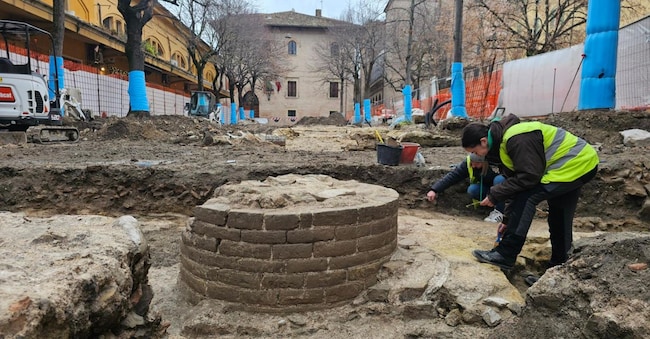
An archaeological discovery comparable in significance to the discovery of Tutankhamun's tomb, the school of Pythagoras in Crotone, or the Lapis Niger in Rome, proof of the existence of the Royal Age. The parallel was made by Culture Minister Alessandro Giuli to express the importance of the discovery of the remains of the Roman Basilica of Vitruvius, a founding figure of western architecture, who was born in ancient Fanum Fortunae, today Fano, in the province of Pesaro Urbino. In the last ten years, Italy has experienced a season of crucial archaeological discoveries that have changed the perception of entire historical periods. Although a ranking is technically impossible, as it is in any case not definitive, it is useful to mention the most important ones.
The Basilica of Vitruvius
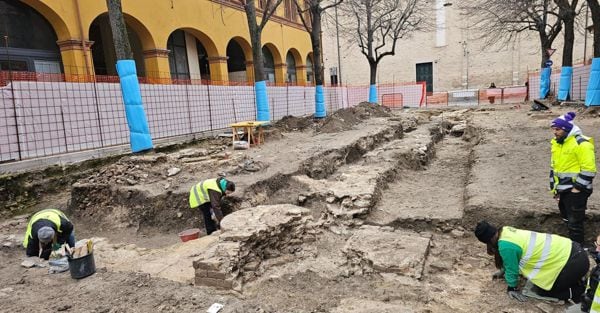
In the first century A.D. Marcus Vitruvius Pollonius designed and realised this architectural work, the only one he later attributed to himself in his De Architectura. Vitruvius' Basilica surfaced in the city centre of Fano, during excavations for the redevelopment of Piazza Andrea Costa: it was a building with a rectangular plan, surrounded by a perimeter of eight columns on the long sides and four on the short sides. Confirmation of the discovery came from a final survey that returned the fifth corner column and the correspondence of its position, orientation and planimetric description to that made by Vitruvius. The columns, five Roman feet in diameter (147-150 cm) and approximately 15 metres high, were leaning against pillars and pilasters supporting an upper floor. This result is part of a path of research that has been underway for years: in 2022, imposing wall structures and precious marble flooring were found in Via Vitruvio, indicating the presence of high-class public buildings. The investigations will continue on the construction site, which is set to expand and is financed with Pnrr funds.
The Bronzes of San Casciano
Discovered between 2022 and 2024 in the thermal mud of Bagno Grande, they represent the largest deposit of bronze statues from Etruscan and Roman times ever found in Italy. They consist of over 24 intact statues (including figures of deities such as Apollo and Hygea), thousands of gold and silver coins, and anatomical votive offerings. Inscriptions in Etruscan and Latin on the statues confirm a peaceful coexistence between the two cultures. The site was a healing sanctuary where the waters were considered sacred. Many artefacts have been exhibited at the Quirinale and on tour in major national museums, and a dedicated museum is to be opened in the village of San Casciano.
The Thermopolis and Regio V in Pompeii
The securing of the excavation fronts (2018-2024) made it possible to explore areas that had never been explored before. The Thermopolis was found intact in 2020. It is a 'diner' of antiquity with a corner counter decorated with frescos of animals (a rooster, a dog on a leash) and still lifes. Inside the containers (dolia), traces of food were found: pork, fish, snails and broad beans. The House of the Painters at Work, discovered in 2024, shows a domus under renovation at the time of the eruption, with buckets of lime and pigments ready to be spread on the walls. Thanks to digital technologies such as Reflectance Transformation Imaging (RTI), dozens of new graffiti and drawings were discovered on the walls of an ancient corridor in Pompeii, some with love notes and images of gladiators. This type of everyday writing greatly enriches our understanding of social life in the city buried by Vesuvius.
The Portico of Caligula
Discovered in June 2024 during pedestrianisation works for the Jubilee 2025, this discovery changed the map of imperial Rome. An imposing portico with reticulated walls and a large open garden area overlooking the Tiber emerged. The discovery of a lead pipe (fistula) with the inscription 'C(ai) Caesaris Augusti Germanici' allowed the area to be attributed to the Horti Agrippinae, the gardens owned by Caligula's mother. Excavations for the extension of Rome's Metro C in Piazza Venezia have uncovered remains of houses and workshops belonging to 2nd-1st century BC Rome, including multi-storey structures. This is expanding our knowledge of urban planning and the daily life of the Roman working classes.

