

Ageing is not an illness: one in two people over 65 see an improvement in their cognitive and physical performance
Decline in old age is not the norm. Much depends on how we experience it and whether we consider ourselves to be elderly. Here is some advice from the experts

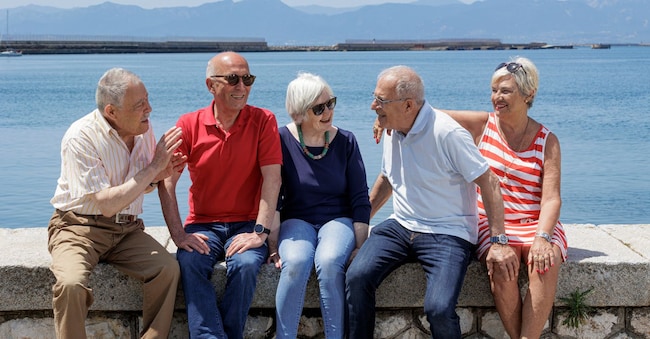
If you are among those who believe, like Publius Terentius Afro, that ‘senectus ipsa est morbus’ – in other words, that old age is, in any case, an illness bound to have a negative impact on one’s well-being – you will have to think again. In fact, for almost one in two over-65s, physical and mental performance actually improves in old age, in spite of the passing of time. Let’s be clear. Ponce de Leon’s Fountain of Eternal Youth isn’t just round the corner. Let’s not delude ourselves. But whilst science is trying to unlock nature’s secrets to help us improve our journey through ageing and achieve healthy longevity, let’s not assume that growing older always and inevitably means decline. On the other hand, even among those in their 80s and 90s, there are people capable of continuing to improve their intellectual performance. Not only that: if we consider Leo Tolstoy, who learnt to ride a bicycle at the age of 64, it becomes clear that our perception of the passing of time and its impact on the mind, psyche and body depends above all on us. In short: cognitive and physical abilities (sometimes even together) can in fact improve even in the over-65s. And significantly so, to the extent that it takes on clinical significance. This has been put in black and white by research conducted by experts at Yale University, published in *Geriatrics* and coordinated by Becca R. Levy, a professor of social and behavioural sciences at the Yale School of Public Health (YSPH). As well as demonstrating that many older people can improve their performance as they get older, the study also reveals another aspect that is often overlooked: it is our beliefs about ageing, rather than the ageing process itself, that guide the path to healthy longevity. In other words: if we ‘fixate’ on the idea that we are losing our edge, we really will lose it.
Let’s turn the paradigm on its head
The analysis examined data from over 11,000 participants in the Health and Retirement Study, a survey of older adults in the US that tracked these individuals for up to 12 years. To measure changes in mental abilities, the researchers used a global cognitive assessment. Physical function was assessed using walking speed, a measure often regarded by specialists as a key indicator of general health, as it is closely linked to disability, hospitalisation and mortality. For those who expect a gradual decline, the evidence clearly contradicts this view. In total, 45 per cent of the participants showed an improvement in at least one of the two areas examined (and sometimes in both). Roughly one in three (32%) showed cognitive progress, whilst 28% showed physical improvement: these advances were often clinically significant. Not only that: when including individuals whose cognitive abilities remained stable rather than declining, more than half of the participants avoided cognitive decline, suggesting that ‘losing one’s marbles’ in psychoneurological terms is not a sentence without appeal. “Healthy longevity does not depend solely on genetic or medical factors, but also on the quality of our mental attitude towards ageing,” comments Dario Leosco, president of SIGG (Italian Society of Gerontology and Geriatrics). Cultivating resilience, cognitive flexibility, a sense of self-efficacy and positive expectations can help to shape more active, fulfilling and healthy ageing trajectories. Ageing thus appears not as a uniform trajectory of decline, but as an open-ended process, in which psychological resources can play a decisive role in shaping individual outcomes.”
Misconceptions
“What is striking is that these improvements disappear when only the averages are considered – as Levy comments in a university press release. If you take an overall average, you see a decline. But when individual trajectories are examined, a very different picture emerges. A significant proportion of the older participants we studied showed an improvement.” In short: let us not fall into the trap of equating ageing with an inevitable downward spiral leading to the progressive loss of physical and cognitive abilities. Improving performance, even in old age, is not impossible. In fact, it happens more often than one might think. The reason for this negative view, according to the study, lies in the way we perceive ageing. The survey reveals that older adults who adopt a positive outlook on the passage of time are significantly more likely to improve both their cognitive performance and their walking speed, even when taking into account age, gender, education, any chronic conditions and depression. According to Levy’s so-called ‘theory of the embodiment of stereotypes’, it is therefore our way of seeing things that makes the difference. The theory suggests that age-related stereotypes, internalised by society through sources such as social media and advertising, can ultimately take on personal significance and have measurable biological effects. On the other hand, those who convince themselves that they are heading towards negative ageing tend to have a weaker memory, a slower walking speed, an increased cardiovascular risk and even higher levels of biomarkers linked to Alzheimer’s disease.
What needs to change
“The study shows that a significant proportion of older people not only maintain their cognitive and physical abilities, but can even improve them,” says Leosco. “This helps to overcome a stereotypical view of old age as a phase inevitably characterised by loss and decline. In this context, psychological resilience emerges as a fundamental resource in shaping the trajectories of ageing.” Resilience can be defined as the ability to adapt to the challenges, changes and losses that accompany the course of life, whilst maintaining a sense of personal efficacy and a sense of purpose. It does not mean denying the difficulties of old age, but developing the ability to cope with them without identifying completely with them. So let us remember: healthy longevity does not depend solely on genetic or medical factors, but also on the quality of our mental attitude towards ageing.

