
Air transport in chaos: thousands of flights cancelled and Europe-Asia routes at risk
Among the airlines that have cancelled flights are Emirates, Etihad, Air France, British Airways, Air India, Turkish Airlines, Lufthansa
from our correspondent Marco Masciaga
 Aggiungi Il Sole 24 Ore
ai preferiti su Google
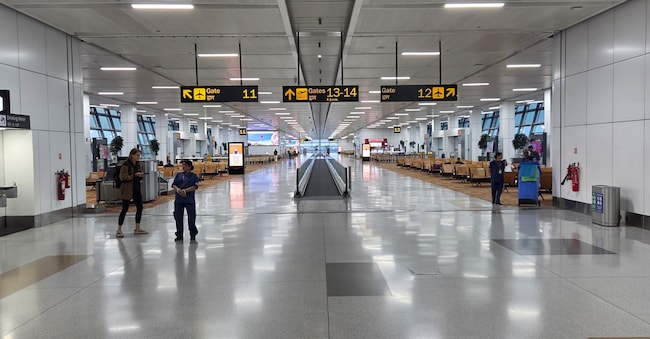
NEW DELHI - The throngs of military personnel who routinely man the security checkpoints make a lounge. Bureau of Immigration officials doze. The long corridors leading to the gate are deserted. The boys who carry the many Indian travellers with walking problems (or little desire to walk) back and forth in their electric cars are so bored that they offer to carry me too. No longer a kid, but not even the classic auntie on the waiting list for a hip transplant. 'Never seen anything like this since the pandemic,' says an Air India stewardess.
TheIndira Gandhi International Airport is the busiest airport in the most populous country on earth, and on the second day of bombings on Iran, missile reprisals against US bases in the Gulf and closure of the skies over the Middle East it is unrecognisable. No queue at check-in, no queue at the immigration counters, no queue at security checks. A situation that is a true reflection of the world's biggest air transport disruption since Covid.
Indeed, thousands of flights by major airlines in the Middle East, Europe, Asia-Pacific and the United States were delayed or cancelled following airspace closures in Iran, Iraq, Israel, Syria, Kuwait and the United Arab Emirates. Dubai International Airport was damaged during the Iranian attacks and Abu Dhabi and Kuwait airports were also affected. According to data from flight tracking platform FlightAware, thousands of flights were cancelled across the Middle East.
Air traffic maps from Flightradar24 show that the airspace over Iran, Iraq, Kuwait, Israel, Bahrain, the United Arab Emirates and Qatar remained virtually empty, with many flights cancelled or diverted due to restrictions on the use of airspace during the hostilities. Among the airlines that cancelled flights were Emirates, Etihad, Air France, British Airways, Air India, Turkish Airlines, and Lufthansa.
The airspace closures in the Middle East are forcing airlines to use increasingly narrow corridors, while the ongoing fighting between Pakistan and Afghanistan adds further risks, explains Ian Petchenik, Flightradar24's director of communications. 'The risk of prolonged disruption,' he explains, 'is the airlines' main concern. Any escalation of the conflict between Pakistan and Afghanistan leading to the closure of airspace would have drastic consequences for travel between Europe and Asia."


