Guides

Airbnb challenges Booking: from accommodation to tourism super-app

With the Summer Release 2026, the platform aims to become the world's tourism super-app and introduces new services: from car rental to home shopping, from transfers to boutique hotels.


by Marco Trabucchi

SAN FRANCISCO, CALIFORNIA - MAY 20: Brian Chesky, CEO, Airbnb, Inc. speaks onstage during the Airbnb 2026 Summer Release keynote on May 20, 2026 in San Francisco, California.  (Photo by Kimberly White/Getty Images for Airbnb) Getty Images for Airbnb

5' min read

Translated by AI
Versione italiana

5' min read

Translated by AI
Versione italiana

SAN FRANCISCO - Already with the introduction of "Experiences" it was clear that Airbnb wanted to extend its playing field, which for years had been limited to finding a place to stay. Today, with the Summer Release 2026 announced with an event at its San Francisco headquarters, the company founded by Brian Chesky is preparing for a strategic leap that goes well beyond its usual scope, including in the app a series of ancillary services through selected partnerships: car rental, grocery delivery, chauffeur-driven airport transfers and the entry of small independent and boutique hotels. Plus the integration of new artificial intelligence-based features to facilitate the booking process. The aim is to become the single point of access to the entire travel experience, without going through other operators.
"The best trips are made to explore, learn and return home with a different awareness than when you left. That is why we have added new experiences and services in line with our values. And this is just the beginning: more services will be coming in the future," said Chesky, co-founder and CEO of the company founded in 2008 and which in Italia alone, according to internal sources, has generated 20 billion euro of total economic impact in 2024 and 110 million in tourism taxes in 2025, equal to almost 10% of the national total.

Loading...

The new services: from shopping to car rental

On the service front, the roll-out is already up and running in the US and being launched in Europe. It starts with grocery delivery, available in over 25 US cities, which allows guests to find groceries ready in the fridge upon arrival at the flat. Transfers to and from the airport are handled through Welcome Pickups, active in over 160 cities worldwide, with a 20% discount for Airbnb users. For luggage storage, the agreement is with Bounce: 15,000 pick-up points in 175 cities, with a 15% discount. Car rental, on the other hand, is available in the United States and four European markets including Italia, with a 20% credit on the next stay for first-time users.

Experiences: from Rome to the World Cup

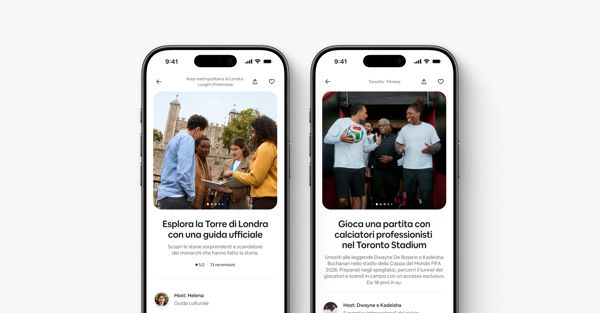
On the experience front, Airbnb is relaunching with an expanded catalogue covering iconic monuments - from the Tower of London to the Taj Mahal - gastronomic itineraries with Michelin-starred chefs (including Gianfranco Pascucci of Pascucci al Porticciolo in Rome) and, above all, an exclusive experience package linked to the upcoming 2026 FIFA World Cup. Guests will be able to attend watch parties with former world champions Abby Wambach and Julie Foudy, or train with Javier Mascherano. Premium content that is difficult to replicate by competitors.
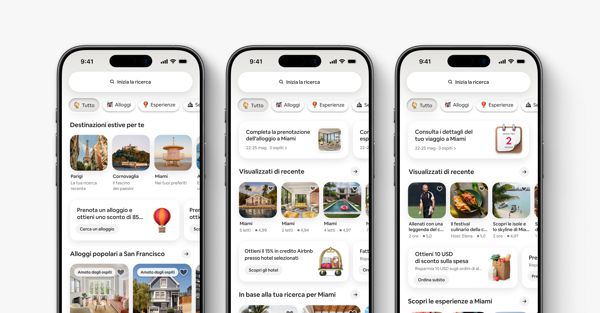
Equally strategically relevant is the entry of boutique hotels and independent hotels. Airbnb will select properties in twenty of the world's most popular destinations - including Rome, Paris, London and Madrid - deliberately excluding the big chains. The price match guarantee policy (with refund in credit within 24 hours of booking) and the 15% cashback on the next stay for those who book a hotel through the platform are incentives designed to attract traffic from the traditional OTA segment.

Artificial Intelligence: reducing friction at every stage

The technological component is perhaps the most dense with strategic implications. Airbnb claims to have over a billion accumulated reviews from guests and hosts: a wealth of information that until now each user was forced to sift through manually before booking. With the new release, artificial intelligence models analyse the entire body of feedback for each accommodation and return customised thematic summaries - location, available services, family suitability, check-in quality - tailored to the priorities of the searcher. This is not a simple summary, explain Airbnb, but a system that tries to anticipate user questions before they are asked.

A further level concerns the selection phase. By saving multiple accommodations in the favourites section, the app will automatically generate a structured comparison of options, with comparison tabs highlighting the relevant differences for that specific trip, according to the features the user chooses to prioritise. The feature, expected by the end of the year, is designed to reduce the abandonment rate in the decision phase, one of the most costly bottlenecks for any booking platform. Chesky gave as an example the possibility to ask targeted questions directly to the app: ask if an accommodation is suitable for children, or if there are hiking trails nearby, and receive a map with available routes in response.

Less booking platform, more social

That social is also used to give travel advice Airbnb has realised this. This is what the new travel map is for, allowing users to add contacts - friends, family - and see where they have previously stayed with Airbnb, the reviews they have left, their next destinations. Tapping on someone else's trip provides access to booking details and the ability to send a direct message asking for recommendations. It is, to all intents and purposes, a social layer grafted onto a transactional platform: a choice reminiscent of the ambitions - never quite realised - of other travel apps that have attempted to build a community around booking. Integration with the shared itinerary, which in a new tab will aggregate accommodation, restaurants, experiences and activities in the vicinity with travel times from the flat, completes a system designed to keep the group coordinated without ever leaving the app. "From a market place to a community place to share what we like," summarised Chesky.

The new customer service

The glue that holds the whole system together is the artificial intelligence-based customer assistant, which an external consulting firm ranked as the best in the travel industry in a comparison of six platforms conducted between March and April 2026. Currently available in 11 languages, the system knows the details of the current trip and offers interactive cards to solve unforeseen issues directly in chat, without going through a human operator. One of the most practical examples given in the demo is the classic example of extending a stay: few chat exchanges, no phone calls, no redirection. By the end of the year, the service will also be accessible by voice command, because Airbnb wants to be reachable even with busy hands, at an airport, in a taxi, at the accommodation.

Towards the super-app

What emerges from this release is not just a product update, but a redefinition of Airbnb's competitive perimeter. The platform has built its advantage on alternative accommodation; now it tries to monetise every step of the journey, from car booking to luggage collection, exploiting a global user base that would be any tour operator's dream. Overall, the AI strategy does not aim to impress with spectacular features, but to reduce friction at every step: from choosing accommodation to managing unexpected events. It is a loyalty rather than acquisition architecture, and perhaps this is the most significant signal that Summer Release 2026 sends to the market.

Copyright reserved ©

Brand connect

Loading...

Newsletter

Notizie e approfondimenti sugli avvenimenti politici, economici e finanziari.

Iscriviti