
At V&A East in London, the accumulation of objects becomes an experience
the Victoria and Albert Museum East brings museum storage from darkness to light by transforming accumulation into experience. The V&A is to the V&A East as the showcase is to the backroom
by Emanuele Papi*
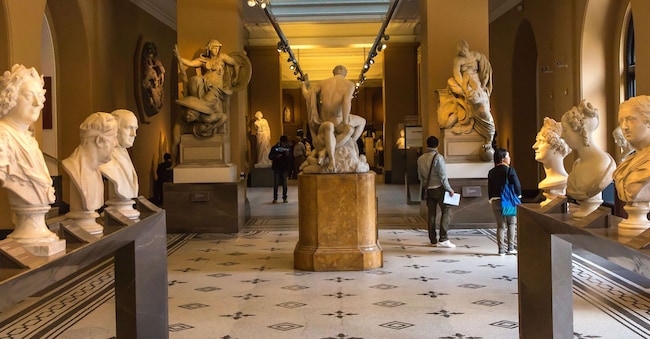
At the Victoria and Albert Museum - now abbreviated to the more hasty V&A - the industrial age showcased itself in the upmarket South Kensington district. Founded in 1852, the London Museum was created to educate taste, train manufacturers and consumers, offer a repertoire of models to British manufacturing, and celebrate the empire of things under London's gaze. Not just a temple of the applied arts, but a laboratory of modernity. Since then, it has amassed over 2.8 million objects - textiles, ceramics, furniture, sculptures, jewellery, clothing, tools, disassembled architecture - a veritable encyclopaedia of global material culture. An ambitious and dizzying undertaking: collecting the world to shape it and teach it.
Doubling to overcome the liturgy of the traditional museum
Today, the V&A has doubled as the new V&A East, which, however, is not a museum. Or, rather, it is only insofar as it forces us to redefine what we call a museum. Paul Valéry's impression is no longer valid here: that place that "exerts a kind of constraint" and from which "one comes out oppressed", as after listening to "ten orchestras together", nor is Theodor W. Adorno's aphorism confirmed: between museum and mausoleum there are only three letters of distance. On the contrary, the V&A East attempts to rescue works from that double condemnation, bringing the repository from darkness into the light and transforming accumulation into experience. The V&A stands to the V&A East like the shop window to the backroom.
Those accustomed to the liturgy of the traditional museum with objects lined up in an orderly and disciplined manner will be taken aback. At V&A East the collection escapes the meshes of selection, hierarchy and silence: it is stacked and displayed en masse. There is no compulsory route but a free exploration. The Wunderkammer comes to mind, but brought to an industrial scale: a chamber of wonders with warehouse logic. Where the exception is no longer the rare object, but the accumulation.
Amazon of Culture
Not surprisingly, the recurring image is that of an Amazon warehouse of culture. This may sound provocative, but it is not. The visitor does not just look: he chooses, he demands, he activates. The principle is simple and destabilising: no longer what the museum decides to show, but what each person decides to put into play, becoming the director of his or her own scenography.
The architecture also participates in this reversal. The building, designed by O'Donnell + Tuomey, renounces deconstructivist rhetoric and works by folds and continuous surfaces. Not a shrine to be entered on tiptoe, but an organism to be traversed in freedom. Inside, the space is continuous, layered, without a real beginning or end. The museum is not visited: it is walked through, like a city. Even the layout marks a distance from the 20th century model: an end to display cases as separating devices, an end to chronological order as a guiding principle.

