
Albania, 4 out of 16 migrants sent back to Italy
Two declared themselves to be minors and therefore would not be covered by the agreement between Rome and Tirana, which provides for the procedure only for adult males; two others reported health problems. The four were taken by patrol boat back to the navy ship, with destination the Italian coast.

2' min read
2' min read
Italy was the dream destination of the 16 migrants intercepted at sea last Sunday night. Yesterday morning they disembarked in the port of Shengjin, in Albania, after a long voyage aboard the Libra ship of the Italian Navy: the 10 Bengalis and the 6 Egyptians, the first to experience the accelerated border procedures in a third country, will be detained in the Gjader camp, in the hope of being able to avoid repatriation. All but four: two declared themselves to be minors and therefore would not be covered by the agreement between Rome and Tirana, which foresees the procedure only for adult males; two others reported health problems. The four were returned by patrol boat to the navy ship, with destination the Italian coast.
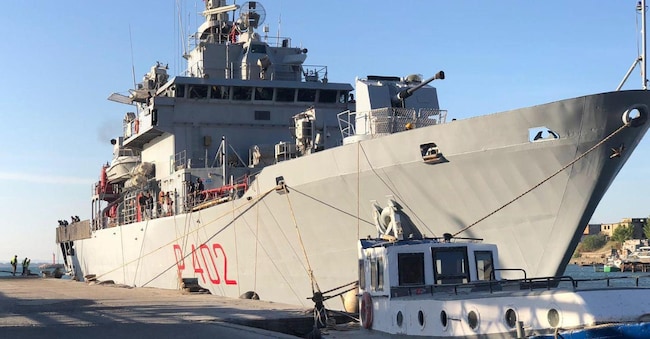
Shortly before 8 a.m. on 16 October, the Libra ship appeared at the port, docking at a dedicated quay, a short distance from the hotspot set up inside the port of call. After about two hours, disembarkation began. The migrants were disembarked in groups of four. In single file, escorted by the Italian police force, they walked the short distance to the entrance of the facility, where doctors, interpreters and cultural mediators awaited them, while UNHCR and IOM personnel travelled with them.
The operations began with health screening, after which they were refreshed and provided with new clothes. The identification process, on the other hand, took longer, continuing until late in the evening, whereas initially it was expected to last only a few hours. The final destination is the Gjader camp, a few dozen kilometres inland. It is in the reception area of the site, currently with a capacity of 400 people, that the migrants will spend the next few weeks, awaiting the outcome of their asylum applications.
Those whose applications are rejected will be transferred to the Cpr, inside the camp, where a small prison has also been set up for those who commit crimes.

