
Altman to businesses: ‘AI safety first’. Oracle brings Google’s TPUs in-house
The partnership between OpenAI and Oracle is being strengthened. Oracle is also bringing Google’s AI chips – which until now had only been used in its own data centres – and those of other companies, including the one led by Altman, into its own data centres.
from our correspondent Luca Salvioli
 Aggiungi Il Sole 24 Ore
ai preferiti su Google
Key points
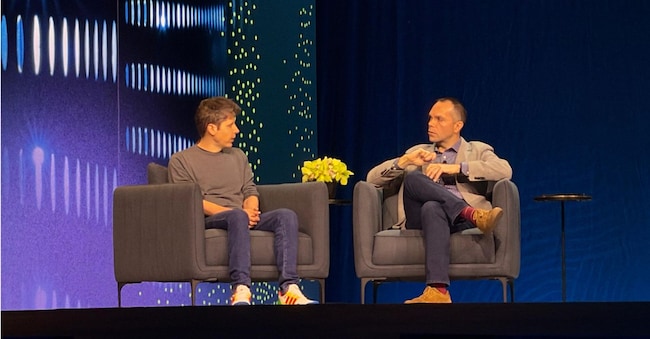
LAS VEGAS – If he were to give companies just one piece of advice on artificial intelligence, “in the very short term, even before productivity, I would recommend that they really understand the landscape of AI-related security threats and protect themselves. I realise that coming from me, this sounds a bit irritating, as if to say: ‘You’re the ones creating the problem’,” says Sam Altman, CEO of OpenAI, from the stage at Oracle AI conference currently taking place in Las Vegas.
The agreement on chips for data centres
This development follows a new agreement between the two companies, which already have close ties. Indeed, OpenAI and its LLMs are the first customers for the large data centres that Oracle is building. And now, those data centres – where Nvidia’s GPUs are currently in use – will be equipped with additional chips. From 2027, Google’s TPUs – which until now have only been available on Google Cloud – will be introduced. These will be followed by chips from Cerebras and SambaNova, which specialise in inference – that is, the stage at which the models respond to users – and finally Jalapeño, which OpenAI has developed with Broadcom for the same purpose. ChatGPT is also becoming a gateway to Oracle’s systems, through which employees will be able to access data and carry out business procedures. Added to this are Codex for building applications and a cybersecurity service based on OpenAI’s models.
Security threats
Joining him on stage is Clay Magouyrk, co-CEO of Oracle, who, on the subject of security, also emphasises how artificial intelligence is, at the same time, the solution: ‘AI is uncovering all the vulnerabilities we have accumulated over the last 50 years’. The CEO of OpenAI agrees, saying he is ‘shocked’ by the number of vulnerabilities the models are finding and by the effort required to fix them. Fixing bugs one by one throughout the entire supply chain may not be enough: according to him, we need services that continuously monitor traffic and prevent vulnerabilities from being exploited.
From writing code to the factory inside the PC
Altman strengthens OpenAI’s corporate presence the day after the presentation of the IPO documents by Anthropic, a strong competitor in the business sector. Regarding the growth in the adoption of models, he says: ‘GPT-6’s has been by far our strongest.’ Oracle is among the most enthusiastic customers: with Codex, according to Magouyrk, ‘the vast majority, probably over 70 per cent’ of the company’s software now runs on it. So there is less and less traditional coding work. Altman describes his job today as follows: “It’s like running a factory inside a computer. I automate the things I don’t like doing.”
To round off the interview, Magouyrk asks him what excites him most about the future. Altman replies that, in just a few years, we have moved from chatbots to agents that programme, right through to AI that translates directly into innovation. ‘Whether it’s making a chip or treating a disease, we’ll all have much better things, of higher quality and at lower cost.’


