

An electronic tattoo for burnout
A wireless forehead patch detects and predicts mental stress

2' min read
2' min read
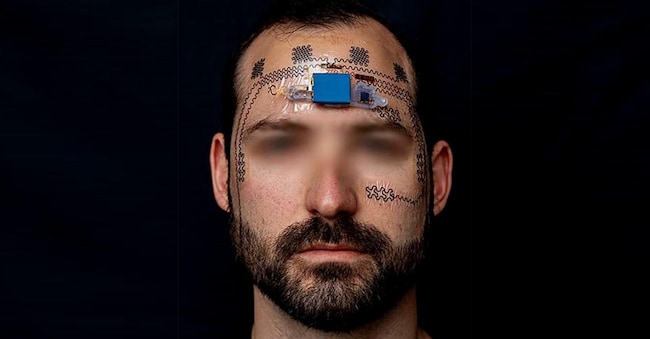
Measuring mental stress with a temporary, wireless tattoo applied to the forehead. This is the new frontier of portable neurotechnology, described in the journal Device by a team from the University of Texas at Austin. The device, similar to a thin transparent patch, can detect cognitive load in real time by analysing brain waves and eye movements.
"Technology is evolving much faster than our cognitive capacity," explains Nanshu Lu, Professor of Engineering and first author of the study, "There is an optimal mental load zone, different for everyone, where we do our best. But it is easy to end up in overload or distraction, with even serious consequences at work'.
A tailor-made technology for reading minds
.The electronic tattoo works like an electroencephalogram (Eeg) and electrooculogram (Eog), but without the limitations of headphones, wires and gels. It consists of a lightweight battery and very thin sensors that can stretch and adapt to the skin, thanks to a design with wavy coils and elastic rings. "The amazing thing," continues Lu, "is that, unlike classic Eeg caps, our e-tattoos guarantee more precise reception because they are customised to the physiognomy of each participant's face.
From stress to prevention: Ai comes into play
During the tests, conducted on six volunteers engaged in memory exercises of increasing difficulty, the device detected increased activity in theta and delta brain waves - indicators of cognitive engagement - and a decrease in the alpha and beta bands, associated with mental fatigue. But it did not limit itself to measuring stress in real time: thanks to an artificial intelligence model trained on the signals collected, the system was also able to predict moments of cognitive overload.
"The current standard of mental evaluation, the Nasa Task Load Index, is based on subjective and a posteriori questionnaires," explains Luis Sentis, co-author of the study. "We offer an objective, continuous and low-cost alternative.


