
The hidden diseases of Napoleon's Russian Campaign: ancient DNA reveals the truth

2' min read
2' min read
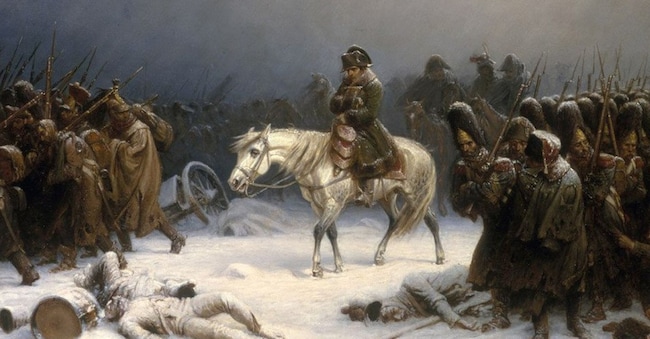
Starting on 24 June 1812, some 600,000 soldiers led by French Emperor Napoleon Bonaparte crossed the Nemunas River to invade the Russian Empire. The war was one of the most costly in history and, just under six months later, only a few tens of thousands of men returned across the river. In early August, a preprint study, not yet peer-reviewed, by microbiologist Rémi Barbieri of the University of Paris and his team identified other pathogens that may have actually been responsible for most of these deaths.
According to the analysis of ancient DNA extracted from the teeth of 13 soldiers found in mass graves in Vilnius, Lithuania, Napoleon's troops retreating from Russia in 1812 were not only decimated by typhus, but also by paratyphus and a recurrent fever transmitted by lice.
Historical documents of the time show that doctors accompanying the army diagnosed typhus on the basis of symptoms such as fever, headache and rash, and an analysis of the remains in a 2006 study had suggested possible typhus infections and trench fever. At the time, there was no way to detect the presence of Rickettsia prowazekii, the bacterium responsible for epidemic typhus, or Bartonella quintana, the cause of trench fever, which infected more than a million soldiers during the First World War. Doctors of the time documented cases of typhus, with symptoms including fever, headache and rashes. "Although not necessarily fatal, recurrent fever transmitted by lice could significantly weaken an already exhausted individual," the researchers write.
The fact that the analyses did not detect any traces of typhus does not mean that the disease did not contribute to the human casualties: in addition to the 13 soldiers already examined, 'more samples will need to be analysed in order to fully understand the spectrum of epidemic diseases that affected Napoleon's army during the Russian retreat,' the researchers write. "In light of our results, a reasonable scenario for the death of these soldiers would be a combination of fatigue, cold and several diseases, including paratyphoid fever and recurrent lice-transmitted fever."


