
Apofruit: how climate change is putting the company’s strong 2025 results at risk
A review of a season that had got off to a good start, according to Apofruit’s 2,600 members, following a 2025 that closed with a turnover of 313 million (+5 per cent)

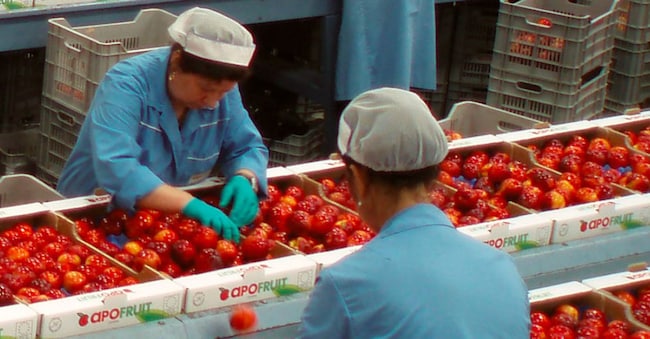
The summer had got off to a promising start, with a buoyant market for seasonal fruit such as peaches, nectarines, apricots and plums and, above all, blueberries. And with exceptional demand for organic produce, which in June saw a 30 per cent rise in sales by value and volume for the specialist company Canova, operating in Italia, Spain and France, and a 40 per cent rise for ViviToscano, which operates in central and southern Italia. But then the exceptional and prolonged heatwave took its toll, putting pressure on the more than 2,600 members of Apofruit spread across Italia, from Trentino to Calabria.
“Our growers are feeling the effects of climate change and are very concerned about it – explains Mirco Zanotti, president of Apofruit Italia, which is celebrating its 65th anniversary this year – From water shortages, even in the north, to excessive heat, which has ‘scorched’ many crops. Such as 20 per cent of Gala apples, which are harvested in August and which will potentially become increasingly difficult to grow and, therefore, at risk of being grubbed up.
Climate change affects not only the quantity and quality of produce but also the organisation of work, with harvesting schedules and timings being redefined to avoid the hottest parts of the day. This need to adapt is also reflected in investment trends. Hail nets, for example, are increasingly being used as protection against solar radiation, whilst variety selection focuses on identifying crops best suited to the new climatic conditions. This complex scenario is placing increasing pressure on fruit and vegetable growers.
The extraordinary general meetings convened in recent months by Apofruit to meet with its supplier members have painted a consistent picture: climate change affects us all, even the northern regions which, until a few years ago, were considered relatively sheltered. Consequently, climate, water and the availability of labour are becoming increasingly decisive factors in the ability of fruit and vegetable companies to generate value, and represent major challenges even for a giant such as Apofruit Italia, which closed 2025 with positive results in terms of revenue and profitability. Turnover rose by 5 per cent, reaching 313 million euros, whilst net profit was up 52 per cent compared with 2024, exceeding 1.3 million euros. The consolidated financial statements, which include the eight subsidiaries operating in Italia, France, Spain and Portugal, show the Apofruit Group exceeding €401 million in turnover for the first time (+6 per cent), although net profit was halved compared to 2024 (€427,000).
But there is another particularly significant figure: the record payment made to producer members who, against a 2.5 per cent increase in the quantities supplied, received 147.5 million euros – 4.8 per cent more than in 2024. In this context, the payment for the 2025 winter harvests represents another indicator of the co-operative’s ability to create value: kiwis, apples, pears, citrus fruits, potatoes and onions generated €80.51 million, up 9.3 per cent on 2024, with a 8 per cent increase in the volumes supplied, totalling 969,000 quintals. This figure is in addition to the €1.5 million earmarked for restoring the production capacity of farms in the Romagna region affected by the 2023 floods.

