Culture and Conflict

Archaeological sites, how war puts art and artefacts at risk

There are 56 areas monitored by Unesco. Despite international law, 343 properties were destroyed in the clash between Russia and Ukraine

by Margherita Ceci and Serena Uccello
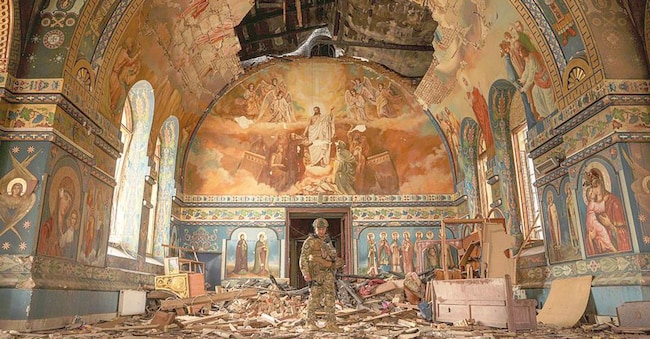
Il militare ucraino Gennadiy Yudin si trova all’interno di una chiesa ortodossa pesantemente danneggiata da un bombardamento russo a Novoekonomichne, in Ucraina, martedì 17 settembre 2024

4' min read

4' min read

Conquered, looted, attacked, even torn apart by an explosion, yet the Parthenon soars majestically on top of the Acropolis to remind, at least that part of the world to which we belong, the Mediterranean, that our beginning was there. And who knows if that was also the beginning of the very long list of artistic heritage destroyed by wars.

Looking back at more recent history, we realise how bloody it has been: from Palmyra, the ancient city mutilated by Isis during the 2011 civil war in Syria, to the Iraqi museums - first and foremost that of Baghdad - looted following the US military intervention in 2003; and again the Sidi Yahia mosque in Timbuktu, destroyed by the jihadist Ahmad Al Faqi Al Mahdi.

Loading...

And the artefacts do not always survive. "I am thinking of the Buddhas of Bamiyan, in Afghanistan, dating back between 1,500 and 1,800 years, destroyed by the Taliban on 12 March 2001, as idolatrous testimonies," recalls scholar Pietro Graziani in the special issue "Effects of Wars on the Cultural Heritage of Territories" of the journal Territory of Culture, published by the European University Centre.

"In 1993, the Mostar Bridge, over 500 years old, which united two communities, the Croatian and the Bosnian Muslim, was destroyed: another symbolic testimony to the war in the former Yugoslavia. It had no strategic-military value, it was a pedestrian bridge, but the symbol it represented was relevant. To these actions in the various war zones we must then add the so-called collateral effects: the destruction of theatres, museums, monuments, historical buildings, which are still daily news today'.

Unesco assets in danger

.

Cultural assets are an expression of man's presence on a territory, and it is no coincidence that attempts at conquest and control in the event of conflict pass through here.

There are currently 56 sites that the UNESCO World Heritage Committee considers to be in danger. The state with the highest number of threatened sites is Syria (with six sites listed), heavily mutilated during the civil war and recently liberated from the regime but still in turmoil. Behind it are Libya (with five) and Yemen (four), the latter having recently joined theUnesco and Unidroit conventions for the protection of cultural heritage.

But on what basis are properties included in the List of World Heritage in Danger? The normative framework isArticle 11 of theUnesco Convention of 1972 which states that those properties are included "for the conservation of which major interventions are necessary and for which assistance has been requested". Assistance without which they could disappear due to 'accelerated deterioration', disasters and cataclysms, or even due to 'the threat of an armed conflict'.

A threat, the latter, growing in recent months, especially in two areas: Middle East and Ukraine. Unesco calculated last February that "from 7 October 2023 to date, there are 22 sites of cultural interest that have been destroyed in the conflict between Israel and Palestine. These include five religious sites, ten buildings of historical and/or artistic interest, two repositories of cultural objects and goods, one monument, one museum and three archaeological sites'. Also in the crosshairs is Lebanon, where the military operations of the Israeli Defence Forces (IDF) against Hezbollah are seriously endangering the cultural heritage. Heavy bombing of Baalbek and Tyre. As for Ukraine, "there are 343 the goods that, as of February 2022, have been damaged or destroyed during the conflict, namely 127 religious buildings, 151 buildings of historical and/or artistic interest, 31 museums, 19 monuments, 14 libraries and one archive".

The International Standard

.

Yet, it is since the Second World War that the UN has identified the cultural property of any country as part of the 'universal cultural heritage', seeking to put an end to practices - such as looting or destruction - hitherto accepted as inevitable consequences or collateral damage of war. The reference texts are the Hague Convention of 1954 and its two subsequent Protocols of 1954 and 1999. They are part of international humanitarian law, but only bind signatory states, to date 123.

The provisions require states to take all necessary measures in peacetime to ensure the protection of cultural property in conflict situations. In the event of occupation by another state, the latter must take over. The use of cultural property for military purposes is also forbidden, and the adversary is also obliged to prevent all forms of theft, looting, embezzlement and vandalism. Regulations that unfortunately often remain unimplemented. Yet, in history there are examples of states that, although they have not ratified the Convention, have adhered to a practice that is considered established. This is the case, for example, of the US and UK during the first Gulf War, which interdicted the aerial bombardment of Ur and Nineveh.

In recent years, following systematic attacks on cultural heritage by extremist groups, since the protection of cultural heritage concerns the entire international community and not only individual states, the United Nations Security Council has expressed its views on the subject with Resolutions 1483/2003, 2199/2015, 2253/2015 and 2347/2017. The last two in particular came to hinder the financing of terrorism: the aim was to prevent Isis or al-Qaida from also recovering large resources from the trafficking of cultural property.


Copyright reserved ©
Loading...

Brand connect

Loading...

Newsletter

Notizie e approfondimenti sugli avvenimenti politici, economici e finanziari.

Iscriviti