
Bills, Arera: Italian families pay more than the rest of Europe. Here is the comparison
President Besseghini: 'We must not slacken our immediate commitment to the transition to sustainable production and consumption patterns'

3' min read
Key points
3' min read
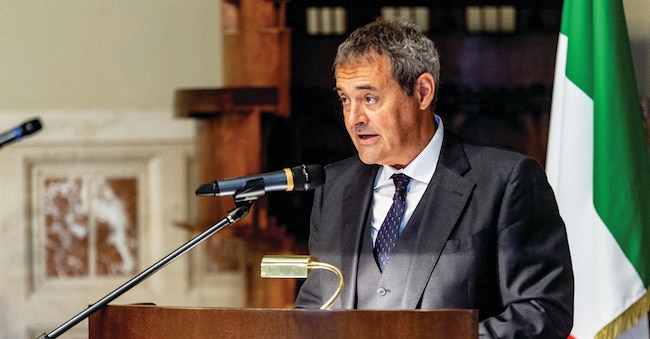
In spite of the 2024 drop in 17 eurozone countries, Italian households continue to pay the highest bills along with those in Germany. This is what emerges from the data released by the Authority for Energy, Networks and Environment, on the occasion of the presentation to the government and Parliament of the Annual Report 2024, the last of the college chaired by Stefano Besseghini. Who today, in the particularly packed parliamentary groups' hall, recalled the need, without prejudice to "the active commitment to the development of medium- and long-term solutions" to alleviate costs by diversifying the Italian energy mix (still too dependent "on expensive imported raw materials and often exposed to unpredictable exogenous stresses", read gas), not to loosen "the immediate commitment to the transition towards sustainable production and consumption assets". Without neglecting the strategic options already on the table, such as nuclear technology ("the government has done well to bring this issue back into the debate," says Besseghini).
The gap with the rest of Europe
.It is therefore necessary to continue working on prices. Also because Arera's figures document, as mentioned, a significant gap with the rest of the EU countries. In the comparison with the main reference countries, writes Arera, the highest prices are confirmed to be those paid by German families (41.13 euro cents per kilowatt hour), followed by those in Italy (35.70 c€/kWh), France (28.03 c€/kWh) and Spain (26.26 c€/kWh). The same ranking applies to net prices, i.e. without charges and taxes, which in Italy are 14% higher than the Eurozone average (25.92 c€/kWh vs. 22.73 c€/kWh) despite the reductions recorded by both the recorded energy component (-21%) and grid costs.
The burden of charges and taxes
.But what is the reason for such a still high bar? According to the Authority, the final prices paid by Italian households, in fact, continue to be penalised by the components of charges, taxes and fees whose 28% increase has cancelled out the reductions recorded by the energy component and network costs. In international comparison, the Italian tax component is the highest, higher than that of France (+51%), Spain (+36%), and the Eurozone average (+18%). Looking at consumption classes, the Italian price differential with German prices in 2024 is negative in all classes, with a minimum (-20%) in the DE class (above 15,000 kWh/y), which represents a residual share of household consumption (around 2%). The differentials with respect to France, although decreasing with respect to 2023, remain positive in all classes, with a maximum (+11.8%) in the DE where small consumers are included (up to 1,000 kWh/a). Compared to Spain, the differential is also positive and growing for all classes, going from +17% for the DA class to +37% for the DD (5,000 to 15,000 kWh/a).
What's happening in the gas market
As for gas, the considerations are similar. In the international comparison with the main Euro Area countries, reads the data provided by Arera, the average price of natural gas (including taxes and charges) for domestic consumers in Italy recorded a significant increase in 2024 (+15.1%) reaching 13.1 euro cents per kilowatt hour. Contrary to 2023, Italian consumers paid tariffs 5.3% higher than the Eurozone average (-8.3% in 2023). The highest prices were achieved in the Netherlands (16.8 c€/kWh) and Portugal (14.8 c€/kWh), and the lowest in Hungary (2.88 c€/kWh) and Croatia (4.62 c€/kWh).
The causes of the increase
.The increase is substantially attributable to two factors: the growth in grid costs (from 2.6 c€/kWh in 2023 to 3.0 c€/kWh in 2024) and, above all, that of the tax component (from 0 to 3.2 c€/kWh). In 2024, in fact, the effects of the government interventions that had established the reduction of VAT to 5% and the temporary zeroing of system charges, which had, in fact, cancelled the impact of the latter on the price of gas, came to an end.


